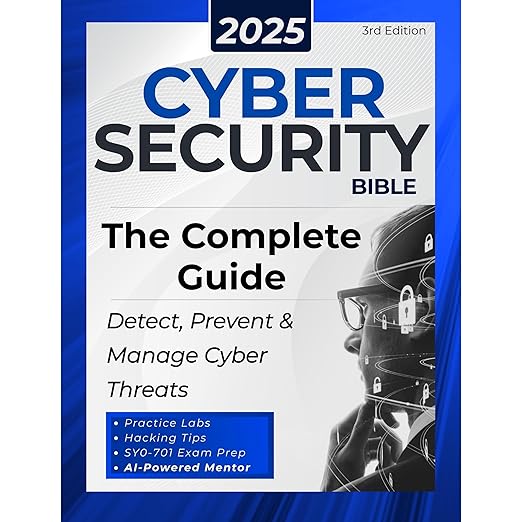
Shawn Walker’s Cybersecurity Bible audiobook is already on its third edition, updated for 2025 and bundled this time with something called AI Mentor Pro, an add-on digital mentor promised to answer questions and coach listeners through the material around the clock. Read by Virtual Voice across seven hours and fifty-one minutes, the book positions itself as a broad on-ramp into cybersecurity: multi-layered defense strategy, threat detection and prevention, network security, risk management, and eventually the kind of “strategic thinking and decision-making skills” the synopsis says can carry a listener into cybersecurity leadership roles. The marketing copy itself is aggressively self-published in style: emoji bullet points, bolded promises, repeated “Buy Now” calls to action, all worth naming plainly before getting into what’s actually inside.
Now on a Third Edition, With an AI Mentor
Underneath the marketing language, the actual content promise is broad and genuinely structured: building a multi-layered defense architecture across networks and endpoints, identifying and neutralizing threats early, securing networks against unauthorized access, managing risk for both business and personal data, and using industry-standard tools in practice. That is a real attempt at end-to-end coverage rather than a narrow single-topic guide.
The bonus material extends the package further still: hands-on practice labs simulating real-world cyber threats, “hacking tips” framed around understanding attacker thinking, and exam preparation materials for both CompTIA Security+ and A+ certifications. Combined with the promised AI Mentor Pro companion, this reads less like a single audiobook and more like an attempt to bundle an entire beginner course, mentorship included, into one purchase.
Being on a third edition, freshly updated for 2025, says something real about staying power: this isn’t a one-and-done self-published title but an actively revised product responding to an evolving field, which is a meaningfully different signal than a guide that hasn’t been touched since its original release.
“Become a cybersecurity leader” is one of the synopsis’s explicit bullet points, and it signals ambition beyond pure technical skill-building: strategic thinking and decision-making for leading initiatives, not just executing them. That leadership-track framing, alongside the more hands-on technical bullets, suggests the book is trying to serve someone’s career arc over time, not just their immediate skill gap.
Risk management gets named specifically among the book's core promises, and it represents a different kind of skill than pure technical threat detection: assessing and prioritizing danger strategically, a business and decision-making layer sitting on top of the more purely technical defense material covered elsewhere in the guide.
Three Audiences, One Seven-Hour Audiobook
Reviewer Karla G. specifically credits the book with “breaking down complex ideas” clearly, calling it “an essential resource for anyone serious about diving into the world of cybersecurity,” and praising its coverage of “both foundational concepts and advanced topics” in one package rather than splitting beginner and advanced material across separate titles.
J. Mielke’s review confirms a sensible structural progression: the opening sections explain what common cyber threats actually are and why they matter, before the back half goes deeper into specific threat types in more detail. That beginner-to-intermediate arc matches the synopsis’s own claim to serve both total newcomers and people already working to strengthen existing defenses.
The book is explicitly building for three different audiences at once, home users protecting personal data, working IT professionals shoring up existing defenses, and total newcomers considering a career change, which is a genuinely ambitious scope for one seven-hour, fifty-one-minute audiobook to serve well.
Whether one guide can really serve a nervous first-time home user and a working IT professional equally well, without the material feeling too basic for one or too advanced for the other, is a fair question worth asking upfront. But attempting that dual promise at all, rather than splitting into two narrower, safer products, is worth noting as a deliberate and genuinely ambitious positioning choice.
Synthetic Narration Meets an AI Study Companion
Virtual Voice reads the entire seven-plus hours, and dense technical material full of acronyms and layered defense concepts is exactly the kind of content where careful pacing and emphasis matter most. None of the three attached reviews single out the narration itself, so it’s worth going in aware that synthetic delivery is the default here, not a confirmed strength.
The hands-on labs, exam prep materials, and AI Mentor Pro companion are all, by nature, things that live outside the audio itself. Nothing on the listing clarifies exactly how those bonuses are delivered or accessed, so listeners drawn specifically to the interactive extras should confirm what they’re actually getting before treating the audiobook purchase as the whole package.
A real gap separates the packaging from the substance reviewers describe: the marketing leans on emoji bullet points and repeated “Buy Now” urgency, but Karla G. and J. Mielke both describe genuinely structured, substantive content underneath, suggesting the aggressive self-published marketing undersells what’s actually inside.
Whether the promised AI Mentor Pro companion can meaningfully offset a synthetic Virtual Voice narrator’s inherent flatness is worth wondering about directly: pairing an AI narration engine with an AI mentor tool means very little of the listener’s experience here involves a human voice or human judgment at any stage, which some listeners will find perfectly fine for reference material and others will find a genuine drawback for a subject this dense.
The synopsis itself leans heavily on punchy, bulleted, exclamation-marked marketing copy, which is worth reading as a signal about pacing: content packaged this way often favors quick, list-style delivery over slower, narrative-driven explanation, worth knowing if you prefer nonfiction that lingers on a single concept before moving to the next.
The synopsis's closing call to “step confidently into your future” is standard self-published motivational framing, the kind that shows up across countless similar guides regardless of subject, and it is worth reading past rather than weighing heavily when judging the actual technical substance sitting underneath it.
Business-Level Defenses Get Their Own Named Audience
Total beginners wanting a broad first orientation before specializing, and career-changers seriously considering a move into cybersecurity, are the clearest audience, especially listeners who want CompTIA Security+ or A+ context alongside general conceptual grounding.
Experienced IT professionals wanting a single-volume refresher across multiple cybersecurity domains, rather than deep specialization in just one area, are well served by the “bible”-style breadth here, even if they skip past the more beginner-oriented sections.
Small business owners specifically, distinct from home users protecting personal devices or IT professionals managing enterprise systems, are a real third audience here, since “business-level defenses” gets named directly alongside personal protection in the book's own stated scope.
A live, constantly updated threat feed is not what any fixed-runtime audiobook can offer, no matter how many bonus labs are bundled in, so working security professionals facing an active incident tonight need a different, real-time resource, not this one.
- Narration: Virtual Voice reads the entire seven-hour, fifty-one-minute guide, a flat synthetic delivery that suits reference material better than it builds excitement about the subject.
- Themes: cybersecurity fundamentals, threat detection, career preparation
- Mood: Ambitious and bonus-packed, closer to a course bundle than a single narrative
- Verdict: A broad, genuinely useful orientation for beginners and career-changers; not a substitute for hands-on labs or live threat intelligence.
Does this audiobook actually include the AI Mentor Pro and practice labs mentioned in the description?
The listing describes AI Mentor Pro and hands-on practice labs as bonus material, though by nature they depend on more than audio alone, so confirm exactly how they're delivered before buying based on those extras.
Is this Cybersecurity Bible audiobook enough to prepare for the CompTIA Security+ exam?
The listing includes CompTIA Security+ and A+ exam prep materials as bonus content, but with no reviewer confirming exam-pass results, treat it as supplementary rather than a full standalone exam course.
Who narrates the Cybersecurity Bible audiobook?
Virtual Voice, Amazon's synthetic narration, reads the full guide; no human narrator is credited.
Is this audiobook aimed at beginners or experienced IT professionals?
Mainly beginners and career-changers. J. Mielke's review notes the book opens by explaining what common threats even are before going deeper, which signals an entry-level starting point.