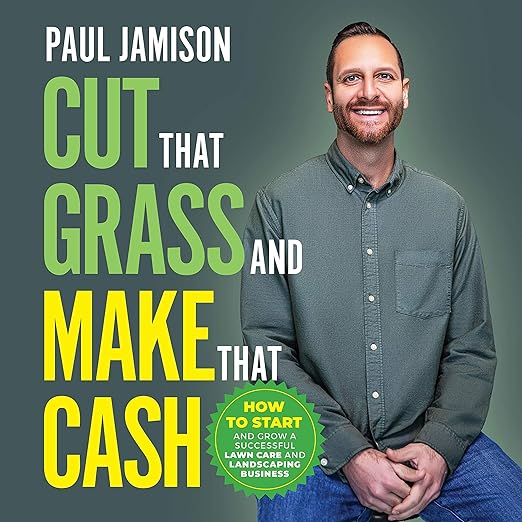
There is something immediately clarifying about an entrepreneurship audiobook narrated by the person who actually built the business being described. No intermediary, no polished at-a-distance retelling. When Paul Jamison describes loading equipment into the trunk of a rusty 1997 Honda Accord and going out to find his first clients, you hear it from someone who was there. That grounding in specific, unglamorous reality is what distinguishes Cut That Grass and Make That Cash from the broader and considerably blander category of small business self-help.
I listened to this one on a Tuesday morning during a walk, which felt appropriate, there is a forward-momentum quality to Jamison's delivery that suits physical movement. Four hours and two minutes is a well-calibrated runtime for this material. Long enough to go deep, short enough to hold focus without losing practical density.
Rusty Honda Accord Days and a Hundred Fifty Interviews
Jamison's origin story is genuinely instructive rather than merely inspiring. The Honda Accord detail matters because it names the actual starting condition rather than softening it. He is not presenting a success story in which the difficulty has been retroactively smoothed. He is describing what building a business actually looks like when you start with almost nothing, and the candor of that description extends to the mistakes. He covers the errors that new lawn care and landscaping professionals consistently make, pricing missteps, underestimating equipment costs, overextending before systems are in place, in enough detail to function as genuine warnings rather than cautionary footnotes.
As host of the Green Industry podcast, Jamison has interviewed more than 150 lawn care and landscaping professionals. That research base shows. The book is not purely autobiographical, it integrates insights from practitioners who have built successful businesses across a range of markets and scales. That combination of personal experience and aggregated wisdom gives the advice more texture than a pure memoir would have and more specificity than a purely instructional manual.
Jamison's Pacing Speeds Up When He's Excited
Jamison's narration of his own work carries a quality of investment that matters for this genre. You are not listening to a voice artist rendering someone else's hustle. The pacing of his delivery, faster when he is excited about something, more deliberate when he is making a point he wants you to retain, reflects how he actually thinks about the material. One reviewer described being able to see Paul's story unfold through the reading. That visibility is a function of narration, not just content.
The faith dimension of the book is worth flagging, not as a criticism but as information. Jamison attributes a significant part of both his mindset and his success to his Christian faith, and several reviewers specifically called out the integrity of that attribution, he is not using it as a marketing posture but as a genuine description of how he approaches his work. Listeners who respond well to that framework will find it reinforcing. Those for whom it is not a natural frame should know it is present throughout rather than limited to isolated sections.
Second-Season Owners Call the Timing Gold
The book is most useful for people in the early stages of building a lawn care or landscaping operation. Reviewers with two, three, and four years in the industry found the material particularly resonant in the first half, which covers the foundational challenges of getting started. One reviewer described the experience of their second season in business, finding the book to be, as they put it, gold. That specificity of audience is genuine: if you are five years into a stable, established operation, some of the foundational material will feel familiar. But even experienced operators have reported finding useful perspective in the later chapters on long-term goal setting and avoiding complacency.
The book does not attempt to be a comprehensive business manual. It does not cover legal structures, accounting software, or HR in depth. What it offers instead is a practitioner's mindset guide, the internal posture that allows someone to make good decisions when the external conditions are unpredictable, which is most of the time in a service business with weather as a variable.
Aspiring Lawn Care Owners Get a Mindset Primer
This is squarely suited for anyone considering starting a lawn care or landscaping business, and for people in their first few years of operation who want to pressure-test their approach against someone who has made the common mistakes and come out the other side. It is also useful for aspiring entrepreneurs in adjacent service industries who value a model of starting genuinely small and building deliberately. Those looking for a conventional business school framework or a comprehensive operational manual should supplement this with additional resources. But as a first listen on the entrepreneurial mindset specific to this industry, it is difficult to improve on.