The Short Version
- Voice: Jonathan Davis brings genuine warmth and energy to a subject that could easily read as dry technical history.
- Big ideas: Hacktivism and internet freedom, unconventional political influence, personal data protection
- Atmosphere: Irreverent but substantive
- Worth it?: A smart entry point into hacker culture for listeners who want story and personality over technical manuals.
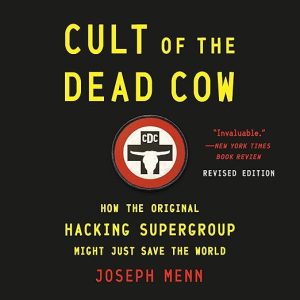
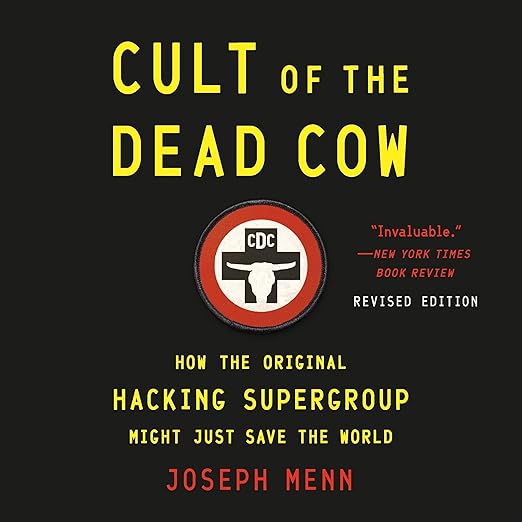
Who protects the internet when governments and corporations won't? That question sits underneath this audiobook's entire premise, and Joseph Menn's answer runs through the oldest, most respected hacking group in American history, a loose collective of activists, artists, and musicians who eventually ended up advising presidents, cabinet members, and CEOs. Cult of the Dead Cow traces the group's origins in the internet's earliest days through its current work fighting electoral misinformation and pushing for stronger personal data protection, with a new afterword updating where the collective stands now.
Reviewer milton sums up a more detailed critical response in three words, "Great book!", and H. Adkins's review title calls it "Compelling, Thrilling, Important", adjectives that between them capture how the book operates on multiple registers at once, narrative pull, real stakes, and cultural significance, rather than succeeding at just one of the three.
The description of members as "activists, artists, and musicians" rather than engineers or programmers is doing real work in the synopsis; it signals upfront that this is a story about a specific creative subculture that happened to intersect with computer security, not a straightforward technical history of exploits and vulnerabilities, and that framing carries through everything Menn covers from the group's earliest days to its present-day advocacy work, which also explains why the book reads more like narrative journalism than a security-industry retrospective.
Pranksters Who Walked the Corridors of Power
The New York Times Book Review called it "a hugely important piece of the puzzle for anyone who wants to understand the forces shaping the internet age", and that framing captures what makes this book distinct from a typical hacking exposé: it's positioned as a missing piece of internet history rather than a true-crime thriller about cybercrime. Reviewer H. Adkins situates it inside a growing library of books tracking the internet's transformation from a scrappy, early-days project into a dominant economic and cultural force, crediting Menn specifically with filling in gaps that earlier accounts left open.
Not every reviewer is fully sold on the balance Menn strikes. Henrry Castelblanco's review appreciates the deep dive into politics and elections but wishes the book included more granular technical detail, the kind that would satisfy a reader coming specifically for hacking craft rather than cultural and political context. That's a fair tension in a book trying to serve both a general audience and readers with real technical curiosity at once.
The synopsis notes members of the group eventually came to "walk the corridors of power in Washington and Silicon Valley", a genuinely unusual trajectory for people who started out as anonymous internet pranksters and artists; Menn's reporting traces that specific transition, from countercultural outsiders to trusted advisors, without losing sight of how strange that arc actually sounds said out loud.
The synopsis frames the group directly as "the elite secret society of hackers fighting to protect our freedom", language that could easily tip into overblown marketing copy for a lesser book, but Menn's reporting, drawing on the group's actual documented history rather than mythology, earns the framing rather than just asserting it; the book supports the claim with specific documented episodes rather than leaning on the group's own self-mythologizing.
Davis Lets the Absurdity and Stakes Coexist
Jonathan Davis brings genuine warmth and energy to a subject that could easily read as dry technical history in less capable hands, and that register suits the material specifically well; this is fundamentally a book about odd, irreverent characters who happened to become internet-security pioneers, and a flat, procedural narration would undersell the personalities driving the story. The book reads, and sounds, more like community-portrait journalism than a manual, which is precisely the register this group's own culture would probably prefer.
The narration's accessibility matters because the book itself is explicitly aimed at non-technical readers rather than security professionals; Davis doesn't over-explain technical concepts in a way that condescends, but he also doesn't rush past them assuming prior expertise, which keeps the story legible whether or not a listener already understands what electoral misinformation defense or personal-data protection work actually involves day to day.
The book's balance of humor and real political stakes is part of what makes it work as a listen rather than a dry policy briefing; a group whose name is deliberately, permanently ridiculous fighting genuinely consequential battles over misinformation and privacy creates a tonal tension that Davis's narration leans into rather than smooths over, letting the absurdity and the seriousness coexist without undercutting either.
The book's own opening framing, "the shocking untold story", promises revelation, and it delivers on that promise less through shocking individual anecdotes than through the cumulative surprise of watching outsiders steadily gain real institutional influence over several decades; that slower-building form of surprise suits long-form audio narration well, since Davis has the runway to let the group's trajectory unfold gradually rather than needing a single dramatic reveal to hold listener attention throughout.
Tracking a Large Cast Across Several Decades
Henrry Castelblanco's critique is worth taking seriously if you're the kind of listener drawn specifically to technical depth; the book's real strength is character and cultural history, not a hands-on account of specific exploits or methods, and readers hoping for that level of granular hacking detail may come away wanting more depth than the book ever intends to supply.
The subject matter spans several decades and a genuinely large cast of characters moving in and out of relevance to government and corporate power, and keeping track of who's who across that span takes some real sustained attention from the listener; this isn't a book built for background, half-attentive listening, especially in the sections tracing the group's political influence over time.
Henrry Castelblanco's critique about missing "field facts" is worth weighing against what the book is actually trying to do; it favors a decades-long cultural and political throughline over a technical field guide to hacking methods, so readers should calibrate expectations toward narrative history rather than a hands-on technical resource.
Musicians and Artists Who Became Security Pioneers
Readers who assume hacker culture is all balaclavas and server rooms are exactly who this book is built to surprise, since the actual story runs through musicians, artists, and eventual White House-adjacent advisors rather than the usual cybercrime-thriller cast. Anyone interested in internet history broadly, not just security specifically, gets a genuinely accessible entry point that doesn't require prior technical background to follow.
Deep technical curiosity goes underserved here, so readers specifically chasing exploit-level detail or hands-on hacking methodology should look elsewhere; this book's real value is in the people and the politics, not the code, and it's honest about that scope rather than overpromising technical depth it doesn't deliver.