The Short Version
- Read by: Kyria Montoya narrates the Spanish-language edition with clarity and professional cadence appropriate to the business communication subject matter.
- At its heart: body language and charisma, professional presence, influence and communication
- Vibe: Practical and accessible, aimed at application rather than theory.
- Short version: The Spanish edition of Cues delivers Vanessa Van Edwards's core framework on nonverbal communication effectively, best suited for Spanish-speaking professionals seeking to build executive presence.
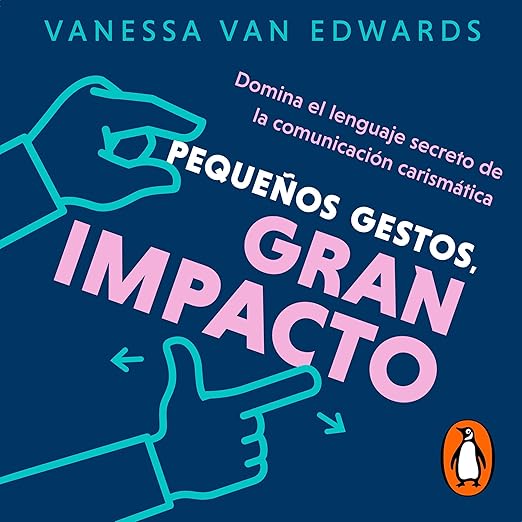
A quick note before I get into the substance of this one: Cues in this Audible edition is the Spanish-language version of Vanessa Van Edwards's book, narrated by Kyria Montoya and titled accordingly. If you are looking for the English edition, this is not it. That distinction matters, and I want to be upfront about it so listeners can make an informed choice about whether this is the right format for them.
With that said, the core content of Cues translates well to Spanish and to audio, and the book's subject matter, nonverbal communication and what Van Edwards calls vocal, physical, verbal, and other cues, is both practically useful and genuinely underrepresented in the business communication canon. Van Edwards built a following through Science of People, her research and training organization, and the book draws on behavioral science while staying accessible to a general professional audience.
First, the Big Picture
The central argument is that small signals, sent constantly through body language, facial expression, word choice, and vocal inflection, have an outsized effect on how others perceive us and how our ideas land. Van Edwards organizes these signals into distinct categories and provides frameworks for reading them in others and deploying them intentionally yourself. The scope is broad: from how to project confidence in a meeting where you keep being interrupted, to how to optimize the specific words in your CV or professional bio for maximum resonance.
The synopsis describes the problem with familiar precision: if you have ever been interrupted in a meeting, passed over for an opportunity you were qualified for, or watched an idea of yours get ignored and then adopted enthusiastically when someone else suggested it later, this book offers a structural analysis of what might have been happening at the level of nonverbal signal. That framing is smart because it identifies a frustration that most professionals have experienced without quite being able to name.
Van Edwards is writing for people who want to increase their professional influence without abandoning authenticity. The distinction she draws, between performing charisma as a mask and developing it as a genuine extension of your actual qualities, is one the book handles more thoughtfully than most self-help treatments of the subject. She is not telling you to fake confidence; she is arguing that the signals you send are often unconsciously undermining the confidence you actually have.
Why Cues Works as an Audiobook
Kyria Montoya's narration suits the material. Business communication content in audio requires a narrator who models the qualities being described, and Montoya's delivery is clear, well-paced, and authoritative without being hectoring. The Spanish edition makes this material accessible to a professional audience that the English version cannot reach, which is a genuine service: the underlying research and frameworks Van Edwards draws on are not culturally specific, and Spanish-speaking professionals navigating international business environments will find the content directly applicable.
The book's structure, built around specific, actionable cues rather than broad personality categories, makes it well-suited to audio. Each section is discrete enough that you can listen in segments and retain the key takeaways without needing to hold a sustained theoretical argument in mind. Revisiting specific sections is easy because the organization is clear.
A Few Reservations
Some of the behavioral science Van Edwards draws on sits in areas that have faced replication challenges in recent years, particularly some of the more specific claims about facial expression and universal emotional recognition. She does not flag these limitations herself, and listeners with a scientific background may find some of the more confident assertions about body language reading to be overstated. The framework is useful as a practical guide even where the underlying science has caveats, but it is worth approaching the more specific claims with some skepticism.
The Spanish-language reviews available for this edition are limited in number and focus primarily on production quality rather than content depth. English-language reviews of the original edition are a better resource for evaluating the content itself.
Who Should Listen to Cues
Spanish-speaking professionals looking for a practical, accessible guide to professional presence and nonverbal communication will find this the most direct option available in their language. It suits people early in their careers who want to understand how perception works in professional settings, as well as more experienced professionals who feel that something in their communication style is not translating as intended. Listeners who want a rigorously cited behavioral science text should look elsewhere; this is a practitioner's guide that uses research as support rather than as its primary focus.