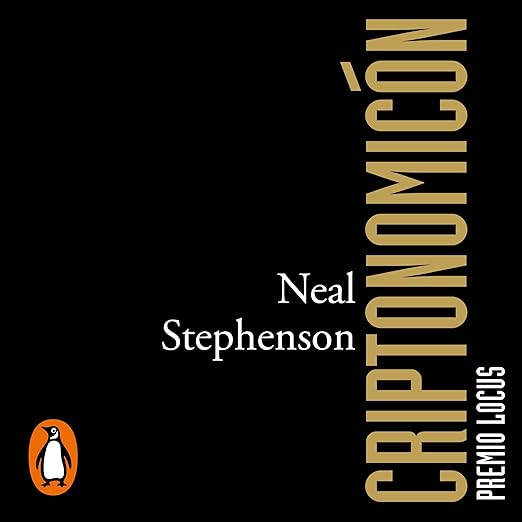
Cryptonomicon rewards patience and a genuine appetite for mathematics more than almost any other novel Neal Stephenson has written, and this particular audiobook edition adds a decision worth knowing before you commit forty-five hours and twenty-five minutes: it is narrated entirely in Spanish, by Hermogenes Alonso. If you are an English-only listener, confirm the edition before buying, since nothing else about the story changes based on language.
Once that is settled, what is actually here is one of Stephenson's most beloved books, sometimes called the cult novel of hackers, and the Locus Award it won places it squarely inside science fiction's own canon even though its two timelines are rooted in very real history.
A Closer Look at Cryptonomicon
The novel splits between 1942 and the late 1990s. In the war years, mathematical genius Lawrence Pritchard Waterhouse and Marine Bobby Shaftoe work a secret Allied mission to crack Axis codes without ever letting the Nazis realize Enigma has already been broken. Sixty years later, Waterhouse's descendant Randy teams up with Amy Shaftoe, Bobby's granddaughter, to build a data haven in Southeast Asia, a stateless refuge for digital freedom that draws the hostile attention of governments and multinationals alike.
The two timelines converge around a sunken Nazi submarine and an unbroken code called Arethusa, and Stephenson uses that convergence to argue, across three generations of the same two families, that cryptography and personal freedom have always been the same fight wearing different uniforms. Reviewer C. Davis calls it Stephenson's best novel precisely because it reads as a mainstream adventure story about mathematicians rather than pure cyberpunk, and reviewer Ramshackle backs that up, naming it, without qualification, among the best books read in years.
Stephenson's broader body of work helps place this one correctly. He had already written Snow Crash and The Diamond Age, both leaner, more overtly science fictional books, before Cryptonomicon expanded his ambitions into historical fiction, technical exposition, and sprawling multi-generational structure all at once. It remains the hinge point in his career between compact cyberpunk and the doorstop-length historical-technical epics, including the Baroque Cycle, that followed.
Bobby Shaftoe's Marine storyline deserves equal billing with Waterhouse's codebreaking arc; where Waterhouse solves problems through pure mathematical abstraction, Shaftoe is the novel's man of action, dropped into the actual physical chaos the codebreaking is meant to prevent or exploit, and the two men's radically different relationships to the same war give Stephenson's dual structure its real tension rather than just its scope.
What Makes Cryptonomicon Worth Hearing
A forty-five-hour, technically dense novel with two intercut timelines and a rotating cast across three generations is a genuine narration challenge, sustaining energy and clarity through extended cryptography and computer science digressions without losing the emotional throughline underneath them. That is the specific test any narrator faces with this book, in any language.
The book's own reputation in its home market is substantial, having reportedly reached a hundred thousand Spanish-language readers and helped introduce Stephenson to a new generation through this single-volume edition. For Spanish-speaking listeners or Spanish learners specifically, that makes this a legitimate way into one of modern genre fiction's most ambitious novels, not a compromise edition.
The data haven Randy and Amy build is not pure invention; it draws directly on real 1990s cypherpunk-movement ideas about offshore digital sanctuaries beyond the reach of any single government, debates that were genuinely happening in mailing lists and early internet forums around the time Stephenson was writing. Knowing that context turns what might read as speculative fantasy into something closer to speculative journalism.
Things to Know Before Starting Cryptonomicon
Reviewer Daniel Myers offers the single most useful warning attached to this title: without real interest in mathematics or cryptanalysis, you will miss much of what makes the book work, and he notes that many of its one and two star reviews likely come from readers who went in expecting something else entirely. Take that seriously before committing forty-five-plus hours.
The genre tagging here blurs on purpose. The site files it under literary fiction and historical fiction, while the Spanish synopsis itself calls it modern science fiction, and both are defensible; Stephenson's book has always resisted a single shelf. Expect extended technical digressions on cryptography and computing as a real feature of the reading experience, not an occasional detour.
The print novel runs past nine hundred pages, and the audiobook's forty-five-plus hours reflect that scale honestly rather than compressing anything. Listeners should treat the runtime itself as a preview of the density inside: this was always going to be a long, unhurried commitment in any format, audio simply makes that commitment explicit up front.
The Locus Award the synopsis cites is specifically the award for Best Science Fiction Novel, voted on by that magazine's readership rather than a juried panel, which is worth knowing since it reflects genuine reader enthusiasm within the SF community rather than critical consensus alone, useful context for a novel that otherwise resists being filed neatly under any one genre heading.
Keep a mental map of which timeline you are in as you listen; Stephenson jumps between 1942 and the 1990s without much narrative hand-holding, and losing track of which Waterhouse is speaking is the single easiest way to lose the thread.
Amy Shaftoe functions as more than a plot device linking the two timelines together; she is Randy's equal partner in the data-haven scheme, and Stephenson gives her genuine technical competence rather than positioning her as a supportive love interest waiting on the sidelines of the men's cryptography work.
Who Neal Stephenson Is Writing For
This is for existing Stephenson fans, listeners with genuine curiosity about cryptography, mathematics, or computer science history, and Spanish-speaking or Spanish-learning listeners specifically, since this edition is Spanish only. Patient literary fiction fans willing to sit with three intercut generational strands will get the most out of it.
Skip it if you need fast, plot-driven-only pacing, if extended technical digressions frustrate rather than fascinate you, or if you do not listen comfortably in Spanish; an English edition would be the better starting point for this specific novel.
Before You Press Play
- Performance: Hermogenes Alonso carries a technically dense, dual-timeline novel across forty-five-plus hours in this Spanish-language edition, a real endurance test for any narrator.
- What it covers: Cryptography and code-breaking, digital freedom versus institutional power, three generations of the same two families
- Feel: Sprawling, intellectually demanding, and quietly funny in places
- Our call: A rewarding but genuinely demanding listen, best suited to Spanish-speaking Stephenson fans with real patience for technical detail.
Is this Cryptonomicon audiobook available in English, or is it Spanish only?
This particular edition, narrated by Hermogenes Alonso, is in Spanish only. English-only listeners should confirm they are purchasing an English edition before committing to the runtime.
Do I need a background in math or cryptography to enjoy Cryptonomicon?
Not strictly, but reviewer Daniel Myers warns that without real interest in mathematics or cryptanalysis, you will miss much of what makes the book distinctive, and low ratings often trace back to mismatched expectations.
Is Cryptonomicon connected to Neal Stephenson's Baroque Cycle novels?
Loosely. The Baroque Cycle follows earlier generations of the Waterhouse and Shaftoe families, functioning as a historical prequel of sorts, though Cryptonomicon reads completely on its own.
How does the audiobook handle the novel's dual World War Two and 1990s timelines?
The story alternates between Lawrence Waterhouse and Bobby Shaftoe's 1942 codebreaking mission and Randy Waterhouse's 1990s data-haven project, converging around a shared mystery involving a sunken submarine and an unbroken code.