Nothing in the product description tells you what happens in this novel. What sits in that field is an essay: a first-person meditation on bank holidays, Treasury bond sales, gun confiscation, and where the United States ranks on somebody's freedom index. It closes by announcing that what follows is just one idea of what this could look like. That is an author's note, and somebody pasted it in as a plot summary. Anyone deciding whether to spend ten and a half hours on this audiobook has to get the story from the responses instead, so that is where I went.
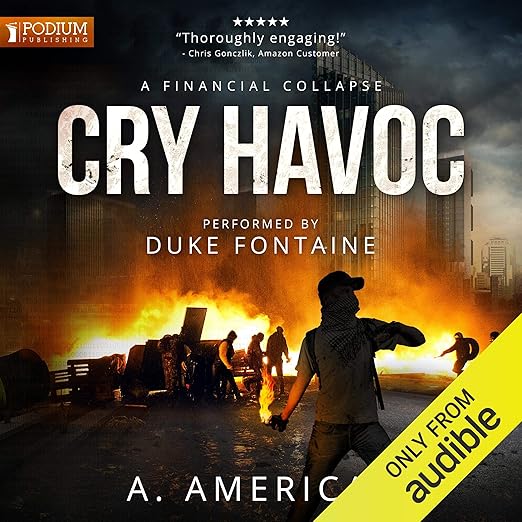
Listener responses supply a plot and also a problem. Four of the five people who wrote in credit A. American, one of them spelling it Angery American, and one mentions the Going Home books by name. The byline field here says Jack Carr. Podium Audio published the recording in June 2017 with Duke Fontaine voicing it across ten hours and thirty-eight minutes. Then the numbers: the display shows 4.5 drawn from a count of one. A single vote can only land on a whole star, so 4.5 has no arithmetic route from one rating, and five written responses sit under a counter reading one.
Where This One Lands
That November 2016 entry carries the most useful criticism attached to this record, and it is dated more than six months before the release date the listing carries, which means it came from the print edition. It splits the book down the middle: five stars for the opening, three for the rest. What earns the first half is the economic collapse setup and a group of people barricaded inside a bank, using it as a fortress. That reader calls the action claustrophobic and the survival logic interesting, and singles out the setting as a genuinely unusual choice for this kind of fiction.
A bank is a good idea for this material. It is the building where the abstraction becomes physical, the place your money is when you are told you cannot have it. Making it the shelter as well as the source of the crisis gives the first act a shape most collapse fiction never finds, because most collapse fiction starts on the road. The same reader reports that the momentum drains once the characters leave the building, which is the recurring hazard of the subgenre. Walking is not a plot.
The Best Parts of Cry Havoc
A November 2023 five-star entry gets at what the audience comes for: life-like characters, a scenario it finds believable, and a story that puts constitutional argument in the mouths of people who are hungry. That entry is explicit about its politics and so is the book. Readers who follow this author across multiple titles are not looking for balance. They are looking for a scenario that takes their premises seriously and then works through logistics, supply, communication, and the question of who ends up in charge once nobody holds authority by default.
An August 2025 response says it has enjoyed nearly everything this author has written and does not feel let down here, which is the ordinary satisfaction of a series readership. A second entry from the same summer wants a sequel and mentions a specific appetite for storylines involving computers and hacking, which suggests the digital-infrastructure side of the collapse gets real page time. Duke Fontaine is the only reader credited for the whole ten and a half hours, and no dramatized alternative appears on the record.
What Gives Us Pause
An August 2021 response, five stars despite the complaint, flags what it calls one major error: the book was written in 2016 before the presidential election was settled, and it builds forward from an assumed outcome that did not happen. That is a dating problem no revision can repair, and it will hit differently depending on how much you need near-future fiction to have guessed right. The same entry praises the plausibility of the situations and the pace of the chapters, so the objection is not a rejection. It is the particular irritation of a reader who wanted the extrapolation to hold.
Beyond that, know what you are walking into ideologically. The material in the description is not framing; it is the argument the novel dramatizes, and it arrives without hedging. Listeners who want collapse fiction that interrogates its own premises, or that considers what the same week looks like from a different political position, will not find that on offer. And because the listing carries no plot summary at all, no way exists to sample the shape of the story before committing. The responses are the only preview available.
Who Should Pick Up Cry Havoc
Collapse-fiction readers already inside the preparedness subgenre are the audience here, along with thriller listeners who can hold a strong political position at arm's length long enough to enjoy a siege plot. The first half is the reason to start: a bank, a locked door, and a group that has to organize itself before anything outside becomes the problem. If that premise appeals, the ten and a half hours are worth beginning even with a weaker second half waiting at the halfway mark.
Most other listeners should probably pass. Anyone who needs a novel to keep its promises through the back half, or who found the road-trip stretch of this author's earlier series tiring, will meet the same complaint here from a reader who liked the book anyway. The record itself is the other caution: a byline four responses contradict, a ratings display arithmetic rules out, and a description that summarizes nothing. Go in knowing the metadata cannot be trusted, and that the story underneath has its own arguments to make.
The byline and the responses name different authors, so who does this audiobook belong to?
The record credits Jack Carr. Of the five posted responses, four credit A. American, one rendering it as Angery American, and one names the Going Home series as earlier reading. The responses were written by people who had read the book; the byline field was filled in by a catalog. Treat the field as the doubtful part.
Why does the description not describe the plot?
What occupies the description slot is an author's note about bank holidays, currency controls, and gun policy, ending with a line announcing that a story follows. No character is named and no event is summarized. The plot has to be reconstructed from listener responses, which supply a bank siege and an economic collapse.
Does the audiobook connect to the Going Home series in any way?
This record carries no series name and no volume number, and no field on the page places it in a numbered sequence. Ten hours and thirty-eight minutes, one credited reader, and no prior volume named anywhere on the page. Whatever continuity exists with the author's other books is undocumented here.
How does the 4.5 rating hold up against a rating count of one?
It does not. One vote cannot produce half a star, so a 4.5 average has nowhere to come from. Five written responses are visible on the same record, scoring five, four, five, five, and four. The counter and the pool are describing different things.