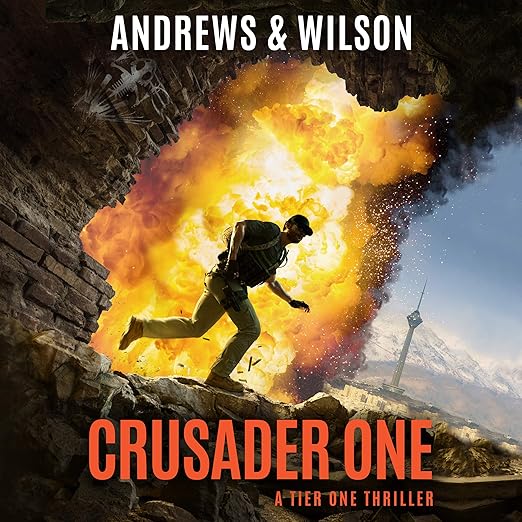
Dempsey doesn't get an easy mission in this Crusader One audiobook, and Brian Andrews structures the opening chapters so that listeners feel the weight of it immediately. Former Navy SEAL and Tier One operator John Dempsey has already lost comrades to an Iranian terrorist mastermind, and when a fresh act of terrorism rocks American and Israeli intelligence at the highest levels, his ultracovert unit Ember doesn't just mobilize for the mission, Dempsey mobilizes for revenge.
The book is the third entry in the Tier One Thrillers series, and reviewer Susan1 titled her own review 'Strike, Retaliate, Escalate,' which doubles as a fair description of the plot's structure. She calls the series 'amazing' and says this installment 'raises the bar even more,' while also flagging something worth taking seriously: she now questions whether Crusader One can be fully appreciated without books one and two already under a listener's belt.
The plot pushes Dempsey and an Israeli counterpart from Tel Aviv toward Tehran on a capture-or-kill mission with no official backup, and the stakes escalate from personal vendetta to something closer to international catastrophe, with the synopsis itself framing the failure state as 'a short countdown to World War III.' It's genre-thriller escalation by design, not restrained geopolitical fiction.
Reviewer Colorado Cowgirl calls it a book that 'delivers from the first page' and takes listeners on 'a riveting roller-coaster ride of excitement, suspense and espionage,' while being upfront that 'the action is over the top.' She says so without complaint, framing the excess as part of the fun rather than a flaw, which is a fair read of what this kind of military thriller is actually trying to do.
Ember functions the way elite black-ops units do across this whole subgenre, official cover for unofficial missions, and readers who know Vince Flynn's Mitch Rapp or Brad Thor's Scot Harvath will recognize the shape of John Dempsey immediately: a operator whose personal losses keep bleeding into missions that are supposed to stay strictly professional.
Why Listen to Crusader One
Ray Porter built his reputation on dry, self-deprecating science fiction protagonists, and he's also a confirmed, capable narrator of military memoir material like Outlaw Platoon, so the register shift into fictional Tier One-operator territory isn't as far a reach as it might first sound. His control over tension and comic timing without tonal whiplash, a strength across his SF work, should serve a story that mixes hard action with real personality.
That personality matters more than the premise alone suggests. Reviewer Jeff Dorigan calls the book 'funny, clever, thoughtful' as well as 'engaging,' a combination that a lesser thriller wouldn't earn. A narrator with real range for wit inside high tension, which is exactly Porter's established strength, is well positioned to carry that specific mix without letting either half undercut the other. Reviewer Jeff Dorigan's advice doubles as a fair closing note: he was already 'buying the next one' before finishing this one.
At 12 hours and 10 minutes, this sits comfortably in the range built for a multi-day commute or a long flight, exactly the kind of runtime where a narrator's ability to sustain tension without fatigue, one of Porter's established strengths across long-form work, matters more than it would in a shorter book.
Porter has built a reputation as one of audiobook's most prolific and consistently well-reviewed working narrators, and that track record across dozens of series matters for a listener deciding whether to commit to book three of an ongoing thriller series sight unseen.
What to Watch For in Crusader One
The series-order question deserves real weight here, not a passing mention. Susan1, an established fan who clearly loves this book, is the one raising doubts about whether it works without the first two installments. Take that seriously: this is a continuation, not a fresh entry point, and the emotional stakes around Dempsey's dead comrades land much harder with that earlier context in place.
Also worth naming plainly: this is a genre thriller built for velocity, not plausibility. The Iran-Israel nuclear-adjacent premise is fictional escalation in the Vince Flynn and Brad Thor tradition, and Colorado Cowgirl's own 'over the top' comment about the action should be read as a description, not a warning label, for anyone who already knows what they're signing up for.
The 'Tier One' label itself is worth understanding for genre newcomers: it refers to the U.S. military's most elite special operations designation, and Andrews leans on that real-world vocabulary to ground fictional stakes that otherwise run toward the maximalist end of the thriller spectrum.
Dempsey's 'formidable Israeli counterpart' gives the book a genuine cross-agency partnership dynamic rather than a lone-wolf American hero narrative, reflecting a real-world alliance the thriller genre returns to often when Iran is the antagonist. That partnership, not just Dempsey's personal vendetta, is part of what keeps the mission grounded in something resembling actual geopolitics.
Readers who enjoy Brad Taylor's Pike Logan novels will recognize the same DNA here: an off-books unit operating just outside normal military channels, a protagonist whose competence is never really in doubt, and a plot that treats real-world geopolitical flashpoints as fuel rather than subject matter to interrogate.
Who Should Listen to Crusader One
Fans of Vince Flynn, Brad Thor, and Mark Greaney should feel right at home, and existing Tier One Thrillers listeners already know what they're getting. Anyone drawn to military-operator fiction that mixes real humor with high-stakes global conspiracy will find a lot to like in how Andrews balances the two.
Newcomers wanting a true standalone entry point should start with book one instead of here, and readers expecting the literary-fiction sensibility the genre tag technically suggests should recalibrate: this is genre thriller through and through, built for pace over prose style.
The book closes with enough momentum that it clearly isn't positioning itself as a series finale, and listeners who get pulled in should expect Andrews to keep escalating Dempsey's world rather than wrapping it up neatly here.
A modest rating count of seven shouldn't be mistaken for thin enthusiasm; every review attached to this listing runs positive to enthusiastic, which for a book three in an ongoing series usually means the fanbase reading it already knows exactly what it wants and is getting it.
Do I need to listen to the first two Tier One Thrillers audiobooks before this one?
Yes. Even an established fan reviewing this book questioned whether it works without books one and two, and the emotional stakes around Dempsey's dead comrades land much harder with that earlier context.
How does Ray Porter's narration compare to his science fiction audiobook work?
He shifts into a harder military-operator register here, though the same control over tension and comic timing that defines his science fiction narration carries over well to this book's mix of hard action and personality.