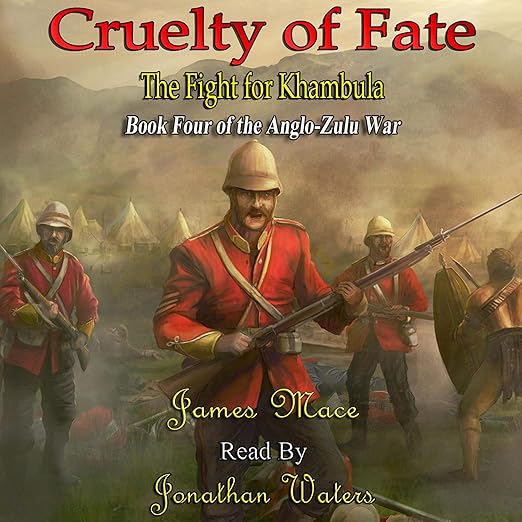
News of the disaster at Isandlwana reaches Colonel Henry Evelyn Wood in late January 1879, and he makes an immediate, defensive choice: withdraw his Number 4 Column to a fortified position near Khambula rather than risk a second catastrophic defeat. This audiobook, James Mace's fourth installment in his Anglo-Zulu War series, picks up exactly at this pressure point, with a second British column already trapped under siege at Eshowe and General Lord Chelmsford demanding Wood keep harassing Zulu forces without the numbers needed to safely engage the full Zulu army. Jonathan Waters narrates just under eighteen hours, continuing a role he has now carried across every entry in this series.
Mbilini's Guerrilla War Gets Its Own Book
What this volume adds to the series is a theater of the war that gets far less popular attention than Isandlwana or Rorke's Drift: the northern column's campaign against the semi-autonomous abaQulusi tribe and their formidable ally, an exiled Swazi prince named Mbilini, a master of guerrilla warfare who harries Wood's forces relentlessly while waiting on reinforcements from the Zulu king Cetshwayo. Reviewer M. Shigley confirms this focus directly, describing the book as covering the operations of the Number 4 Column under Colonel Wood specifically, beginning shortly before the ultimatum's expiration and running parallel to, rather than through, the more famous battles happening simultaneously in the central column's territory.
That structural choice, following the war's quieter northern front while Isandlwana and Rorke's Drift happen elsewhere in the timeline, gives this installment genuinely fresh material even for readers who already know the war's more famous battles well. Cetshwayo's own position gets real attention too: his regiments return home triumphant but bloodied after Isandlwana to bring in the harvest, and his subsequent peace overtures get flatly rebuffed by Chelmsford, setting up the next escalation the series will presumably cover.
The book's title itself, Cruelty of Fate, points toward a thematic concern beyond pure battle narrative: both sides in this specific campaign are operating under leadership making high-stakes decisions with incomplete information, Wood weighing caution against the political pressure to keep Zulu forces occupied, Cetshwayo weighing peace against the momentum of his own recently victorious regiments. Mace seems less interested in simple heroism than in how commanders on both sides navigate genuine uncertainty after a catastrophe has already reshaped everyone's assumptions about what the war will look like going forward.
Age-Grade Regiments Explain Zulu Resilience
Waters's continuity across every book in this series is a genuine asset rather than a marketing point, and it shows most clearly in how he handles the large, recurring cast of both British and Zulu historical figures across escalating battles. Reviewer Bob Jarvis calls this a truly remarkable series overall and this specific entry par for the course, praising Mace's ability to combine real historical research with a writing style that renders gritty conflict scenes in wonderful descriptive detail. That combination of accuracy and narrative pacing is exactly what a long-running historical series needs to keep listeners engaged across multiple lengthy volumes.
The series' overall reputation for careful, well-researched history holds up across this volume specifically, and Waters's steady handling of the war's geography, chain of command, and the specific tactical pressures Wood faced gives listeners a much clearer picture of the broader 1879 campaign than a single-battle account focused only on the famous engagements ever could. The book balances its northern-front focus with enough context about events happening simultaneously elsewhere that listeners are never left wondering how this specific campaign connects to the broader war, a structural balancing act that is harder to pull off than it sounds across a multi-volume project this ambitious.
Mbilini's guerrilla campaign against Wood's column gives the book a different tactical texture than the more conventional pitched battles associated with Isandlwana or Rorke's Drift. Hit and run raids, terrain-based ambush, and a defender forced to adapt to an enemy who refuses to engage on predictable terms make for a different kind of military history than a single decisive battle account, and that variety is a real strength for listeners who have already absorbed the war's more famous set-piece engagements elsewhere.
The Zulu amabutho system, named directly in the synopsis, organized fighting men by age grade rather than by clan or region, a military structure that gave Cetshwayo's kingdom the ability to mobilize quickly and fight with unusual cohesion. That organizational strength is part of why a single defeat, even one as significant as Isandlwana, could not simply end the wider campaign the way a comparable loss might have for a more loosely organized force, and it helps explain exactly why Wood's caution at Khambula was so warranted.
Waters Relies on Pacing Over Funny Accents
At just under eighteen hours and as the fourth entry in an ongoing series, this is not a natural starting point for listeners completely new to Mace's Anglo-Zulu War project or to the war itself. The book assumes real familiarity with the campaign's broader timeline, the disaster at Isandlwana specifically, and the political pressures Lord Chelmsford is operating under, all of which earlier volumes presumably establish in more depth.
As with any long-running series covering the same historical conflict from different columns and vantage points, some crossover in subject matter with sibling volumes is inevitable, and listeners piecing together the full campaign across multiple books should expect a little narrative overlap at the edges where different columns' timelines intersect. That is a structural reality of covering a multi-front war across separate volumes rather than a flaw specific to this installment.
Waters differentiates his large historical cast primarily through pacing and vocal weight rather than exaggerated accents or caricature, a choice that serves the material's underlying seriousness well but does mean listeners need to stay attentive to context and named titles to track exactly who is speaking or being discussed at any given moment, especially across a cast this large and a runtime approaching eighteen hours.
Series Fans Will Recognize the Same Quality
Established fans of Mace's Anglo-Zulu War series, or of detailed, character-driven military history more broadly, are the clear audience, and the strong 4.6 rating across 332 ratings suggests a genuinely satisfied, returning listener base rather than a one-off spike of enthusiasm. Anyone who has stuck with the series through its first three volumes will find the same quality of research and narration continuing here without interruption.
Listeners generally interested in colonial-era African military history, not just this specific series, will find the book's attention to the abaQulusi and Mbilini's role gives it value even as a standalone account of an under-covered corner of the broader Anglo-Zulu War, separate from its function as series continuation.
New arrivals without any of the earlier volumes should strongly consider starting at book one instead of jumping in here, since the emotional and strategic stakes of Wood's caution at Khambula depend heavily on already understanding what happened at Isandlwana and why the British command structure is operating under such pressure. This is a rewarding continuation for series listeners, not an ideal entry point for newcomers to either Mace or the Anglo-Zulu War as a subject.
Does this audiobook cover the Battle of Rorke's Drift?
Not directly. This volume focuses on the northern Number 4 Column under Colonel Wood near Khambula, while Isandlwana and Rorke's Drift happen simultaneously in the central column's story.
Is this audiobook narrated by the same person as the earlier books in the series?
Yes, Jonathan Waters has narrated every entry in this series, giving the whole run a consistent voice for its large recurring cast.