In Brief
- Voice: Jonathan Waters brings appropriate gravity to James Mace's narrative history, handling the period dialogue and battle sequences with clarity and without melodrama.
- Big ideas: Military courage under impossible odds, colonial conflict and its costs, leadership in crisis
- Atmosphere: Tense and immersive, historically grounded
- Worth it?: A thoroughly researched and well-paced account of the Rorke's Drift defense that works for both military history enthusiasts and general listeners drawn to extraordinary true events.
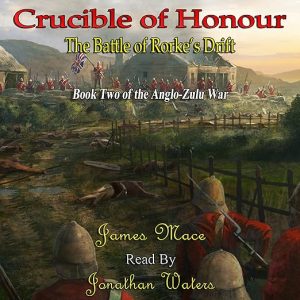
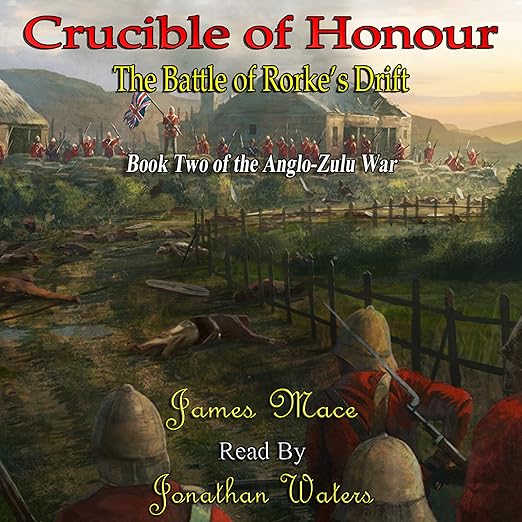
The context that makes the Battle of Rorke's Drift comprehensible is also what makes it almost impossible to credit as anything but fiction. James Mace's audiobook Crucible of Honour: The Battle of Rorke's Drift, book two of The Anglo-Zulu War series narrated by Jonathan Waters across 12 hours and 16 minutes, reconstructs one of the most extraordinary defensive actions in British military history. On January 22, 1879, the main British camp at Isandlwana, just ten miles east of a small supply depot at Rorke's Drift, was destroyed by the Zulu army. Four thousand warriors from King Cetshwayo's elite Undi Corps had been held in reserve during that massacre and denied any share of its glory. Led by Prince Dabulamanzi, they defied the king's direct orders against crossing into British Natal and turned toward the depot. What stood between them and an unguarded territory was 150 British redcoats, a newly arrived engineer officer with no combat experience as their commander, and fortifications built from biscuit boxes and mealie bags in the hours before the assault began.
Reviewer Bob Jarvis, who describes himself as having read extensively on the Zulu War of 1879, called it "well researched and historically spot on," ideal for anyone interested in the battle who does not want something too scholarly. That balance, between historical rigor and narrative readability, is the specific challenge of this kind of narrative history, and Mace handles it effectively across the full runtime. The audiobook carries a 4.6 rating from 736 listeners, placing it among the more consistently praised military history audiobooks available.
Dalton's Role Finally Gets Full Credit
Mace brings the four key defenders into focus with the kind of biographical specificity that distinguishes good narrative history from mere recounting. Lieutenant John Chard, the engineer thrust into command without combat experience. Lieutenant Gonville Bromhead, previously considered an undistinguished officer whose performance that night permanently revised the assessment of his superiors. Twenty-four-year-old Colour Sergeant Frank Bourne. And James Dalton, the retired soldier turned civilian volunteer who may have been the most tactically decisive figure in the garrison's survival and who received less public credit than his contribution warranted. That Dalton's role was historically underacknowledged is one of the book's implicit corrective arguments about how military glory gets assigned after the fact.
Waters' narration carries the period dialogue and tactical narration with equal assurance. He does not over-dramatize the action sequences, which is the right choice: the events are dramatic enough that restraint serves them better than theatrical intensity. The 12-hour runtime allows Mace to situate the Rorke's Drift defense within its full strategic context, including the disaster at Isandlwana and the position of Lord Chelmsford's column at Mangeni Falls, fifteen miles further east with over 20,000 Zulu warriors between it and the depot.
Dabulamanzi's Defiance Sets Everything in Motion
What Mace does particularly well is resist the temptation to treat the Zulu forces as a monolithic threat rather than a complex military organization with its own internal politics. The decision by Prince Dabulamanzi to cross into Natal against Cetshwayo's explicit orders, driven by the humiliation of his warriors having been denied participation in the Isandlwana victory, is presented as the key strategic decision that set everything in motion. Understanding why the Undi Corps attacked when and where they did makes the defense more comprehensible and the battle's outcome more remarkable. Mace is interested in both sides of the engagement, not only in the heroism of the defenders but in the motivations and honor codes of the attackers.
One reviewer noted the audiobook contains "interesting little tidbits which make the story great," which is accurate: Mace includes the kind of individual-level details that military historians spend careers uncovering, the specific decisions made under fire, the improvised fortifications, the character assessments that were revised upward as the night progressed. These details are what separate a well-researched narrative history from an encyclopedia entry, and Waters delivers them with the kind of measured emphasis that allows their significance to register without overstating it.
Text Typos Don't Touch the Narration Quality
One reviewer flagged some typos and misspellings in the source text that survived proofreading. In an audiobook these do not affect the listening experience directly, but they are worth noting as evidence that this is an independent or small-press publication rather than a major house release. The narrative quality more than compensates, but listeners with strong feelings about production polish should factor this in when making their purchasing decision.
The book is the second in the Anglo-Zulu War series, and while it works as a standalone account of the Rorke's Drift engagement specifically, listeners who want the full context of the 1879 campaign will benefit from reading or listening to the series in order. The first book covers the broader war and the buildup to Isandlwana, and understanding that catastrophic defeat in its full strategic context makes the scale of what the Rorke's Drift garrison survived all the more striking. Mace's reconstruction benefits from being read as part of his larger project.
Fans of the 1964 Film Get More Here
This audiobook is well suited for military history readers who want a narrative rather than an academic treatment of the Anglo-Zulu War, for anyone who encountered the battle through the 1964 film Zulu and wants the full historical account with its complexities restored, and for listeners generally drawn to true stories of small units surviving against overwhelming force. It is a 12-hour investment that rewards patience with genuine detail and historical insight. Listeners who want a briefer introduction to the subject might start with the first book in the series, but Mace's account stands on its own and delivers on the promise of its subject matter entirely.
Can I listen to the Crucible of Honour audiobook without reading the first book in The Anglo-Zulu War series?
Yes, the book focuses specifically on the Battle of Rorke's Drift and provides enough context to follow as a standalone. However, reading the first book in the series first will give you fuller background on the Isandlwana disaster and the broader 1879 campaign.
How historically accurate is the Crucible of Honour audiobook according to reviewers with existing knowledge of the period?
A reviewer who describes having read extensively on the Zulu War of 1879 calls it well researched and historically spot on. Minor proofreading issues in the source text have been flagged but do not affect the substantive historical content.
Does the audiobook cover only the British perspective on the battle, or does it address the Zulu side as well?
Mace presents the Zulu forces with strategic depth, including Prince Dabulamanzi's decision to defy Cetshwayo's orders against crossing into British Natal and the internal politics of the Undi Corps that drove the attack.