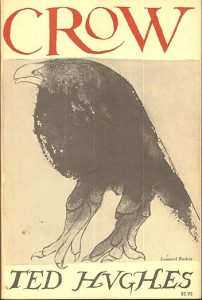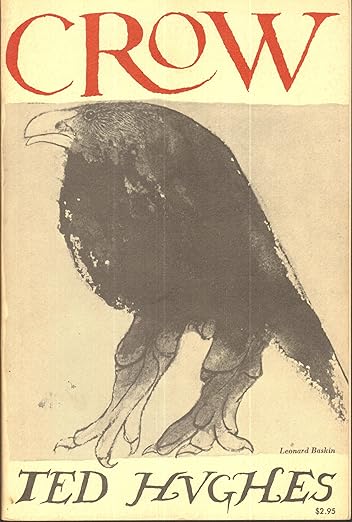
Every sentence in the field marked description on this audiobook grades a physical object. First US edition. Three brief lines written in ink, facing inside front cover. Clean, bright used copy with tight binding. Never a library book, with the never set in capitals. Then a pair of initials, the way a secondhand dealer signs off a stock card. Not one clause concerns a poem, a line, a sequence or a voice, and the recording it is attached to runs an hour and forty-eight minutes. Somewhere between a dealer's inventory and this catalog, the copy written for a printed volume got pasted over the copy for a recording, and nobody noticed.
Hughes Wrote It and Hughes Reads It Here
Here is the fact that actually matters, and the entry buries it in a field nobody reads. Ted Hughes is credited as the author of Crow. Ted Hughes is also credited as the reader. Whatever else this record fails to tell you, it tells you the poems arrive in the voice that wrote them, and for poetry that is not a small thing. A hired reader interprets, decides where the weight goes, and hands you a performance. A poet at a microphone tends instead to expose where the stresses were meant to land, which makes an hour and forty-eight minutes of this a different purchase from an hour and forty-eight minutes of somebody else's reading. A recording made by the writer also settles something no summary could, since it removes the middleman between the poems and the listener entirely.
When a catalog entry is this thin, the surviving scraps start doing extra duty. The imprint on file is Harper and Row, Publishers, with a stray invisible character parked in front of the name. The release date reads January 1, 1975, which is the shape a date takes when a system needs a year and has nothing more exact to offer. The price is $18.95. Taken one at a time these are database artifacts and nothing more. Taken together they describe an entry assembled out of a print record and never once checked against the thing it is selling. The language line says English and the length line says an hour and forty-eight minutes, and between them those two fields hold more accurate information about this recording than the description does.
Under Two Hours Makes Repeat Listening Cheap
Whether an hour and forty-eight minutes is enough depends on what you think a collection of poems ought to do to you. It is short for an audiobook and long for a single sitting with verse. That compression is the argument for the format. You can take the recording in one pass, in sequence, at the tempo its author chose, and sequence matters in a way that a shuffled reading destroys. Under two hours also makes the thing repeatable, and repetition is how poems do their work on a listener, so the runtime reads as a feature, not a shortfall. Poems are also the one form where hearing them is not a substitute for reading them but the original condition, which is a reasonable case for buying a recording over a paperback.
The single classification attached here is, unusually, right. Poetry, filed under literature and fiction, with a poet reading. Everything else here has drifted loose, and that single label has stayed put. If you are shopping for recorded poetry and this turns up, the two things you most want settled are already in front of you: who wrote it, and who is speaking it, and on this record those are the same person. Harper and Row is a print imprint and tells you nothing about who produced the audio, but the tag and the credit between them cover the ground a summary normally would. In practice that is worth considerably more than the paragraph you did not get.
Five Fives and One Four Explain the Score
What the rating does here is genuinely instructive. The badge reads 4.8 across six votes, which forces the six votes to add up to twenty-nine when thirty is the ceiling. Only one arrangement of whole-star votes reaches twenty-nine: five fives and a four. So five people gave the recording everything and one person withheld exactly one star. Of those six, a single voter wrote anything at all. The badge you see is therefore one point short of a clean sweep, and the person responsible for the shortfall left no explanation and no name attached to a reason.
Nothing in the one visible response concerns the recording either. RO, posting in December 2025, filed five stars and two sentences: Yes. It was an excellent and clean copy in very good condition. That is a verdict on a parcel, and it agrees so precisely with the description above it that both were plainly written about the same printed book and neither about the audio. On a listing carrying exactly one review, having that review point at the wrong object leaves a shopper with nothing usable at all.
Listeners should also register the questions this entry never raises. How many poems. Which text. Whether the sequence runs complete or selected. Whether the recording was made in 1975 or made decades afterward and then stamped with the date of a first US edition. An hour and forty-eight minutes is the only measurement anywhere on the record, and a runtime is not a contents list. A poetry recording without a track list is also its own kind of purchase, because you cannot jump to a poem you half remember and you cannot go back and check the one that just went past. If completeness is something you care about, nothing here will settle it.
Only the Credit Survives This Confused Listing
That leaves a narrow but perfectly real audience. Anyone who already knows they want to hear Ted Hughes read Crow can stop reading and start listening, because the credit line answers the only question that was ever going to matter. Anyone teaching or studying the work is the second audience, since a reading by the writer counts as primary material in a way a commissioned performance does not. Anyone arriving without either of those reasons gets no assistance whatsoever: a bookseller's condition note where a summary belongs, a single response grading the packaging, and a badge computed from five voters who never spoke.
Where this record leaves an ordinary browser is guessing, and the guess costs $18.95. What would make it an easy purchase is precisely what has gone missing: a sentence about the sequence, a note on whether the reading runs complete, a date attached to the recording instead of to a first edition. What does survive the mess is the credit, and on a poetry record the credit is most of the argument. Hughes wrote it and Hughes reads it; everything else on this entry belongs to a used hardback somebody sold across a counter decades ago.
At a Glance
- Read by: Ted Hughes is credited as both author and reader, so the poems come in the voice that wrote them across an hour and forty-eight minutes.
- At its heart: Unstated. The listing carries a used-book dealer's condition note where an account of the poems should be.
- Vibe: Compressed and unmediated, a poet at a microphone for under two hours.
- Short version: Buy it for the credit line, since the credit line is the only dependable information on the entry.
Whose voice is on the Crow audiobook?
Ted Hughes, according to the credit. The author field and the reader field carry the same name, which on a poetry record is the most useful line available. It means the pacing, the line breaks and the emphasis you hear are the ones the writer intended, and it removes the main hazard of recorded verse, an interpreter imposing a reading.
What is a bookseller's condition note doing in the description field?
Because it is a secondhand dealer's condition note that ended up in the wrong field. It records a first US edition, three lines of ink inside the front cover, a clean bright used copy, tight binding, never a library book, and then a pair of initials. All of that describes a printed object and none of it describes a recording.
How long is the Crow recording, and does it cover the whole sequence?
An hour and forty-eight minutes. Whether that covers everything is not answerable from this entry, which offers no contents list, no poem count and no note on which text was used. The runtime is the only measurement available, and a runtime cannot tell you what was left out. Ask before buying if completeness matters.
What does a 4.8 rating from six votes actually mean on this audiobook?
Six whole-star votes averaging 4.8 have to total twenty-nine against a ceiling of thirty, and one arrangement alone reaches that figure: five fives and a four. So a single voter out of six held back one star. Only one of the six wrote anything, a five-star note about the physical copy, which leaves the dissent invisible.