Key Details
- Read by: Tobias Weatherburn gives Warlow's Welsh procedural world a lived-in credibility, navigating the team ensemble with clean differentiation.
- At its heart: Small-town silence, the homeless crisis, mortality and justice
- Vibe: Brooding and atmospheric, with bursts of procedural urgency
- Short version: A strong nineteenth entry that sharpens the personal stakes for Warlow while delivering a genuinely unsettling case.
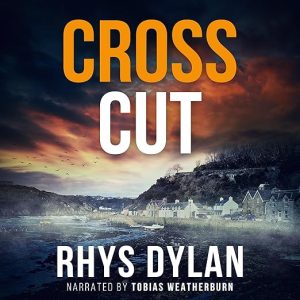
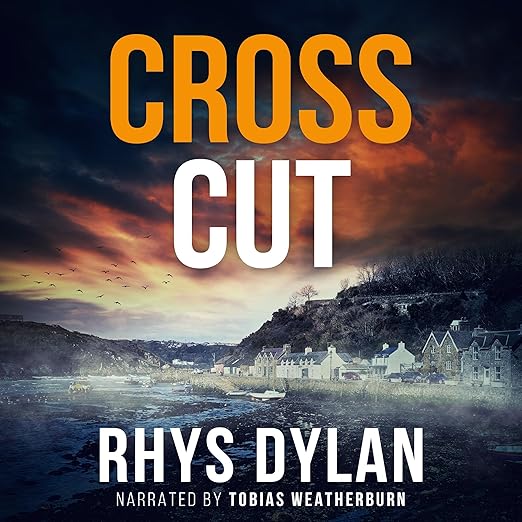
Rhys Dylan's DCI Evan Warlow series has been running for nineteen novels, and Cross Cut (this audiobook edition narrated by Tobias Weatherburn) arrives at exactly the point in a long-running procedural series where the author has to decide whether to deepen or coast. Dylan chooses to deepen. The result is one of the more layered entries in a Welsh crime fiction landscape that has grown considerably crowded in recent years, but which still has room for a detective who feels genuinely inhabited rather than assembled from genre parts.
The case begins with the discovery of media student Nicholas Vernon's body in a quiet Welsh town, spotted by a refuse worker in what the synopsis describes as a routine enquiry that spirals quickly into something far more disturbing. What Dylan does well here, and what separates Cross Cut from its genre neighbors, is the way the social margins inform the mystery. The plight of the homeless is not a backdrop prop; it is woven into the investigative logic, forcing Warlow and his team to look at who gets noticed and who does not in a community held together by shared silences.
Warlow's Quiet Reckoning With Mortality
The procedural architecture is sturdy in Cross Cut, but what holds the attention is the personal thread running alongside it. Warlow confronts a truth about his own mortality that the synopsis flags and which Dylan handles with restraint: not a melodramatic revelation, but a quiet reckoning that surfaces at intervals and gives the investigation an undertow of urgency it might otherwise lack. Reviewer Debbie Kingsbury's observation that the characters feel like a true team you get to know like friends captures something real about this series. The ensemble work is genuinely warm without being cozy in the pejorative sense. These are colleagues who carry history, friction, and loyalty in equal measure.
Archbishop Edward Skiba's review mentions an interesting surprise ending, and that lands accurately. Dylan has developed a reliable instinct for the final pivot: not the kind of twist that retroactively damages what came before, but the kind that recontextualizes just enough to make the replay worthwhile. The macabre obsessions alluded to in the synopsis are handled without exploitation, which is harder than it sounds in contemporary crime fiction, where the temptation to linger on darkness for shock value is constant.
Weatherburn's Welsh Voice Never Turns to Caricature
Tobias Weatherburn's narration is the right fit for this material. Welsh crime fiction has a particular tonal quality: a certain damp weight to the landscapes, a community-level wariness in the dialogue. Weatherburn captures both without leaning into caricature. His Warlow has authority without bluster, and the secondary characters are differentiated enough that a listener coming in at book nineteen can orient quickly. Clare Balkus notes in her review that she has thoroughly enjoyed every book in the series, and the audio version supports that kind of long-haul commitment. Weatherburn has built a consistent sonic identity for this world that makes each new entry feel like returning somewhere familiar.
The Welsh setting is not decorative here. Dylan uses it to examine how geographic insularity shapes community response to crime. Local loyalties running deep is the synopsis's phrase, and it is precise. The forensic evidence is described as thin on the ground, which puts the interpersonal detective work front and center. That is a structural choice that serves the atmosphere well: less procedural mechanics, more human pressure.
Homelessness and Digital Rumor Layer This Case
Listeners new to the series should know this is book nineteen in the DCI Evan Warlow Crime Thriller sequence. Cross Cut does not require prior knowledge for the central case, but the personal thread (Warlow's confrontation with his own mortality) carries more weight if you have some familiarity with who this man is and what he has accumulated across the earlier books. Starting here is possible but not ideal. The series is best entered from the beginning for full effect, though Dylan is careful enough with exposition that newcomers will not be left entirely at sea.
The social commentary around homelessness is handled with seriousness rather than sentiment. Dylan does not resolve the systemic problem; he uses it to illuminate how cases involving the most vulnerable members of a community can be minimized until someone like Warlow refuses to look away. That refusal is both the detective's professional instinct and, in this volume, something more personal: a man who knows his own time may be shorter than expected finding new reasons to pursue justice anyway. The online rumours and whispers that surround the Nicholas Vernon case are another layer Dylan handles well, placing the investigation inside a community that processes grief through speculation before it processes it through truth.
The investigation into Nicholas Vernon's background also asks questions about how media students document their lives online and what happens when that documentation becomes evidence. Dylan weaves the online rumours surrounding the case into the procedural fabric without reducing them to a subplot, giving the investigation a contemporary texture that suits the small-town setting rather than conflicting with it. Warlow's team navigates the gap between what the community is willing to say and what the digital record has already made visible, and the friction between those two information streams is one of the novel's smarter structural choices.
Not the Starting Point, But a Strong One
Existing fans of the Warlow series will find this a satisfying and notably personal entry, with Weatherburn's narration at its most assured. Readers who enjoy Welsh crime fiction in the vein of Peter Robinson or Simon McCleave (procedurals with atmospheric settings and ensemble teams rather than lone-wolf detectives) will find Dylan's approach compatible. Those who prefer their crime fiction tightly paced over psychologically layered may find the social texture an occasional brake on momentum, but most will consider it worthwhile. Not the starting point for the series, but among its stronger recent chapters.