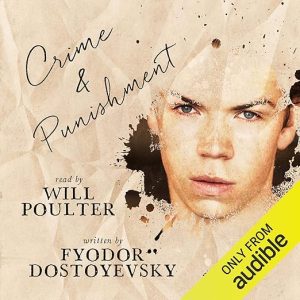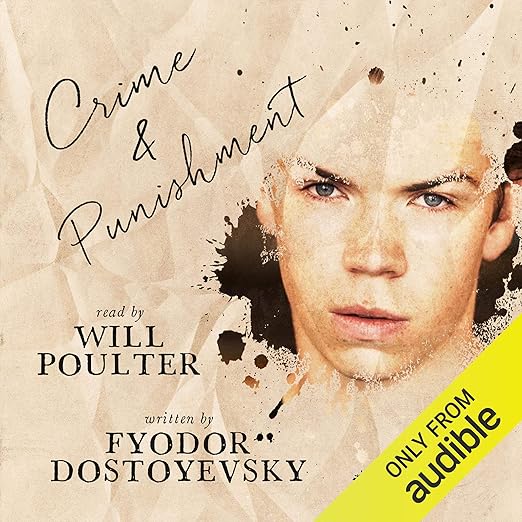
Some novels ask to be read quickly and some actively resist it, and Crime and Punishment belongs firmly in the second category, which makes it an unusually demanding audiobook to recommend casually. Dostoevsky built this novel almost entirely out of one man's collapsing self-justification, and spending twenty-some hours inside that collapse by ear is a genuinely different experience than turning pages at your own pace.
Our Take on Crime and Punishment
The craft of Fyodor Dostoevsky is, above all, the craft of interiority, and Crime and Punishment as an audiobook lives or dies on whether a narrator can transmit the pressurized inner life of Rodion Raskolnikov without reducing it to melodrama. This recording, with Anthony Heald credited as narrator, represents one of the more testing assignments in the classical literature catalogue. I came to this production having read the novel in print twice over the years, once as a student and once in my early thirties, and the audio format genuinely reframed the experience in ways I did not expect.
Dostoevsky wrote Crime and Punishment in the 1860s as a work that excavates the psychology of a young man convinced he has the intellectual right to murder, and then shows what happens to that conviction once the act is done. Raskolnikov kills an elderly pawnbroker not for money, not primarily, but as a kind of philosophical experiment: he wants to determine whether he belongs to the class of extraordinary men to whom ordinary moral laws do not apply. What follows is a sustained record of psychological collapse, guilt, paranoia, and eventual confrontation with the detective Porfiry, who may understand exactly what Raskolnikov did and why.
The psychological thriller label that often gets applied to this novel is accurate in structure but somewhat misleading in tone. Dostoevsky is not primarily interested in suspense, in who-did-it mechanics. The reader knows from the opening chapters what Raskolnikov did. The question the novel pursues is far more uncomfortable: what does guilt do to a mind that does not believe in guilt? The audiobook format makes this question audible in a specific way. Raskolnikov's internal monologues, his increasingly erratic conversations with Sonya, his chess-like exchanges with Porfiry, gain a temporal weight in audio that the eye can skim past on the page.
One reviewer who came to this with deep familiarity with Dostoevsky's milieu noted the difficulty of accessing a world 'sandwiched in between serfdom and the Communist Revolution in Russia,' a period most modern listeners cannot personally attest to. This is real, and the audiobook does not paper over that distance. Saint Petersburg in the 1860s is a specific sensory world of poverty, overcrowded tenements, blazing summer heat, and social stratification, and the narration carries that atmosphere with notable consistency. A second reviewer described the edition as making them want to 'slow down and savor every page,' which translates in audio terms to the willingness to let the twenty-hour runtime breathe rather than racing through it.
At just over twenty hours, this production asks for a genuine time commitment. That is appropriate to the material. Crime and Punishment is not a novel that rewards rushing. The accumulation of Raskolnikov's self-justifications, the gradual crumbling of his certainty, the way Sonya's faith functions as both reproach and lifeline: all of this needs time to register. I found the experience of listening while walking particularly effective, the forward motion of walking doing something for the forward motion of the narrative that sitting still did not.
What to Watch For in Crime and Punishment
Dostoevsky's narrative method has a specific structural habit that listeners should know about: he frequently allows scenes to go on past what a contemporary editor would permit, allowing characters to exhaust themselves in conversation until something true surfaces. The interrogation scenes between Raskolnikov and Porfiry are the most striking examples. They go on long enough that both characters reveal more than they intended, and the audio format makes the psychological pressure of those extended exchanges feel almost physically uncomfortable in the best possible way.
The novel's religious dimension, Sonya's readings of the resurrection of Lazarus to Raskolnikov, the epilogue's tentative gesture toward redemption, is handled with more seriousness than some modern listeners expect. Dostoevsky was not a comfortable, settled Christian; he was a man who had stood before a firing squad, survived, and spent the rest of his life working out what that meant. That biographical weight shows in the text and in the way the audiobook's final chapters land.
The translation choice matters enormously for a production like this, and listeners should check which translation underlies the recording they select. The Russian prose rhythms that made Dostoevsky distinctive do not survive all translation approaches equally, and some of the novel's characteristic intensity can be blunted by translations that prioritize smoothness over friction.
A note on the moral architecture of the novel: Dostoevsky does not allow Raskolnikov a clean escape through remorse. The guilt that assails him after the murder is not straightforwardly the guilt of a man who has accepted that killing is wrong. It is the guilt of a man who cannot sustain the self-conception that made the act possible, which is a subtler and in some ways more damaging thing. The audiobook format, with its continuous temporal experience, is particularly effective at conveying how this distinction operates across time. You hear the erosion happening, chapter by chapter, argument by argument, without the option to step back that the printed page provides.
Who Should Listen to Crime and Punishment
Listeners with an appetite for psychological depth and philosophical density will find this one of the most fully realized audiobooks in the classical catalogue. Those coming to Dostoevsky for the first time will get a genuine encounter with one of the greatest novelists who ever lived, though it will demand patience and attention. Readers who love contemporary psychological thrillers and want to trace the genre back to one of its origins will find this genuinely illuminating.
Those seeking lighter listening, or who find extended passages of tortured interior monologue exhausting rather than absorbing, should adjust expectations accordingly. This is not a novel that offers easy release or clean resolution.
Questions Listeners Ask
Is the audiobook version of Crime and Punishment a good way to experience the novel for the first time?
Yes, particularly if you tend to rush literary prose in print. The audio format enforces the pacing the novel requires and makes Raskolnikov's internal monologues feel more immediate.
How important is the translation in this audiobook production?
Critically important. Different translators handle Dostoevsky's register very differently, and the choice of translation shapes how the novel's psychological intensity and philosophical dialogue come across. Checking the translator credit before purchase is worthwhile.
Is Crime and Punishment suitable for audiobook listening in short sessions?
It can be, but the novel rewards extended sessions more than fragmented ones. The interrogation scenes and the longer interior passages lose their accumulated tension when broken up too frequently.