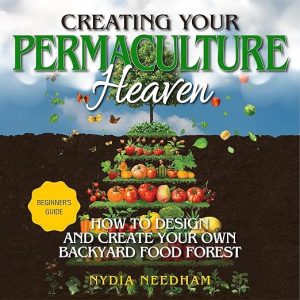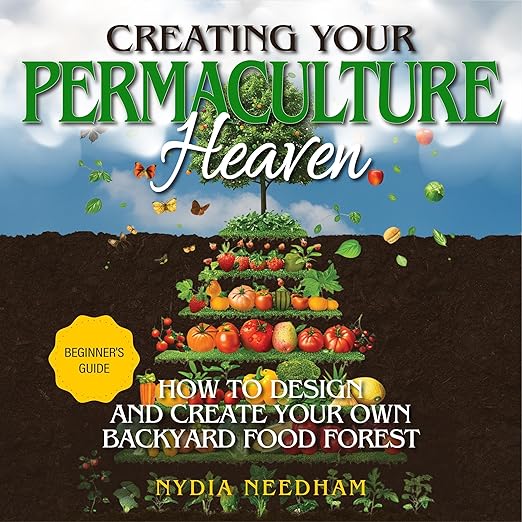
Nydia Needham's Creating Your Permaculture Heaven is the kind of audiobook that proves its value when you catch yourself, mid-listen, mentally redesigning your growing space. The book opens with Bill Mollison's famous observation that the world's problems are increasingly complex but their solutions remain embarrassingly simple, and Needham takes that idea seriously across nine hours of practical instruction. This covers permaculture not as an ideology but as a set of working principles: how to use natural systems efficiently, how to manage water, how to keep soil alive, how to design relationships between plants that do the work of pest control and fertilization without synthetic intervention. Stephanie Barry narrates with a calm, steady quality that suits the material well, because permaculture is, after all, a practice built on patience and careful observation rather than dramatic intervention.
More Practical Than a Ten-Day Permaculture Academy
Needham's approach is explicitly beginner-friendly without being shallow. The book opens by acknowledging the intimidation that often accompanies the word permaculture, which can conjure images of elaborate design certifications and whole-property overhauls before you can grow a single carrot sustainably. Needham dismantles that image early and consistently. The argument is that permaculture principles scale down to any context, from a window ledge with tomato plants to a fifty-acre farm, which is precisely what one reviewer described when they noted that this book gave them more practical traction than a ten-day permaculture academy had managed. That is a strong endorsement from someone with hands-on institutional training, and it points to Needham's specific skill: making principles legible at the level of actual practice rather than design philosophy.
The content covers a significant range of permaculture fundamentals: water capture and use, soil health and nutrition, companion planting, pest management without chemicals, food forest design, and even the possibility of generating income from a permaculture system. Each chapter includes practical exercises, which the audiobook notes are accompanied by a PDF available in the listener's library. The exercises are not decorative; they are designed to move listeners from conceptual understanding to actual planning, which is the gap that most gardening books fail to bridge effectively. Even the slug-management section, which sounds prosaic, contains practical strategies that most vegetable gardeners would find immediately applicable.
Barry Paces Nine Hours Like the Method Itself
Barry's narration makes nine hours manageable in a way that reflects Needham's own philosophy about pacing. Permaculture rewards patience and iteration rather than dramatic intervention, and Barry reads with a measured, unhurried quality that embeds that principle in the listening experience itself. She does not push through complex sections about soil composition or companion planting relationships at a pace that leaves listeners behind; instead, she gives the technical content the space it needs to settle. For a topic this dependent on spatial and relational thinking, that pacing is a significant advantage of the audio format over skimming text.
The PDF companion is worth noting explicitly. Several sections of the audiobook, particularly those involving companion planting charts and water management diagrams, will be more fully useful with the visual supplement. The audio stands on its own as instruction, but the combination rewards the more committed listener. Reviewers who kept the audiobook in their library for reference noted that the chapter structure makes it easy to return to specific sections during active garden planning seasons, which is exactly how this kind of practical content is most effectively used. One reviewer described keeping it for their children and, hopefully one day, their children's children, which speaks to the evergreen quality of the fundamental material.
Passive Listening Won't Get You Very Far
The book's scope is broad by design, and some topics, particularly the more advanced concepts like food forest establishment and commercial applications, are treated at a level of detail that opens the question rather than fully answering it. Listeners who are ready to move beyond the fundamentals will find that Creating Your Permaculture Heaven provides an excellent framework but not necessarily the depth needed for specific implementation decisions at scale. The book knows this and positions itself honestly as a starting point rather than a complete system. Those looking for detailed design methodology or site-specific analysis will want to supplement with more specialized resources or hands-on design courses.
The audiobook runs nine hours and three minutes, which is substantial for a practical gardening title. The chapter-by-chapter exercise structure helps break this into manageable segments, but listeners who prefer to consume instructional audiobooks passively and hope the knowledge will accumulate may find they need to pause and engage more actively with the material than is typical for narrative listening. This is a book that works best when you are listening with a notebook nearby or with the companion PDF open for annotation alongside the audio. Passive listening alone will leave most of the practical value unrealized.
Small Urban Lots Get the Same Framework
This audiobook is the right choice for beginning gardeners who are frustrated by conventional growing approaches and want to understand how natural systems can do more of the work for them. It is also well-suited to intermediate gardeners who have mastered the basics of vegetable production and are ready to think about their growing space as an ecosystem rather than a series of individual plant relationships. Experienced permaculture practitioners may find the material too introductory, though the accessible framing makes it useful for anyone who wants to introduce the principles to skeptical friends or family members. Those with small-space growing contexts, patios, window boxes, and small urban lots will find the book's emphasis on starting at any scale genuinely applicable rather than aspirational.
- Narrator: Stephanie Barry narrates with an encouraging, unhurried quality that suits permaculture's slow-and-steady philosophy, making nine hours of practical instruction feel like a thoughtful companion rather than a textbook.
- Subjects: Working with natural systems, food sovereignty, sustainable abundance
- Tone: Practical and quietly inspiring, grounded in the tangible rhythms of soil and season
- Bottom line: Beginning and intermediate gardeners who want to move beyond basic vegetable plots toward a more ecological approach to growing food will find this audiobook a genuinely useful starting point.
Questions Listeners Ask
Does the Creating Your Permaculture Heaven audiobook work without the companion PDF, or is the visual supplement essential?
The audio stands on its own as instruction and is designed to be fully intelligible without the PDF. However, sections covering companion planting relationships and water management design will be reinforced significantly by the visual materials. The PDF is free with purchase and available in your audio library, so there is no reason not to use it alongside the listening.
Is this audiobook suitable for apartment dwellers or urban gardeners with very small growing spaces?
Yes. Needham explicitly addresses small-scale applications and emphasizes that permaculture principles scale to any context. The window ledge tomato plant example she uses early in the book is deliberate: this is not a guide for people who already have acres to work with.
Is Creating Your Permaculture Heaven audiobook useful for experienced gardeners, or is it strictly a beginner title?
It is primarily positioned for beginners and intermediate gardeners. Experienced permaculture practitioners will find the fundamentals familiar, though the accessible framing and comprehensive scope make it a useful reference for introducing the system to new growers. Those who have already completed permaculture design courses will likely want more advanced material.