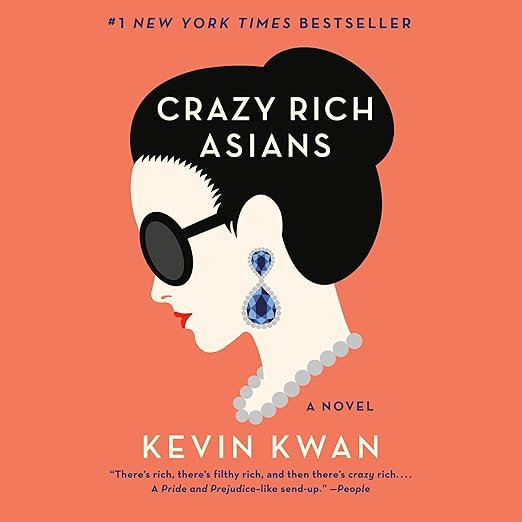
- Performance: Lynn Chen is the single credited voice for a novel whose comedy lives in asides and in a very large family, with no supporting cast listed.
- What it covers: Old money against new money, an outsider vetted by a dynasty, class comedy with genuine affection in it.
- Feel: Glittering, gossipy and sharper than it looks.
- Our call: Still the best entry point to the trilogy, as long as you want social comedy rather than plot across fourteen hours.
Rachel Chu expects a humble family home and a quiet summer in Singapore with the man she hopes to marry. What arrives instead, in the description's own tally, is a childhood house that looks like a palace, a partner who grew up riding in more private planes than cars, and the news that he happens to be the country's most eligible bachelor. Random House Audio put this audiobook out on June 11, 2013, Lynn Chen reads, and it runs thirteen hours and fifty-three minutes. Fifty-four ratings average 4.3, and the lowest of the five written responses concerns something other than the story.
Rachel Navigates Singapore's Old and New Money
Kwan's method is accumulation, and the comedy comes from precision rather than from exaggeration. Old money, new money, nosy relatives and scheming social climbers is how the copy sorts the cast, and the novel treats those categories as a working taxonomy with rules an outsider cannot see and everyone else has known since birth. Rachel serves as the reader's instrument: intelligent, unimpressed by wealth as an abstraction, and wholly unequipped for a system whose rules never get stated aloud to anybody who might need them.
Richard C. Reynolds, writing in August 2013, calls it both a beautiful love story and a wickedly funny satire, which is the balance the book must strike to work at all. That entry supplies plot the description withholds, including the best friend's wedding that draws everyone to Singapore, and describes Rachel as an American-born Chinese woman walking into a family that has already made up its mind. Satire without affection curdles quickly. This one keeps the affection visible while itemizing exactly what money does to people.
Kwan's Scrapbook of Labels Says Everything
Sally, writing in July 2013, identifies the mechanism better than any summary could: one character keeps a fine scrapbook of the labels from clothes he buys, the author declines to make anything of it, and that one sentence tells you everything about the sort of person he is. Kwan lavishes attention on his characters, in that entry's phrase, and the whole book runs on details deployed once and never explained. Comedy assembled that way rewards a listener who is paying attention and quietly punishes one who is not.
Fourteen hours is a long stay inside a single social world, and the length earns itself because the world keeps producing new rooms. A best friend's wedding, a family house resembling a palace, and a summer's worth of relatives all work as arenas where the same status contest gets restaged with fresh participants. The risk is obvious, since a satire that catalogs can start to feel like a catalog. Kwan sidesteps it by keeping a straightforward love story running underneath, so the sequence of set pieces always has somewhere to arrive.
Five Reviews, but None Mention the Audio
Areej left one star in July 2024, and the complaint concerns paper. That entry, written in Arabic and filed from Saudi Arabia, reports a cover that tore and stock of the worst kind, and advises against buying. Nothing in it touches the novel, a translation or any recording, and it sits in the same column as the grades for the writing. Pooled listings do this constantly, and the consequence is that one of five visible opinions reviews a physical object no listener will ever handle.
AGC, writing in September 2025, came from the film and stayed for the book, judging the novel more dramatic and more detailed than the adaptation while calling the ending abrupt. That last observation is the useful one. A comedy of manners that has spent thirteen hours assembling a social machine has to decide how much of it to take apart, and at least one reader felt the closing chapters chose speed over satisfaction. Anyone who needs a tidy landing should treat that as a warning rather than a quibble.
Five people have written about this recording and not one of them mentions it. The column grades a novel, a film comparison and a paperback's binding, which leaves the audio edition undescribed after more than a decade on sale. That is ordinary on a title whose print life dwarfs its audio life, and the practical answer does not change: the sample is the only evidence available, and fourteen hours is long enough that three minutes of listening first is simply rational.
Comedy of Manners Fans Should Test Themselves First
Lorene, writing from Canada in June 2018, gives the reaction the book is engineered to produce: glitz, glamour and a look into a world that entry had never known existed, followed by an immediate commitment to reading all three. The same response concedes the plot is a tried and true trope and argues it is done well regardless, which is the correct defense. Nobody arrives here for structural surprise. The pleasure lies in watching a familiar shape play out among people with unfamiliar quantities of money.
Comedy of manners is the genre to test yourself against before buying. If novels whose stakes are social rather than physical bore you, thirteen hours of Singapore society will feel like a very long dinner party you were not invited to. If watching a system of rules get revealed one violation at a time is your idea of a good evening, this is among the most entertaining recent examples, and the Pride and Prejudice-like send-up the copy quotes describes the shape fairly.
Listeners arriving from the film are welcome, and the description all but invites them by leading with the movie rather than with the novel. Expect more people, more subplots and more social taxonomy than two hours on screen could ever hold, and expect the ending to land differently than the adaptation's did. As a first volume it works cleanly on its own terms, with the trilogy fields on this record showing plainly where the story continues for whoever wants the rest.