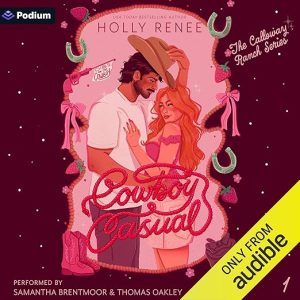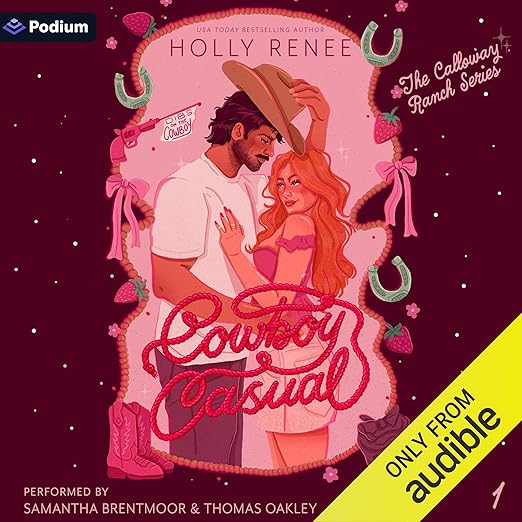
- Read by: One credit, Samantha Brentmoor, under a description whose last line reads "Narrated in duet style," with no second reader named anywhere on the listing.
- At its heart: Second chance, single dad cowboy, small-town return, a family farm in trouble.
- Vibe: Warm, loud and unembarrassed about its heat.
- Short version: Worth the twelve hours if these are your tropes, with the duet claim left entirely unverified.
Four words sit at the bottom of the description for this audiobook, tucked under a first-person monologue that never names the man doing the talking: "Narrated in duet style." In romance listening, duet ordinarily means two readers, one per point of view, trading the scene back and forth. The credit line under the title carries a single name, Samantha Brentmoor, and no second performer appears anywhere on the page. Either the listing has dropped a reader or the phrase is being used more loosely than the format usually allows, and nothing here lets you settle which before you commit twelve hours and fifty-four minutes. It is a small discrepancy, and everything else this page offers about the recording amounts to a single name.
The Verdict, Briefly
Blaire Monroe left this Tennessee town ten years ago and comes back to her grandmother's failing strawberry farm after a broken engagement, which is roughly the whole of what the description commits to. The review column fills in the rest and is far more forthcoming than the blurb. Maria Diaz names Grant, the man Blaire walked out on, along with June, the grandmother, and a new friend called Maggie who takes her to a cowboy bar. Sally C. supplies the fact the description withholds altogether: the cowboy next door is now a single father, and his daughter is called Ruby. A synopsis written in that man's own voice somehow leaves out that he has a child. Maria Diaz also explains what Blaire is running from beyond the engagement itself: a senator's daughter practiced at managing scandal, who decided she was done doing it and went home to Tennessee with June instead.
Podium Audio put the recording out on March 3, 2026, as the first book of The Calloway Ranch Series. Every date in the review column falls before that day. October 2025, then January and February 2026, four entries filed in the United States and one in Australia, all of them logged while the audio edition was still ahead of them. Whatever those readers were responding to, it was not this reading, and Maria Diaz says so in the opening breath by calling the book "such a joy to read." The detail and generosity are real. The evidence is about a text.
What Makes Cowboy Casual Worth Hearing
What comes through in the column is a specific list, not a general glow, and that is more useful than praise. Haley Marsh stacks the tropes up in order: single dad cowboy, second chance romance, small town. Romantic_Rush_Reads adds strawberry fields, a great deal of healing, and "plenty of that Holly Renee spice." Stephanie, writing from Australia, reports crying several times. Put together, that stack is a straighter index of what you are buying than the description itself, which runs on wildfire imagery and pressed-against-the-wall tension while saying almost nothing about the decade in between. Notice as well that the copy never names the man speaking it, while all five reviewers name him at once and without ceremony. Colt reaches you through the column instead of the description, a strange way to sell a book whose opening sentence belongs to him.
Twelve hours and fifty-four minutes is generous for a contemporary romance with one central couple, which suggests the ten-year gap gets filled in rather than summarized. Sally C. calls the leads "two magnets waiting to collide," the right image for a book that puts them in the same room early and then has to sustain the charge for the rest of the runtime. If the duet credit is accurate, that structure is the best possible argument for two voices, because a second-chance plot lives on two people remembering one shared decade in incompatible ways. If it is not accurate, one reader is carrying both halves of that memory.
Points to Consider
Sally C. is the one dissenting grade, three stars rounded down from a stated 3.25, and the reservation is structural, not a matter of taste: the romance fell off because the physical chemistry arrived before the build had finished. Weigh that against the other four grades, three fives and a four, because it describes a problem long recordings make worse. A slow burn that resolves early leaves hours of runtime to fill afterward. Nothing in the column says whether the back half sags under that weight, and the review bodies all stop before their authors reach the point where they would tell you.
Second, the badge is not a rounding artifact here. Nine people voted and the average sits at 4.3, which pins the total at exactly 39 points out of a possible 45. The five written grades account for 22 of them, leaving 17 spread across the four people who rated without writing anything, out of the 20 those four could have given. So the six missing points split evenly, three in the part of the page you can read and three in the part you cannot. The silent voters are no harsher than the visible ones, which is rarer than it sounds.
All five review bodies stop in mid-sentence, and three of them stop in mid-word, a property of how this page stores text and not of how anyone wrote. It matters because the entries are long and the cut lands early. Maria Diaz breaks off exactly as Blaire first catches sight of Colt across the bar. Romantic_Rush_Reads breaks off two letters into a word. You get the setup from four different angles and the assessment from almost none of them, so the column reads as five beginnings with no endings attached.
Who Should Listen to Cowboy Casual
Second-chance readers who like a small-town romance with the heat declared up front will find their people here. The tropes are announced rather than teased, and Sally C. even attaches a spice score of 2.5 alongside that three-star grade, more calibration than most listings offer. Twelve hours is long enough to settle into, the series position is book one, and the farm, the town and the ten-year silence are all introduced from scratch. Anyone who has read this author before will already know whether the register suits them.
Hold back if the duet question is the reason you were interested, and it reasonably might be, because listeners who buy romance specifically for the two-voice format are being asked to take a phrase on trust. Hold back too if you want somebody else's verdict on the recording before spending a credit, because every voice under the buy button here was talking about pages. Anyone who needs the reading itself to prove something first is better served waiting for the first response that arrives after March 3.
Frequently Asked Questions
Does the duet-style line mean two narrators read this audiobook?
The description ends on that phrase, but the credit names only Samantha Brentmoor and no second performer appears on the listing. Duet narration normally means two readers splitting the points of view between them. On the evidence available you cannot confirm it here, so treat the line as a claim the page never backs up with a second name.
Why is every written review dated before the release?
The recording is dated March 3, 2026, while the five written entries carry stamps running from October 2025 through February 2026. They respond to the book itself, not to this reading, and one of them duly opens by calling it a joy to read. No entry in the column describes a performance.
What does the 4.3 average actually tell you about this audiobook?
Nine votes at 4.3 fix the total at 39 points out of 45. The five visible grades, three fives, a four and a three, account for 22 of those, which leaves 17 across the four people who rated without writing. The six missing points divide evenly between the visible and silent halves.
Where does Cowboy Casual sit in The Calloway Ranch Series?
It is the first book, so nothing precedes it and no prior listening is assumed. The description introduces the town, the strawberry farm and the ten-year gap from a standing start, and the reviewers write as though the world is new to them as well. Familiarity with the author affects expectations, not comprehension.