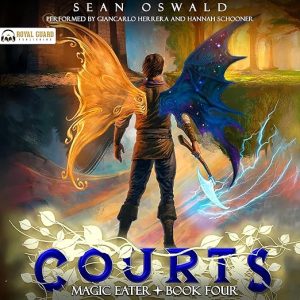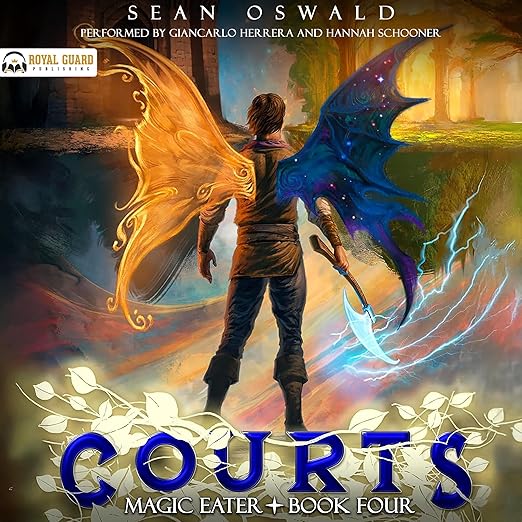
The most telling praise in this audiobook's review column is praise for something the book stopped doing. Amazon Customer, writing in January, calls it "a good continuation of the story" and then adds that "not constantly hearing about him want to open a shop is a plus. It was getting annoying." That is a reader thanking a fourth installment for retiring a running preoccupation carried over from the earlier ones. It tells you more about where Magic Eater sits in its own life cycle than the publisher's paragraph does, and the publisher's paragraph is all the listing offers.
First, the Big Picture
Tad has dealt with one set of enemies, reached a new town, opened a new shop, made friends and found "a happiness he didn't know existed." Then the copy turns: his heritage is pushing into his life, choices will have to be made, and the people who want a piece of him have become more powerful. Four sentences of setup, one of complication, and a closing question about whether the quiet life is still the life he wants. Nothing in it names the series mechanics, the magic, or a single supporting character. The shop, the friends and the happiness all arrive as bare facts rather than as scenes anyone can picture.
Three of the five responses supply what that copy leaves out. Jason calls the book "a great litrpg" and lists "Action and fantasy and believable characters." Kindle Customer reports "More crafting, fun concepts introduced" and the pleasure of watching "everyone level up and the stakes get higher." The pair signing as Dustin & Lisa W. describe a volume that is "a little slower and more enchantment heavy than action oriented." Between them they file a fairly precise genre reading, assembled entirely by strangers.
What the listing calls this book and what its readers call it are two separate things. The genre field files Courts under teen and young adult, with a tag reading Literature & Fiction. Not one reviewer reaches for either phrase. They write about systems, scrolls, adherents, level-ups and a war being prepared for, which is the vocabulary of progression fantasy rather than of a coming-of-age shelf. The secondary tag helps no one either, since Literature & Fiction is broad enough to cover almost anything with sentences in it. Anyone arriving on the strength of that category will meet twenty hours of stat-adjacent adventure instead.
What Makes Courts Worth Hearing
Sean Oswald is four books into a series that has plainly found its regulars, and the column reads like regulars talking. Jason's headline reports an addiction, and the body asks for the next one. Kindle Customer signs off with "Looking forward to the next." Carl Stalhood, the only reviewer withholding a fifth star, still files a paragraph of plot notes detailed enough to prove close attention. Whatever Courts is doing across its running time, it is doing it for an audience that was already in the room.
Twenty hours and one minute is that running time, and the narrator field holds exactly one name, Giancarlo Herrera, for every minute of it. That weighs more here than in most fiction. Progression fantasy runs on lists, on numbers spoken aloud, on the audible difference between a rule being announced and a character speaking. One reader has to keep that legible across the length of a full working week, with no second voice to mark where system text ends and dialogue begins. The credit indicates no one else was involved.
Carl Stalhood's review is the most useful item on the page and also the oddest. It reads as a beat sheet: a new friend created, a batch of scrolls, multiple systems shared with another series, a temporary power-up with future consequences, a follower who helps build accessories, and the line that gave the review its headline, "The Law attacks MC." It is a plot log rather than a verdict, and it breaks off mid-word inside the war preparations, so the last sentence never arrives at its object.
A Few Reservations
A single number on this page does not survive inspection. The badge reads 4.7. The vote counter beside it reads one. A lone whole-star ballot returns a 4 or a 5 and nothing between them, so 4.7 is not a figure one vote can produce, and five written responses sit beneath a counter that claims one. Treat the average as decoration. The five paragraphs underneath it are the only real evidence the page carries about how this landed.
Nothing about the dates lines up either. Royal Guard Publishing gives this edition a release date of March 3, 2026. All five responses are older than that: January 15, January 20, January 25, January 31, and February 16, every one of them the same year. Readers were filing verdicts weeks before the recording was meant to exist, which normally means the column was inherited from an earlier format of the same text. The listing never says which format that was.
Book four of Magic Eater opens with the previous set of enemies already dealt with, which is a courteous way of saying the description assumes you were present. Tad's shop, his friendships, his heritage and the people circling him all arrive pre-loaded, unexplained and unnamed. At least the series title and number are filled in, so the running order is visible from the page, but the copy does nothing at all for a listener who lands here first and wants to know who anybody is. Two sentences of recap would have closed that gap.
Should You Listen to Courts?
Readers already four books deep into Magic Eater are the obvious audience, and the column suggests they are being looked after: four five-star responses, one four-star, and a recurring irritation retired. Listeners who want crafting, enchantment work and visible escalation more than they want combat should note that this entry tilts their way, at least on the reading Dustin & Lisa W. give it. Twenty hours is generous runway, and much of it appears to go on arrangements for whatever comes next.
Anyone arriving from the teen and young adult category will find nothing to hold onto, because the label is wrong and the book makes no concession to it. Listeners who came for the action-forward register of the earlier volumes should weigh the one review calling this one slower and heavier on enchantment. Anyone who has never met Tad, meanwhile, faces hours of guesswork about relationships the description declines to explain, which is a real cost when the recording runs twenty hours and a wrong entry point is expensive. Start at book one and the payoff here arrives on schedule.
A Few Questions About Courts
How long is the Courts audiobook, and who reads it?
Twenty hours and one minute, with Giancarlo Herrera as the only reader named on the credit. No co-narrator, full cast or production note appears anywhere on the listing. For a fourth volume of progression fantasy, that means a single voice carrying every system, faction and character across a stretch close to a full working week.
Can I start the Courts audiobook without the earlier Magic Eater books?
The description opens with one set of enemies already dealt with and a shop already opened, so it assumes you were present for the earlier volumes. Tad's friendships, heritage and enemies all arrive without introduction. Nothing on this page summarizes what came before, and no reviewer treats the book as a standalone entry.
Why does the rating show 4.7 from a single vote?
Because those two figures cannot both be accurate. One whole-star ballot returns a 4 or a 5, never 4.7, and the counter reading one sits directly above five written responses. Read the five paragraphs instead: four award top marks, and Carl Stalhood withholds a star while filing the longest notes of the group.