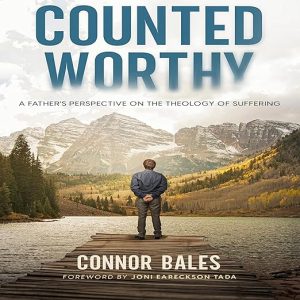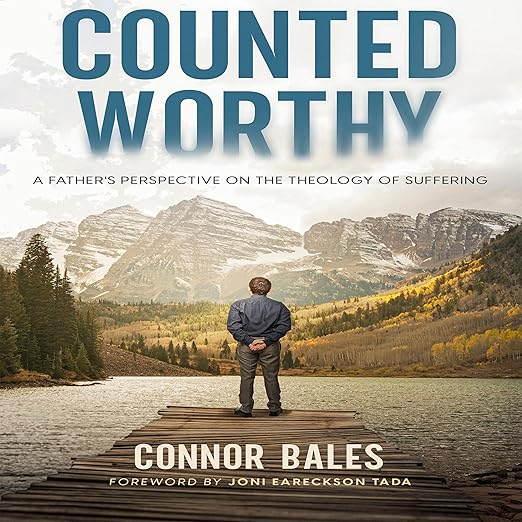
Books about suffering usually arrive from a safe distance, written by someone who has studied the problem rather than lived inside it. This one does not. Connor Bales is a pastor who has spent years fielding hard questions about pain from other people, and then found himself raising two children with a rare genetic disorder alongside his wife, Mary. The audiobook runs four hours and fifty-six minutes, appeared in March 2023, and ninety-six ratings have carried it to 4.9. He reads it himself, which for this particular kind of book is less a production choice than a condition of the thing existing at all.
Three Hard Questions About a Family's Suffering
Three questions from the description set the structure: how followers of Christ should respond to suffering, what it means if the calling itself is to suffer, and how to respond when the people you love are the ones suffering. That third question is where most books in this category go quiet, and it is what Bales is best placed to answer, since he has been on both sides of it as a pastor and as a father in an emergency room.
What the book promises is a practical theology rather than a comfort read. The description sets out the full arc: the confusion and the questions of why, the exhaustion of endless tests and treatments and hospital visits, and the emotional, physical and spiritual cost to a whole family. It says plainly that Bales leaves nothing off the table, which is a promise worth checking, because a pastor writing about his own children has more reasons than most to leave things on it. It also promises that listeners will grow close to the Bales family, which is an unusual undertaking for a publisher and a fair description of what this kind of memoir does when it works.
Bales's Narration of His Own Children's Story
Self-narration is the correct decision here and it is not a close call. This is testimony about a man's own children, and hiring a professional would mean paying somebody to perform another family's worst nights. When a father says out loud what a diagnosis did to his marriage and his faith, the fact that the voice belongs to the person it happened to carries information that no reading, however skilled, could supply.
Pastoral register helps too. Bales has spent his working life speaking to rooms full of people who need something from him, and a pastoral voice knows how to hold a difficult passage without either hurrying past it or wallowing. One responder puts the effect precisely, writing that "sharing what a father endured gave me such respect for both Pastor Connor and his wife with what they went through and still are". That present tense at the end is doing real work.
Length is a mercy on material like this. A single long journey or a few evenings covers it, and a book about a family living inside a chronic medical situation would be a very different proposition at twelve hours. The shape suggests something written to be finished rather than endured, and the description's own promise of hope and comfort sitting above the brokenness is consistent with a book that knows where it is going.
The responses describe a specific and unusual effect. Ted Strange reports having "never cried through an entire chapter of a book before" and says the book "allowed me to grieve and process some of my own experiences", with the chapters that follow supplying comfort rather than leaving a reader there. Another entry calls Bales "transparent and honest about his journey" and adds that it helps others become more sensitive to people going through their own. Neither review dwells on doctrine. Both describe a book that does something to a reader rather than merely informing one, which is a rarer outcome than the marketing around this category suggests.
Near-Perfect Ratings Worth a Second Look
A 4.9 average across ninety-six ratings is close to unanimous, and unanimity is worth interrogating rather than trusting. Every visible written response gives five stars, and the shortest of them runs to six words: "Amazing story. Amazing family. Amazing God." That is a sincere reaction and it is not information. Books drawn from a congregation and a personal network tend to gather scores from people who already know the author, and nothing here separates that readership from a stranger's verdict.
Dates say something similar. Three of the five entries were posted before the March 2023 recording, the earliest by seventeen months, so the enthusiasm on this page was generated by the printed book and inherited by the audio edition. Only two responses postdate the recording at all, and neither of them mentions the edition they are attached to.
Classification here is simply wrong. This listing carries a Children's Health tag and sits under health and wellness, which will deliver it to parents looking for medical guidance and hide it from the readers who actually want it. Bales is writing pastoral theology out of a family medical crisis. Nobody will find practical care advice here, and nobody browsing Christian living will find the book at all.
Faith is the frame, and the description states it without apology. The questions are addressed to Christ-followers, the comfort on offer is described as supernatural, and the promised outcome is drawing closer to God. A listener who does not share that framework can still take a great deal from a father's account of years spent inside a medical crisis, but this is not a secular book about resilience wearing a religious coat.
Another Parent in the Same Position
The clearest match is another parent in the same position. MaryD., who has a special needs child, describes reaching for happy escapes rather than hard books and then finding this one impossible to put down, crying through parts of it. Pastors, chaplains and anyone who keeps having to say something useful to a suffering friend will also get more from this one recording than from a shelf of general encouragement. Small groups working through a season of loss together would find it easy to divide across a few weeks.
Look elsewhere for medical or practical caregiving advice, and stay away if a Christian framework is a barrier rather than a support, because it is the load-bearing structure and not a decoration. What I would say is that a book like this stands or falls on whether the author flinches, and five hours in the voice of the man it happened to is the fastest way to find out that he does not.