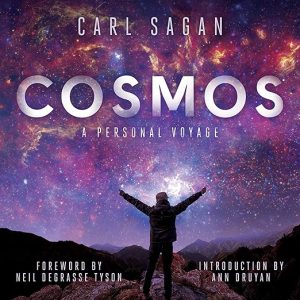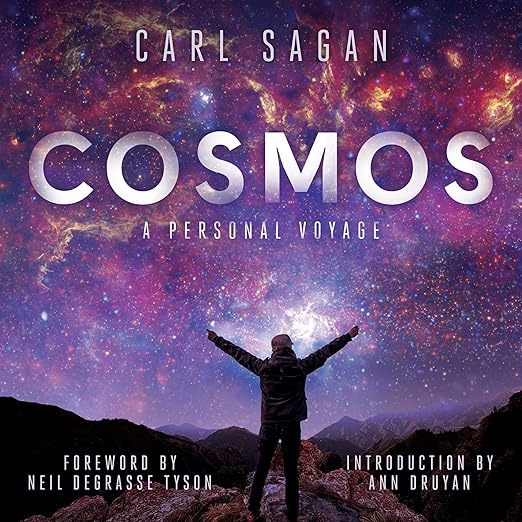
Carl Sagan wrote Cosmos in 1980 as a companion to his landmark PBS television series, and the audiobook version, narrated by LeVar Burton across 14 hours and 31 minutes, arrives as both a preservation of a classic and a new interpretive act. The production includes the Vangelis composition "Heaven and Hell" from the original series as introductory music, which immediately situates the listener within the full multimedia experience Sagan created rather than treating the book as a standalone artifact. Burton is one of American public culture's most recognized voices for science communication and literacy, and the combination of Sagan's prose with Burton's delivery is not a random pairing. It is a considered act of cultural transmission.
The scope of Sagan's original ambition was genuinely extraordinary. Across 13 chapters, he moves through 14 billion years of cosmic evolution: the origin of life, the human brain, Egyptian hieroglyphics, spacecraft missions, the death of the Sun, the evolution of galaxies, and the scientists and philosophers who shaped the modern understanding of the universe. The organizing thesis is that we are made of star stuff, that the atoms in our bodies were forged in ancient stellar furnaces, and that recognizing this kinship with the cosmos is both the most scientifically accurate and the most humanistically significant thing we can know about ourselves.
The Verdict, Briefly
Burton's narration brings something specific to the material. His voice carries warmth and a quality of invitation that suits Sagan's writing, which was always addressed to the general reader rather than the specialist. Where Sagan writes about the scale of time and space with a combination of precision and awe, Burton delivers that combination without collapsing either element into the other. The chapters that are most scientifically dense, including the evolution of galaxies and the death of stars, are paced differently from the more humanistic chapters on the history of astronomy, and Burton modulates between them with appropriate care.
Reviewer Breakfast Winner made the observation that Sagan "writes beautifully indeed" for a scientist, which reflects something genuinely unusual about the prose. Sagan was trained as an astronomer, but his writing apprenticeship included serious engagement with literature and philosophy, and it shows. The Plain Dealer's quoted praise that the book "seems too good to be true" captures the experience of encountering science writing that is also genuinely good prose. The Newsday observation that Sagan keeps "one eye on the stars, another on history, and a third, his mind's, on the human condition" is both poetic and accurate as a description of how the chapters are structured throughout.
Why Cosmos Works as an Audiobook
The 14-hour runtime allows the book to breathe in ways that a shorter popular science title cannot. Reviewer Nichanan Kesonpat noted reading slowly because each chapter was "so packed full of historical anecdotes, scientific findings" that absorption required pauses between chapters. Audio format calls for slightly different attention management, but these chapters reward replay in the same way they reward re-reading. The chapter on the library of Alexandria, which traces the destruction of accumulated human knowledge and what it cost science, is one of the most affecting passages in popular science writing, and hearing it in Burton's voice rather than reading it silently is a different emotional experience.
The Vangelis music that opens the audiobook is a deliberate link to the television series that many listeners will know. Including it situates the audio version within the full multimedia experience Sagan created, rather than treating the book as a standalone artifact. That choice signals that the production team understood what made Cosmos significant beyond its prose, and it honors the emotional context in which millions of people first encountered Sagan's ideas. For listeners who grew up watching the original series, the opening bars will activate something the text alone cannot reproduce.
Points to Consider
The book was published in 1980, and some of its scientific content has been updated by subsequent discovery. The chapters on spacecraft missions, planetary science, and cosmology reflect the knowledge available at the time, and a 2026 reader will notice places where the picture has been filled in or revised. This is not a reason to approach the book with skepticism; it is a reason to hold it in its historical moment. Sagan's frameworks and his way of asking questions about the universe remain as useful as they were in 1980, even where specific details have evolved significantly.
The humanistic and philosophical dimensions of the book have aged differently in some cases more powerfully than the scientific content. Sagan's arguments about the fragility of human civilization, the dangers of superstition over empirical reasoning, and the political stakes of scientific literacy were prescient in 1980 and remain urgent. These are not incidental to the science; they are woven through it as the moral argument Sagan believed the book was making all along. A reader who approaches Cosmos as popular astronomy will get that, but will miss what the book is actually for.
Who Should Listen to Cosmos
This audiobook is for anyone who has not encountered Sagan's work and wants to understand why it had the cultural impact it did, as well as for longtime admirers who want to experience the text in a new interpretive context. The material presupposes no scientific background; Sagan wrote for curious general readers and the audiobook maintains that accessibility. Listeners who want cutting-edge cosmology as of 2026 should pair this with more recent titles; Sagan is not the best source for the latest findings on dark matter or gravitational wave astronomy. But as a statement of what science is for and why it matters to human life, nothing in popular science has offered the same combination of scope, clarity, and genuine literary quality.
Before You Listen
Is this audiobook still scientifically accurate given that Cosmos was published in 1980?
In broad framework, yes. In specific details of planetary science, cosmology, and spacecraft missions, some content has been updated or revised by subsequent discovery. The book should be treated as a historically important scientific text rather than a current reference, and its arguments about the nature and value of scientific inquiry remain as sharp as ever.
Does the audiobook version of Cosmos include any additional material beyond the print text?
Yes. It opens with the Vangelis composition 'Heaven and Hell' from the original television series, used with permission from Druyan-Sagan Associates. This is a meaningful addition that situates the listening experience within the broader multimedia context of the original Cosmos project.
How does LeVar Burton's narration suit Sagan's style of writing?
Very well. Burton's warmth and his established public identity as an advocate for literacy and wonder align closely with Sagan's intended tone. He handles both the scientifically dense chapters and the more humanistic and philosophical passages with appropriate modulation, and the 14-hour runtime does not feel padded.