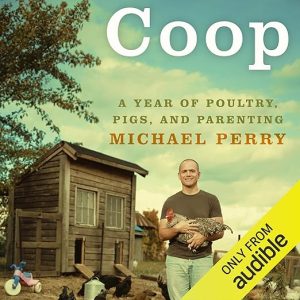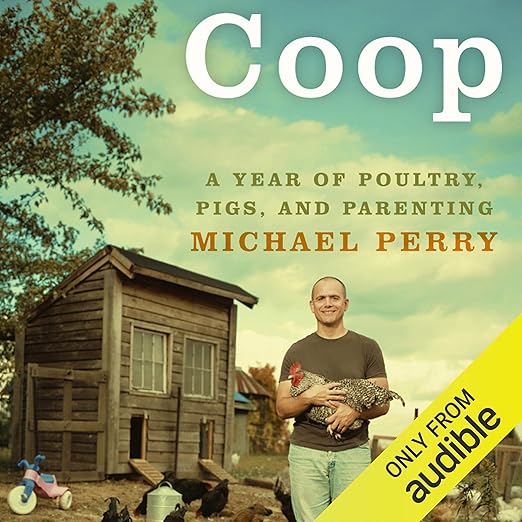
I came to Coop through a recommendation from a reader who described it as "the book I give everyone who says they don't read memoir." I had a long afternoon drive ahead of me and nothing else queued up, so I put it on. I finished it the next morning, sitting in a parking lot, not quite ready to get out of the car. Michael Perry does something in this book that is very hard to do: he writes about small things, chickens, pig wrestling, a child being born at home, in a way that makes them feel like the only things that matter, without ever claiming that they are.
Perry is a Wisconsin essayist, former rural emergency responder, and the author of Population 485, a book about volunteer firefighting that has its own devoted readership. Coop is different in texture, more personal, more domestic, centered on a particular year in which he and his wife Anneliese are renovating a farmhouse, raising pigs and chickens, preparing for the home birth of their daughter Amy, and navigating questions about faith that Perry has been avoiding since leaving the obscure fundamentalist Christian sect of his upbringing. These things are intertwined in Perry's telling, which is the point.
The book's organizing metaphor is the chicken coop Perry is building throughout the year, a simple structure, requiring basic skills, producing a predictable result if you follow the instructions correctly. Parenting, faith, and marriage are not like this, and Perry knows it. The coop is not heavy symbolism; it is just something he is doing with his hands while he thinks about harder things. That combination, physical work alongside philosophical uncertainty, is where Perry does his best writing.
He is genuinely funny. Reviewers consistently mention this, but it is worth emphasizing because the humor in Coop is not separate from the tenderness. Perry coins words, "slumpage," "drifty", that reviewers have adopted into their own vocabularies. His account of being bitten while wrestling a pig is the kind of sentence that makes you want to read it aloud to whoever is nearby. His account of his father driving home with a Holstein tethered to the bumper of a Ford Falcon is similarly perfect. These are not jokes; they are just how Perry sees the world, and the memoir sustains that vision across ten hours without strain.
Michael Perry's Own Timing Carries the Punchline
Perry narrating his own work is the correct choice and one of the reasons this audiobook functions at the level it does. His timing, specifically the pauses, the slight Wisconsin flatness he brings to a punchline, the way he reads his own most vulnerable sentences without leaning on them, is not something a professional narrator could replicate from the page. He has been performing his essays in front of live audiences for years, and that experience is audible. The comedy lands, the emotion lands, and the passages about his daughter Amy's birth and his friend's death land with a weight that print alone does not convey.
At ten hours, this is a comfortable middle length. The memoir does not outstay its welcome. It knows when it has said what it needed to say.
A Slow Structure That Never Seeks Resolution
One reviewer found the book slow and was ready for the end before it arrived. That response is real, and it reflects something true about Perry's approach: he is not building toward a climactic revelation. The book accumulates meaning the way a year accumulates, through small events, small decisions, small moments of clarity or confusion. Readers who expect memoir to organize itself around a transformative event will find Coop's structure loose. Those who find that looseness the point will find it perfect.
The faith material is handled with unusual honesty. Perry is not a believer, exactly, but he is not a comfortable atheist either. He is someone who was raised inside a specific religious community, left it, and has spent adulthood navigating what remains. When his daughter Amy starts asking about God, his account of his own uncertainty is not positioned as resolution. He does not arrive at a tidy answer. That refusal to tidy up is one of the book's genuine strengths.
Quiet Memoir Readers, Not Plot-Chasers
Well-suited to readers who love literary memoir in the Cheryl Strayed or David Sedaris tradition but want something quieter and more rural in its materials. Farm enthusiasts and homesteaders will find it speaks their language while doing more than the genre usually attempts. Anyone navigating new parenthood, religious uncertainty, or the question of what you owe to the tradition you came from will find Perry's account genuinely useful. Listeners seeking momentum and event-driven narrative will find Coop too contemplative for their pace.
Does Perry's narration of his own memoir add to or detract from the listening experience?
Unambiguously adds. Perry has been performing his essays publicly for years, and the timing, particularly his comic timing and the restraint he brings to his most emotionally loaded sentences, is not replicable from a produced reading. The self-narration is one of the audiobook's primary strengths.
Is Coop primarily a farming memoir or does it work for readers with no interest in rural life?
The farming and homesteading material is present throughout, but it functions as the texture of a year rather than the book's subject. The memoir is ultimately about parenthood, faith, loss, and what it means to build a life deliberately. Readers with no interest in chickens or pig wrestling will find the human material more than sufficient.