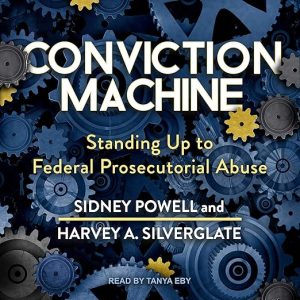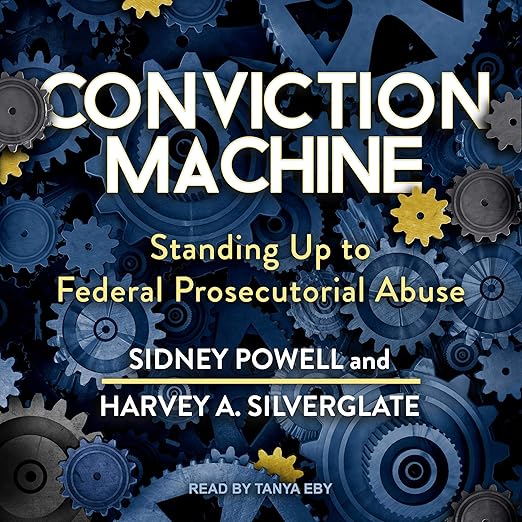
Sidney Powell and Harvey Silverglate's Conviction Machine arrives in audio narrated by Tanya Eby at just under five hours, which is short for a legal reform text but appropriate for one that functions as a focused brief rather than a comprehensive treatise. Powell, a former federal prosecutor who served as lead counsel in five hundred federal appeals, and Silverglate, the defense and civil liberties attorney whose 2009 book Three Felonies a Day remains a landmark critique, combine their distinct vantage points here. Together they describe a system with well-documented structural failures and propose specific remedies. This audiobook is not a polemic; it is an argument from two people who know the machinery from the inside and whose diagnoses are built on decades of direct participation.
The core diagnosis covers: overzealous prosecutors operating with effective immunity from accountability, perjury traps designed to create charges where none existed, negligent judicial oversight of prosecutorial conduct, vague and redundant criminal statutes, insufficient requirements for criminal intent, and no meaningful accountability mechanism for prosecutors who violate defendants' rights. These are not new observations in legal scholarship, but Powell and Silverglate's particular contribution is the specificity of their sourcing and the concrete reform proposals that follow from each diagnosis. They are not writing to shock a general audience; they are writing to change something specific, and the blueprint for change is what distinguishes this from commentary.
Powell's Five Hundred Appeals Back Silverglate's Argument
The audiobook's strongest passages are those where Powell draws on her own prosecutorial experience to describe how the system's failures look from inside the government rather than solely from the defense table. Her account of witnessing prosecutorial abuse more than a decade after she entered private practice, and of tracking the pattern across her five hundred appeals, gives the argument the kind of credibility that external critics cannot replicate. You are hearing from someone who was on the prosecuting side of this system and who saw enough of its internal workings to change how she understood her own prior role within it.
Silverglate's Three Felonies a Day argument, which holds that the average American commits three unintended federal felonies daily due to the vagueness and abundance of criminal statutes, provides the structural backdrop against which Powell's case histories acquire full weight. Together the two authors cover both the prosecutorial incentive problem and the legislative over-criminalization problem, which are related but distinct pathways to the same unjust outcomes. Reviewers have consistently noted that the material is accessible to non-lawyers, and that accessibility is a genuine achievement in a domain where technical writing frequently defeats its own purpose.
Eby Keeps Five Dense Hours Moving
Tanya Eby's narration handles the technical legal material with authority. She does not simplify in ways that lose the argument's precision, but she maintains a pace and rhythm that prevents the denser sections from becoming opaque. At under five hours, this audiobook fits into a schedule that longer legal texts cannot accommodate, making it accessible to general listeners who would not commit to a twelve-hour listen on this subject. The compact runtime also forces a discipline on the authors' argument that benefits the listener; every section earns its place.
The timing of this audiobook in the current political and legal conversation is worth acknowledging. Arguments about prosecutorial overreach, federal power, and accountability gaps have moved from specialized legal discourse into general public debate. Powell and Silverglate's analysis was building this case before it became a partisan talking point, which means the book's value comes from the quality of the underlying legal argument rather than from its alignment with any particular political moment. Listeners on different ends of the political spectrum have cited it as useful, which is reasonable evidence of the argument's structural soundness as a legal critique rather than a political position.
Citizen Steps Buried in a Casual Listen
This is a reform-oriented book, and its proposed solutions are specific enough that they reward careful listening rather than background absorption. The blueprint for reforming the Department of Justice, including the actionable steps the authors propose for citizens, is the section most easily lost in casual listening but most practically valuable for readers who want to move from analysis to application. The book's conclusion that accountability requires both structural reform and citizen engagement is not a rhetorical gesture; it is a specific argument about where change actually begins.
Listeners should also note that Silverglate's original Three Felonies a Day provides useful broader context if they want the full theoretical foundation. Conviction Machine presumes some familiarity with that argument without restating it comprehensively, so the combined read produces a more complete picture of the problem than either book delivers alone.
Anyone Touched by Federal Prosecution Should Listen
This audiobook is essential for anyone who has encountered the federal criminal justice system directly, either as a defendant, a defense attorney, a family member of someone charged, or a citizen who wants to understand the gap between how federal prosecution is supposed to work and how it actually operates. It is also valuable for general listeners who want a structured, evidence-based account of how the incentives within federal prosecution diverge from its stated purpose of delivering justice.
Those seeking a more narrative or case-history-driven approach will find the reform-blueprint structure somewhat dry in comparison to prosecutorial drama or courtroom narrative. But those who want the analytical framework to understand specific high-profile cases in systemic context, rather than as isolated aberrations, will find this audiobook significantly clarifying about patterns that otherwise look like individual failures.
Key Details
- Read by: Tanya Eby delivers the dense legal analysis with professional clarity, maintaining precision across the material's more technical passages without losing the urgency that this subject demands.
- At its heart: Federal prosecutorial overreach, structural failures of the justice system, accountability and reform proposals
- Vibe: Measured and alarming, like reading a white paper written by people who are genuinely angry but know better than to let it show
- Short version: Sidney Powell and Harvey Silverglate have produced the kind of insider critique of the federal justice system that is rare precisely because it requires both the access and the willingness to say the uncomfortable parts clearly.
Before You Listen
Does this audiobook require a legal background to follow?
No. Powell and Silverglate write with enough contextual explanation that a general reader can follow both the diagnosis and the proposed reforms. The book's intent is to reach citizens who can advocate for change, not only legal practitioners familiar with the system from the inside.
Is this audiobook a partisan political text?
The authors are explicit that their critique applies across administrations and both parties. Powell notes her experience under nine US attorneys from both political parties, and the structural failures they describe are independent of which party controls the executive branch at any given time.