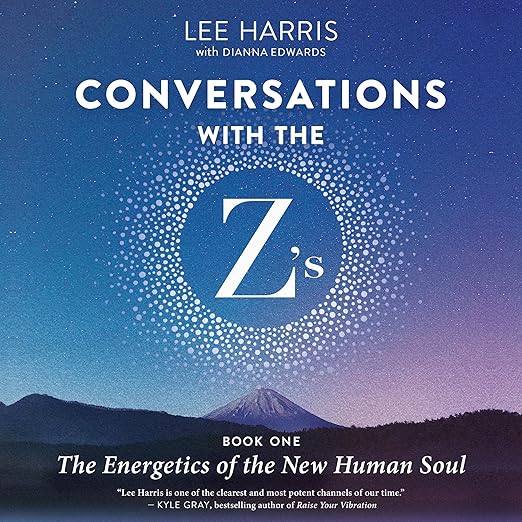
I came to Conversations with the Z's, Book One on a recommendation from a reader who described it as the kind of listening that rearranges the furniture in your mind without making a lot of noise. That is a good description. I finished the three-and-a-half hours on a Sunday morning, which felt appropriate given the material. It is the kind of book that wants quiet around it, not because it is difficult but because it opens up interior space that deserves attention rather than ambient noise.
Lee Harris has been channeling his guides, the entities he calls the Z's, for twenty-four years. That longevity matters to how you receive the material: this is not a recent discovery or a novelty project. It is a practice with depth, and the audiobook reflects that depth without becoming inaccessible to newcomers. The format is genuinely novel: rather than a monologue or a traditional spiritual talk, Harris presents his channeling in conversation with psychotherapist Dianna Edwards, whose role she describes as listening to hear. Her questioning gives the Z's wisdom a contemporary, grounded interlocutor, and the dialogue structure breaks the material into segments that are significantly easier to process than extended channeled monologue can sometimes be.
Is Conversations with the Z’s, Book One Worth Your Time?
Spiritual and channeled audiobooks have a recurring structural problem: without interruption or dialogue, the listener can drift into passive reception rather than active engagement. Edwards' presence as questioner solves this. Her questions are not soft or leading; they are genuinely curious, occasionally probing, and sometimes push the Z's responses into areas that Harris might not have addressed unprompted. The result is material that covers connecting with personal guides, interpreting dreams, navigating environmental and political chaos, the mechanics of manifestation, and the relationship between brain, mind, and heart, but covers it in a way that feels like a conversation rather than a performance.
One reviewer described the experience as sitting down to tea with an old friend if you are already comfortable with multidimensional consciousness frameworks. That is fair, and it also identifies who will get the most from this recording. Listeners who are already somewhat oriented in this territory, who know terms like manifestation magnetics and multidimensional soul, will find the conversation moves at a pace that respects their existing vocabulary. Those who are completely new to channeled material may find some sections require more patience, though Edwards' grounding function helps considerably.
The Best Parts of Conversations with the Z’s, Book One
The practical content is worth emphasizing because channeled material is sometimes dismissed as purely abstract or escapist. The Z's address the current state of environmental, political, and cultural disorder with specificity. They are not optimistic in a naive way and they are not fatalistic. The framework they offer is that collective disruption, the kind that characterizes our present moment, is both necessary and navigable, and that the primary leverage point for any individual is not external action but internal alignment. Whether you find that reassuring or frustrating probably determines whether this book is for you.
The section on interpreting dreams, and the Z's explanation of how guidance arrives through symbolic and sensory channels rather than direct instruction, is one of the more practically useful passages in the book. Several reviewers noted that they felt addressed personally during specific sections, as if the material was responsive to questions they had been carrying without articulating. That feeling of direct relevance is something Harris's work consistently produces for engaged listeners, and the conversation format amplifies it by modeling what attentive, curious reception looks like through Edwards' own participation.
Before You Commit to Conversations with the Z’s, Book One
The decision to have Harris narrate his own material is straightforward for this particular book because the channeling is his lived practice. Another narrator reading the Z's words would have been a category error. What you hear in the audio is the same voice that Harris's community has experienced in live events and online seminars for years: steady, with a quality that some listeners describe as vibrational, a presence that goes slightly beyond ordinary speech cadence without becoming theatrical. Those who are skeptical of channeling will hear an articulate man performing a spiritual practice. Those who are open to the material will hear something more, and those who are already part of Harris's community will recognize the specific quality of transmission they have encountered before.
Should You Listen to Conversations with the Z’s, Book One?
Conversations with the Z's, Book One is not designed as a neutral introduction to channeling for committed skeptics. It addresses listeners who are, in the Z's own framing, anyone with any interest in the personal and planetary way forward, which is a wide enough frame that it can hold quite different kinds of seekers. The practical orientation of the material, its attention to grounded psychological and relational dynamics alongside the metaphysical claims, makes it more accessible than some channeled work. This free audiobook rewards listeners who approach it with openness rather than debate, who want tools for navigating their lives rather than proofs of metaphysical propositions. The series format, with each volume structured as a new conversation between Harris and Edwards, means the material builds across entries without repetition, and Book One functions as both a complete listening experience and an orientation for everything that follows. The runtime of just under four hours makes it an accessible starting point even for listeners who are uncertain about the territory.
Questions Listeners Ask
Is this audiobook more focused on spiritual philosophy or practical tools for daily life?
Both are present, but the conversation format tilts it toward practical application more than a purely philosophical talk would. Edwards consistently steers the Z's responses toward how listeners can use these frameworks in their daily lives, relationships, and responses to collective upheaval. The sections on dream interpretation, guide connection, and manifestation mechanics are explicitly technique-oriented.
Who is Dianna Edwards and what does her presence add to the audiobook that a standard Harris lecture would not?
Edwards is a psychotherapist whose practice she describes as listening to hear, which aligns well with her role here. She is not a credulous yes-and interlocutor. Her questions are substantive and occasionally push back on abstraction. Her presence turns what could be a monologue into a genuine dialogue that models engaged reception and makes the Z's responses more immediately relatable to listeners who have their own unspoken questions about the same territory.