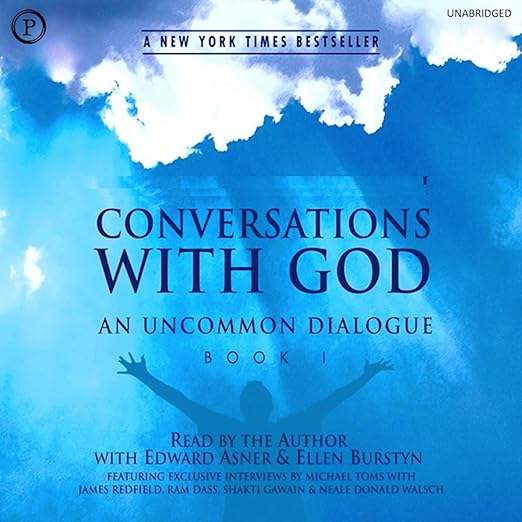
Three ratings sit behind the 4.6 average on this audiobook, and three whole-star votes cannot produce that figure: thirteen stars averages 4.3, fourteen averages 4.7, and nothing lands in between. Five written responses hang below the same counter. Whatever the badge is measuring on this record, it is not the three votes it claims. Edward Asner reads Neale Donald Walsch's dialogue for Phoenix Books across eight hours and twenty-four minutes, issued in August 2009.
The Verdict, Briefly
Premise first, since everything else follows from it. Walsch, deep in a period of depression in 1992, wrote an angry letter to God and reports that an answer came back. The book is the transcript of what followed. Read as literature it is a Socratic dialogue in which one participant is unavailable for interview. Read as devotional writing it is a permission slip. Either way, the form does the persuading: question, answer, follow-up question, for eight and a half hours.
That counter problem is worth restating because of what it costs a buyer. Five people have written responses on this page while the rating count reads three, so the number on the badge is not summarizing the column beneath it. Those five do not form a chorus either. Four are enthusiastic and one is scathing, and the scathing one is the most specific of the five. An average of 4.6 conceals that shape entirely.
Casting Edward Asner to read a dialogue in which one speaker is God was a decision with consequences, and Phoenix Books made it deliberately. The text alternates between a man's frustration and a voice that answers with total assurance, and one reader has to hold both without turning the second into a performance of divinity. Nothing about that assignment is neutral. A listener who finds the answering voice too intimate, or not intimate enough, will know inside the first chapter.
Why Conversations with God, Book I Works as an Audiobook
Four countries appear in a column of five, filed between 2005 and 2021 from the United States, France, Canada and India. Sixteen years and four marketplaces is unusual reach for a page holding this few entries, and it tells you something the star average cannot: the book keeps finding new readers, in different countries and different religious settings, decades after it first appeared.
Skeptics are the audience this book was built to convert, and a five-star from September 2012 describes exactly that process. Raised in the church, struggling to reconcile parts of that upbringing, wary of an author who claims God wrote through him, won over before the first chapter closed. That entry is candid about its own resistance, which makes it more useful than praise would be. The method throughout is to answer the objection you were about to raise.
Dialogue is the shape audio handles best, and this book is nothing else. No diagrams, no exercises, no chapter apparatus to flip back to, just two voices trading questions across eight hours. Anyone who has bounced off written spiritual philosophy because the page felt like homework may find the same material moves differently when it arrives as conversation, which is the form the author says it originally took.
Points to Consider
The one-star, filed from France in February 2021, is the most substantive criticism on the page and it deserves a hearing. It argues that the book assembles ordinary metaphysics, law-of-attraction thinking, borrowed reflections on death from Ms Kubler-Ross and introductory psychology, then dresses the result as revelation, with the framing device serving as a marketing move rather than a discovery. The entry breaks off mid-sentence while explaining the mechanism, and nothing in the description answers the charge.
The publisher's copy has itself come through damaged. One sentence states that the book offers a picture of the could be better, with words plainly missing from the middle, and the paragraph never recovers the thought. The record is also tagged Occult, which will mislead in both directions: readers hunting esoteric or ritual material will not find it here, and readers who would happily take this as devotional reading may pass on the strength of that one word.
Doctrinal readers should expect friction. The book asserts direct revelation and disagrees openly with a great deal of institutional teaching, and one enthusiastic entry opens by listing the accusations that have trailed it for decades: Satanic authorship, hoax, hostility to Christianity. Reporting those charges is not endorsing them. That a five-star review begins by fielding them tells you what sort of argument this book has always sat inside.
Who Should Pick Up Conversations with God, Book I
Seekers who have left an institution without leaving the questions are the natural audience, and a five-star from Canada puts it neatly: written for people wary of church but still interested in faith and knowledge rather than religious construction. Readers of the wider new-thought shelf will find the vocabulary familiar from the opening minutes. Anyone in a period of real difficulty, which is where the author says the whole thing began, is the reader it was written for.
Doctrinally committed listeners, and readers who need arguments to be sourced, should pass, because the book supplies neither citation nor caution. What it supplies instead gets described by a five-star from India as an experience of coming home, which is either the most accurate praise on the page or the precise reason to avoid it, depending on what you want from eight hours. The record will not settle that, and its badge certainly will not.
Before You Press Play
- Performance: One reader for a text that is pure dialogue and offers nowhere to hide, with the answering voice carrying the whole risk.
- What it covers: Direct revelation, doubt and depression, free will, religion set against personal faith
- Feel: Calm, assured and argumentative by turns
- Our call: A landmark of the new-thought shelf that will either open something up or set your teeth on edge, with very little in between.