Key Details
- Narration: Travis Baldree takes on six books of accumulated system machinery that a reader has to say out loud.
- Themes: Post-apocalyptic territory, loyalty valued over resources, guild and faction politics, relentless character progression.
- Mood: Busy, escalating, and comfortably familiar.
- Verdict: A dependable sixth entry for series readers and a closed door to everybody else.
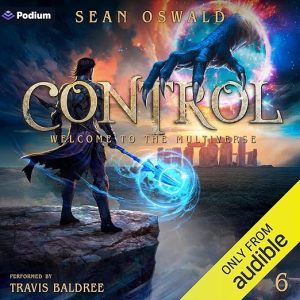
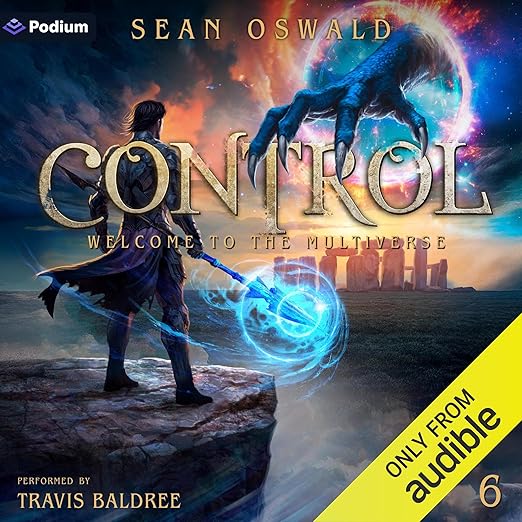
Book six of a LitRPG series is a commitment, and this audiobook makes no attempt to disguise that: fifteen hours and forty-four minutes, no recap, straight into a fight over a newly opened world. Control picks up after an apocalypse that has already arrived and an Earth that has already been inducted into something much larger, and the contest now is over who runs it. Multiple systems, sects, guilds and incursion parties are all aiming at the same rich resources. Silas wants something slightly different, which is the loyalty of the people, and he believes making Earth as strong as it can be matters more than holding ground. Travis Baldree reads it for Podium Audio.
A Closer Look at Control
By the sixth entry a series has either earned its bookkeeping or it has not, and the review pool says this one has. Fanatsyreader8223's five-star account explains the appeal with unusual honesty: what works is the simplicity. The main character fights, advances and gets bogged down with issues; a small subplot handles allies and corporations and a smaller one handles romance; but the majority of each book is the main character getting stronger, which that account states outright is the reason for reading the genre at all. That is a clean statement of the contract between this kind of series and its audience, and Control keeps to it without apologizing.
Counting is where the trouble starts. The listing reports 4.7 from three ratings, and five written reviews sit visibly underneath. Three is not merely a small sample, it is smaller than the number of people whose written opinions appear on the same page, so the score is ignoring the evidence printed below it. Those five reviews carry four fives and a four, which would produce a slightly different figure from the one shown. Nothing about that is arithmetically impossible, but the number is not describing what is there, and on a sixth book most people will buy on series loyalty regardless.
What Makes Control Worth Hearing
Progression is the whole contract of this genre, and Control delivers on it while doing something slightly more interesting alongside. The review from Florida712 describes stakes growing as a small planet starts attracting attention from much larger powers, a real balance between character development and raw progress, and sections that switch away from the main character and give genuine insight into the secondary cast. That last element is what separates a sixth book from a sixth grind. A series that can afford to leave its protagonist for a while has built enough world to be worth leaving him in, which is worth more than it sounds at book six, when the usual alternative is a hero grinding upward while everything behind him stands still. The same account mentions overlaps with two of Oswald's other series and a lot of puns, which is a specific pleasure for readers already inside the wider body of work.
Machinery is the other reason the format matters here. LitRPG runs on system output: notifications, stat blocks, class and skill descriptions, level thresholds, the arithmetic of getting measurably stronger. On the page those sit in boxes you can skim or study at your own speed. In audio they have to be spoken, in sequence, at the reading's pace, which is a genuine design constraint on a book of this length with six volumes of accumulated mechanics behind it. Travis Baldree has the credit, and how much of that machinery gets carried and how much becomes a wall of numbers is the real question the format poses on a title like this.
Things to Know Before Starting Control
Something in this entry lands badly for two of the five reviewers, and they identify different problems. Brent's four-star account loves the storyline and the adventure and finds the fights a bit long winded, then explains the missing star: the book makes all of humanity look incapable of using its head, an implausible response to an apocalypse, and on top of that the system creating incursions over the existing monster and dungeon spawning. The account from David C 1. is gentler and lands in a similar place, calling the story really good and just not as good as the last book. Two of five, then, place this entry below the series at its best.
Orientation is the other problem. A description for a sixth book that runs to roughly seventy words assumes you already know who Silas is, what the induction was, what an incursion party does and why systems, sects and guilds are all competing for the same ground. The series line says Welcome to the Multiverse and the number says six, and that is the entire briefing on offer. For a purchase of this length that is thin, and it is a common failing on deep series entries, where the publisher assumes every buyer is a returning one. The shelving under science fiction is loose too, since the machinery here is levelling and faction politics rather than technology of any kind.
Who Sean Oswald Is Writing For
Nobody five books deep needs persuading, and the reviews confirm as much. Manny, reviewing in October 2025, describes Sean Oswald knowing how to weave worlds together, praises the story, the interactions, the law and the fight scenes, and looks forward to following the protagonist as he weaves alliances and brings the world together, spelling that character Siles Renner while the description spells him Silas. The mismatch is minor and worth noticing anyway, because inconsistent character names are the sort of thing that makes tracking a long series across listings harder than it needs to be. The enthusiasm underneath it is entirely unambiguous, and it is the ordinary state of this readership.
Pass on it if you have not read the first five, because nothing here is built to catch you up, and pass on it if long combat sequences are the part you skim, since the fights in this entry run long enough to draw comment. Readers who want their apocalypse fiction to take human institutions seriously will find the crowd scenes thin, which is the sharpest criticism in the pool and a fair one. Readers who want a competent protagonist accumulating power inside a system that keeps expanding will find precisely that, at length, with the series' own bookkeeping intact and the wider multiverse still opening up. Six books in, that is a promise the series has kept more reliably than most of its shelf-mates manage by book three.
Questions Listeners Ask
Does this audiobook work as a first Sean Oswald book?
Not comfortably. Control is the sixth entry and its description runs to about seventy words, assuming you already know the protagonist, the induction of Earth and how incursion parties operate. No recap arrives at any point. Starting here means reconstructing five books of mechanics and relationships purely from context.
How do LitRPG stat blocks work in an audiobook?
They arrive as continuous speech at whatever pace the reading sets, where a printed page lets you glance at them or work through them at leisure. On a series six volumes deep, class descriptions, skill thresholds and system notifications all get said out loud. Some listeners find that immersive and some find it exhausting.
Are three ratings enough to judge this audiobook?
The listing reports an aggregate built from three ratings while displaying five written accounts, so the score is not counting the opinions printed beneath it. Those five visible reviews would produce a slightly higher figure. Read the written accounts and disregard the number on a listing this thin.