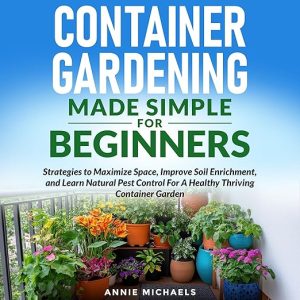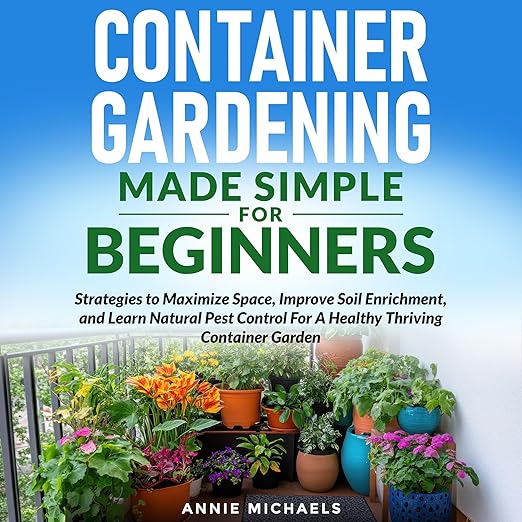
Container Gardening Made Simple for Beginners is the kind of audiobook that rewards very specific ambitions. Annie Michaels is not attempting to write a comprehensive horticultural reference; she is trying to solve a particular problem, which is the gap between wanting to grow things and knowing where to actually begin when your only outdoor space is a balcony or a single south-facing windowsill. As a solution to that problem, the book mostly succeeds, and it succeeds in part because it stays honest about what a listener can accomplish in under four hours of audio instruction.
The synopsis promises a lot: vertical and horizontal gardening strategies, plant guides for fruits, vegetables, and herbs, soil health, organic pest control, budget-friendly container ideas, self-watering systems, and layout planning. For a book that runs under four hours, this is an ambitious syllabus. Michaels handles the breadth by keeping each section genuinely actionable rather than comprehensive. You will not finish this audiobook knowing everything there is to know about any of these topics, but you will finish it knowing enough to make concrete decisions and take concrete steps.
Reviewer Jakob I, who described himself as a landscape architect with professional experience in in-ground vegetation, found the book useful precisely for its container-specific focus. That is a meaningful endorsement from someone who could reasonably be expected to find the material too introductory. The implication is that the book is not simply basic: it is targeted. Container gardening has its own logic, its own failure modes, and its own rhythms that differ enough from traditional gardening to warrant dedicated attention, and Michaels is consistently aware of that distinction throughout the text.
The emphasis on sustainability throughout is genuine rather than decorative. The budget-friendly section on repurposing containers and the recurring attention to organic pest control are part of a consistent orientation toward reducing environmental impact that runs through the whole production. For listeners coming to this from a green living angle rather than a pure gardening angle, that thread will feel satisfying rather than perfunctory.
Caster Avoids Clinical or Falsely Cheerful Tones
Curt Caster's narration handles the instructional content cleanly. How-to audiobooks can suffer when narrators make practical instructions feel either clinical or artificially enthusiastic, and Caster navigates that tension well. His tone is encouraging without being breathless, and the pacing leaves space for listeners to absorb information rather than racing through it. The result is a production that functions as genuine instruction rather than promotional content for the subject it covers.
The format suits the material particularly well for a specific type of listener: someone who wants to learn while doing something else. Reviewer Lisa G. noted that the book made gardening feel achievable for someone brand-new to it, which is the highest compliment a beginner's guide can receive. That sense of accessibility is partly a function of the writing and partly a function of hearing the information spoken rather than read, which reduces the intimidation factor of a subject that can feel technical when encountered on the page in isolation from context.
At 3 hours and 51 minutes, this is a genuinely compact listen. For an audiobook covering this range of material, that brevity is mostly an asset. The sections on self-watering containers and smart layouts are particular standouts, delivering practical specifics that listeners can act on immediately rather than in some hypothetical future well-prepared garden. The soil health discussion, while brief, explains the principles of container-specific growing medium selection in ways that prevent the most common beginner mistake of using ordinary garden soil in pots.
Firmly Beginner-Level, and Regionally Generic by Design
The book is explicitly positioned as a beginner's resource, and it holds to that positioning firmly. Listeners with existing gardening experience, particularly those who already grow in-ground, may find some sections cover ground they have already internalized. The soil health section, for instance, offers solid introductory principles but stops well short of the kind of depth that an experienced grower would find engaging. This is not a flaw; it is a positioning decision that serves the stated audience while creating a real ceiling for what the book can offer to more advanced gardeners.
There is also a regional caveat worth noting. Container gardening is highly location-dependent, and the book operates at a level of generality that will not always translate cleanly to specific climates or growing seasons. Advice about sunlight requirements, watering frequency, and seasonal timing will need to be adapted to your actual environment. Listeners in very short growing seasons or climates that fall outside temperate norms should treat specific recommendations as principles to adapt rather than instructions to follow precisely.
The downloadable PDF referenced in the audio for deduction planners and templates is a useful supplement for listeners who want to move from listening to planning. The companion materials include practical planning tools that extend what the audio can deliver. The book does not depend on the supplementary materials to make its core arguments, but accessing them before or after listening will help listeners bridge the gap between the information they have absorbed and the decisions they need to make.
Apartment Dwellers Over Advanced Container Growers
The primary audience is exactly who the title describes: people who are new to growing things and working with limited outdoor space. Apartment dwellers, urban renters, and anyone who has consistently felt that gardening requires more land than they have will find the book genuinely reassuring rather than overwhelming. Reviewer Russell W described it as a guide for anyone looking to dive into container gardening, and that wide framing is accurate.
Those who have already built a container garden and are looking for advanced technique, varietal-specific guidance, or deep horticultural theory should look elsewhere. This book's value is in reducing the activation energy required to begin, not in pushing the boundaries of what experienced growers know. Reviewer Jakob I's observation that the book inspired him to think differently about container applications even with professional landscape architecture experience suggests the material has some utility beyond its stated beginner audience, but the core promise is an accessible start. For the right listener, at the right moment, that is exactly what is needed.
Is this audiobook useful if you already have some gardening experience?
It depends on whether that experience includes container-specific growing. Reviewer Jakob I, a landscape architect whose work focuses on in-ground planting, found the book useful for its targeted container focus. If your experience is with traditional gardens rather than containers, the book may cover some useful ground. If you already grow in containers regularly, the introductory level may feel familiar.
Does this audiobook include enough detail to actually get started, or is it mainly motivational?
The balance leans toward practical. The book covers container selection, soil preparation, plant choices, watering systems, pest control, and layout planning with enough specificity that listeners can make real decisions. Reviewer Lisa G. described it as making gardening feel achievable for someone brand-new to it. The PDF companion materials referenced in the audio add additional planning tools for those who want them.
How climate-specific is the advice in this audiobook?
The book operates at a level of generality that applies broadly across temperate climates. Specific guidance on watering frequency, sunlight, and seasonal timing will need to be adapted to your location. Listeners in extreme climates or very short growing seasons should treat the recommendations as starting points rather than universal prescriptions.
At under 4 hours, does this audiobook cover enough ground to be worth the time?
For a beginner's guide, yes. The brevity is a feature: the book stays actionable rather than exhaustive, and reviewers consistently describe it as accessible without being superficial. Reviewer Lisa G. used the word comprehensive to describe what it covered. If you want advanced horticultural depth, you will need additional resources, but as a foundation for getting started, the runtime is well spent.