The Short Version
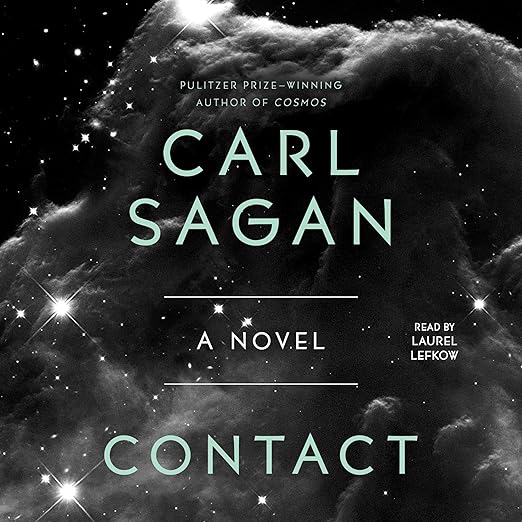
- Performance: Laurel Lefkow brings measured intelligence to Ellie Arroway, capturing the character's scientific rigor without sacrificing emotional depth.
- What it covers: Science versus faith, first contact, the loneliness of intellectual conviction
- Feel: Contemplative, expansive, and quietly awe-struck
- Our call: One of the rare science fiction novels that uses an alien contact scenario to interrogate the deepest questions about human meaning, and it holds up better in audio than most of its contemporaries.
I came to Contact late, having seen the Jodie Foster film in my teens and assumed I understood the book. Reading criticism in graduate school eventually disabused me of that assumption, Sagan's novel contains substantial sections the film could not accommodate, and the ending is genuinely different in ways that matter philosophically. I finally listened to the audiobook one winter, walking through a city that felt very small, and finished it in three days of commutes. The film is wonderful. The book is something else.
Carl Sagan published Contact in 1985, the same year SETI was a subject of serious Congressional debate. The novel is rooted in that specific cultural moment, yet its central questions have only grown more urgent: what would it mean to receive a message from an intelligence that has been watching us? How would human institutions, political, religious, scientific, respond to confirmation that we are not alone? And what would it ask of the person at the center of that discovery?
Ellie Arroway is one of the most fully realized scientist protagonists in American fiction. Sagan gives her a biography that shapes her epistemology: a father's early death, a childhood relationship with radio, a career built on patience and institutional resistance. Her skepticism is not coldness; it is the hard-won discipline of someone who has spent years distinguishing signal from noise. When the signal finally arrives, her response is not triumphant but careful, almost terrified of what it would mean to be wrong.
The novel's treatment of the science versus faith tension is more even-handed than the film's. Sagan had genuine respect for theological reasoning even as he disagreed with its conclusions, and that respect comes through in the character of Palmer Joss's equivalent in the book, whose arguments Ellie cannot always dismiss. One reviewer noted the book honors opposing thoughts and relations, which is an accurate description of how Sagan handles a debate that lesser writers collapse into easy sides.
What Works
Laurel Lefkow's narration is well-matched to the material. She does not dramatize Sagan's prose, which would be a mistake; the writing has its own cadence and rhetorical weight, and she allows it to move at its own speed. Her Ellie is intelligent without being cold, curious without being naively optimistic. The radio astronomy sequences, which one reviewer noted require real patience to appreciate, are delivered with enough clarity that non-specialist listeners can follow without losing the emotional thread.
What the audiobook format does particularly well with Contact is sustaining the novel's contemplative rhythm. Sagan is not a thriller writer; the tension here is intellectual and existential rather than plot-driven. Listening rather than reading makes it easier to surrender to that pace, and Lefkow's even, thoughtful delivery rewards that surrender.
Before You Commit to Contact
The novel's pacing is genuinely slow in sections. Reviewers have noted this directly, and it is worth acknowledging: Sagan is interested in the geopolitical, institutional, and philosophical weight of the contact event, not just the event itself. The Machine's construction takes up a substantial portion of the narrative, and the debates around whether to build it are rendered in granular detail. Listeners expecting a fast-moving science fiction plot will find this more demanding than they anticipate.
The ending is also more ambiguous than the film suggests, and deliberately so. What Ellie experiences, what she is able to prove, and what she is able to believe exist in productive tension that Sagan refuses to resolve. Some listeners find this unsatisfying. I find it the most honest conclusion the novel could have reached.
Who It's For
Contact is for listeners who want science fiction that genuinely grapples with the implications of its premise rather than using the premise as a backdrop for action. It rewards those with some patience for institutional and geopolitical texture, the novel's portrait of international scientific collaboration and Cold War-era mistrust is rich and specific. Anyone coming for fast plot should look elsewhere. Anyone willing to sit with the question of what a message from the cosmos would actually ask of us will find this essential.
Good to Know
How different is the audiobook from the Jodie Foster film?
Substantially. The book includes extended political and institutional sequences the film compressed, the romantic subplot is handled differently, and the ending, including what Ellie discovers and cannot prove, is more philosophically unresolved than the film's version.
Do you need a science background to follow the radio astronomy concepts?
No. Sagan was a lifelong science communicator, and the concepts are explained with clarity accessible to non-specialists. One reviewer with amateur astronomy experience noted learning genuine tidbits about radio astronomy from the novel.
Does Laurel Lefkow's narration work for a first-person female protagonist who is a scientist?
Yes, with reservations. Lefkow captures Ellie's intellectual rigor and emotional restraint well. The narration is strongest in the contemplative sequences and occasionally flattens in the more urgent plot moments, but overall it is a good match for the material.