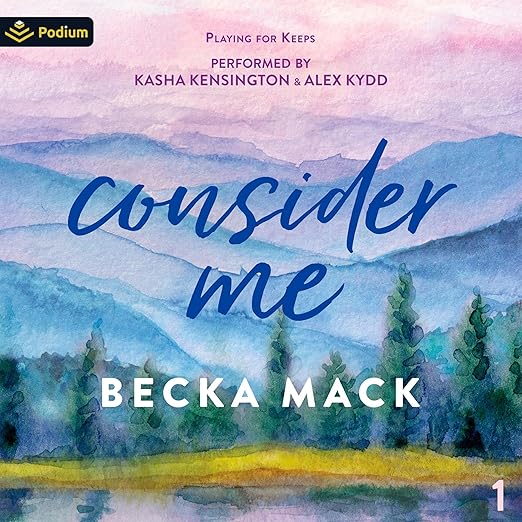
- Voice: Kasha Kensington holds the only voice credit on this record, for a first-person romance whose readers keep praising the size of its cast.
- Big ideas: Bad-boy athlete meets the one person with a rule against him, guarded-heroine resistance, ensemble friendship, frank adult heat.
- Atmosphere: Loud, funny, unhurried, and open about sex.
- Worth it?: Worth the commitment if you want a world to live in rather than a plot to finish; look elsewhere for something tight and closed-door.
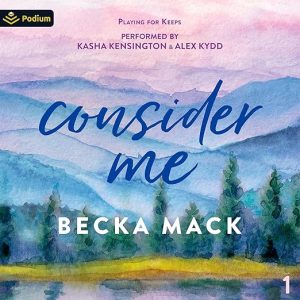
How long should a romantic comedy keep you before the season starts outlasting the story? Podium Audio's edition of Consider Me runs twenty hours and forty-two minutes, roughly double what the genre usually asks and longer than most literary novels sharing its shelf. Becka Mack opens the audiobook in the heroine's own voice, cataloging everything wrong with Carter Beckett, the NHL bad boy who has had everything served to him on a silver platter and who knows precisely how good he looks holding the plate. The premise is familiar. What Mack does with the scale is not.
How Consider Me Holds Up
Two things become clear inside the first stretch. The description tells the truth about its register: this is a book that writes the phrase wrap it before you tap it into its own sales copy, so the comic key is set before you press play. The second is that Mack has no interest in hurrying. The heroine's refusal is the plot for a long while, and the stated preference for a solution kept in a drawer at home gets played for laughs rather than for tension. Patience is the price of admission, and the copy never pretends otherwise.
What that patience buys shows up in the response filed in late September 2022, a five-star that argues most romance characters work as vehicles for the reader and that this cast does not. That entry describes forming distinct relationships with each of them, naming Olivia as the grounded half of the pairing and Carter as a walking laugh-out-loud moment. It is a specific claim about ensemble writing rather than a general rave, and it explains where the length goes: into a group of people rather than into one couple's obstacle course.
Scale also sets the risk. A romance that spends its opening act on refusal has to pay that off with something other than surrender, and Mack's copy promises exactly the reversal it needs: the bricks come down one by one until Carter is the one begging, for time, for trust, for a single chance. Whether the back half earns that turn is the question every listener answers privately. The shape, at least, is honest about itself. Nothing here pretends to be a tidy story about two people who fix each other in an afternoon.
Why Consider Me Works as an Audiobook
Comedy is the strongest reason. The jokes sit in the rhythm of the sentences instead of arriving as set pieces, and the heroine's running commentary on Carter's confidence is what powers the early chapters. Hockey is the frame rather than the subject: the description sells him as the league's resident bad boy, top player on the ice and in the bedroom, which tells you the sport exists to make him famous and watched, not to make you study it. Sports-romance skeptics have less to fear here than the cover category suggests.
Enthusiasm in this column runs high and stays specific. A five-star filed from Brazil in May 2023 keeps its whole verdict to four fragments: Carter is the love of my life, cutest romance, totally had me hooked, please read it. That is the register of the page as a whole, attachment rather than analysis, and it is worth reading as data. Books that produce this kind of response tend to produce it through character time, which is the one resource a twenty-hour romance has in abundance.
Series placement has a clean answer from the publisher and a quieter one from the column. Consider Me is the first book in Playing For Keeps, and the copy states directly that it can be listened to as a standalone. The only entry that speaks to continuing is a four-star filed from the United Arab Emirates in March 2025, three words long: love this series. A book that works alone while being built to sell the next one is a fair account of what the record offers.
Weak Spots in Consider Me
The most useful pushback on the page is a four-star from February 2023, and it arrives with a tell. Its objection is that Carter and Olivia spend the opening constantly vying for the upper hand in what it calls a relationship or non-relationship, and that adult relationships are not supposed to work that way. Its other remark is that the page length looked intimidating because reading strains the eyes. That complaint belongs to a printed book, and it sets the terms for the rest: what these responses grade is the story and the cast.
Canada supplies the oddest artifact in the column. A November 2024 response pastes a favorite line from the book in a decorative alphabet that no recording could reproduce, and its closing sentence breaks off mid-word while naming the team Carter captains. The column as a whole reaches well beyond the United States, which is a wider spread than a debut romance usually shows on an American listing. Small artifacts, but together they describe a page assembled around a print edition's audience rather than around this file.
Heat is stated rather than implied. The description calls this a mature hockey romance with lots of heat, swoon and laughs, and the line about a drawer at home is not a metaphor. Nothing on the record marks where the explicit scenes fall, which makes speaker listening a gamble across something this size. Anyone who prefers closed-door romance should read the last line of the description twice before buying, because it is the closest thing to a content note the page provides.
The Right Listener for Consider Me
Buy this if you want somewhere to stay rather than something to finish. It suits romance readers who like their leads loud, their casts crowded and their timelines generous; listeners who want an athlete hero for the celebrity problem he creates and not for the play-by-play; and anyone who enjoys a heroine who spends a very long time saying no and means it every single time. Mack's premise rewards the people who settle in for the whole run.
Skip it if your listening happens in short scraps, because a file this large rewards continuity and punishes a stop-start schedule. Skip it if explicit content is a problem, since the copy promises it without marking it. And skip it if you want two leads behaving like adults from chapter one, because the early jockeying is a feature of the design and the opening act runs a long while on it. Preference here is not a flaw in the writing, and pretending otherwise wastes your credit.
What the page settles and what it leaves open are easy to separate. Settled: the register, the heat level, the series position, and one credited reader for the whole cast. Open: whether the back half converts all that resistance into something you believe, and whether a recording suits a book whose comedy lives in timing. The sample answers the second question quickly. The first one takes the entire file, which is either the problem with Consider Me or the whole point of it.
A Few Questions About Consider Me
Does the Consider Me audiobook work if I have never read a hockey romance before?
Yes. The description sells Carter Beckett as the league's resident bad boy rather than as a technical study, and the sport is there to explain why he is famous and constantly watched. What the book asks patience for is the couple, not the rulebook, and no prior series reading is assumed anywhere on the record.
Is Consider Me explicit, and does the audiobook mark where the heat falls?
The publisher's own line calls it a mature hockey romance with lots of heat, swoon and laughs, so explicit content is promised rather than hinted. Nothing on the record flags chapters or timestamps for those scenes, which makes shared-speaker listening a gamble. Headphones are the safe default across a file this large.
Do I need the rest of Playing For Keeps to follow this one?
No. The copy states that Consider Me opens the Playing For Keeps series and can be listened to as a standalone, and the numbering on the record puts it first. Order only becomes a question after the last chapter, since the series numbering points forward rather than back.