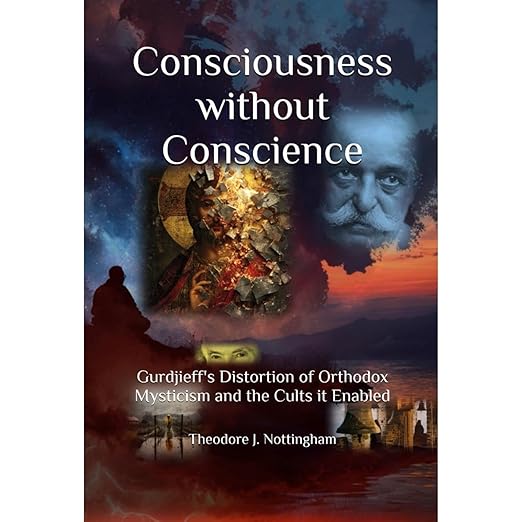
Deathbed sentences make poor thesis statements, but this audiobook opens with one and then spends nearly eighteen hours arguing that it was accurate. George Gurdjieff, dying in 1949, told his students he was leaving them in a fine mess. Theodore Nottingham takes that line at face value and constructs a book around what the mess actually consists of: contemplative practices lifted out of Orthodox Christianity, stripped of safeguards that two millennia had attached to them, and handed to Western students as technique. The argument is specific, anchored to a named tradition, and a good deal angrier than the calm title would lead anyone to expect. Nottingham is not writing about one bad teacher. The claim concerns a structural fault introduced at the moment of transmission, which is a far more serious charge to bring.
Theodore Nottingham writes from three positions at once, and the description states all three plainly: a former member of the Fellowship of Friends, a Fourth Way teacher of forty years, and a scholar of Orthodox mysticism. That combination is what makes the book unusual. Insider accounts of spiritual movements are common enough. Theological diagnoses of why a movement failed are rare, and rarer still from someone who remained inside the broader tradition afterward instead of renouncing it wholesale. This is not an exit narrative. It is an argument that the practices themselves were sound and the transmission was not, which is a considerably harder case to build and sustain.
The Fellowship of Friends supplies the case study, and the description does not soften it: Robert Burton, presented in that copy as a conscious teacher, accused of sexually exploiting hundreds of men across fifty-five years. Nottingham's use of that history is structural rather than sensational. The claim is that a system which turns conscience into a buried function and exempts teachers from moral accountability will produce this outcome eventually, not accidentally. Whether or not you accept the theology underneath it, the mechanism described stays legible: remove the checks, retain the techniques, and the result becomes predictable enough to diagnose before it happens rather than after. That predictive framing is the book's real ambition, and it is what lifts the material above the usual arc of an insider account.
What Makes Consciousness without Conscience Worth Hearing
Orthodox contemplative practice is the standard everything gets measured against, and four named losses give the book its spine. Grace becomes technique. Love becomes secondary to will. Conscience becomes a buried function. Teachers become exempt from moral accountability. Each is a small doctrinal adjustment with an enormous institutional consequence, and setting them out in sequence is the most useful work the book does. A listener with no stake in either tradition can still follow the reasoning, because the underlying question is not really about doctrine. It is about what happens to any practice once the conditions that made it safe have been quietly removed.
Robert Burton's fifty-five years supply the evidence, but the target is broader than one man or one group. The description's own phrase for the endpoint is spiritual criminals, and the book is written to route people somewhere else entirely: toward complete traditions where contemplative practice still carries its protections intact. That prescriptive turn is what separates this from an expose. Nearly eighteen hours is a long time to spend on a diagnosis, and the length only justifies itself for a listener who wants the theological argument rather than the scandal attached to it. The scandal alone could be told in under an hour. What takes eighteen is the case for why the safeguards existed at all, and that portion does not compress without the argument collapsing.
Things to Know Before Starting Consciousness without Conscience
No ratings, no rating count, and no responses appear anywhere on this listing. For a March 2026 release that is unremarkable on its own, but the practical consequence is that a buyer has nothing external to check the publisher's description against, and the description is doing an enormous amount of work. It makes serious allegations about a named individual. It asserts the author's credentials without any third party confirming them. It frames a contested lineage in terms its own adherents would dispute at length. None of that makes the book wrong. It does mean you are buying an argument that nothing on the page corroborates.
Virtual Voice is the credited reader, meaning a synthetic narration, and on a text like this one the choice carries consequences. The book quotes French, moves through specialized theological vocabulary, and depends on emphasis to separate a term being used from the same term being criticized. Machine reading handles none of that reliably, and nearly eighteen hours represents the longest plausible exposure to a voice with no interpretive judgment behind it. Sample it before committing, because the gap between a synthetic reading that fades into the background and one that grates from the first paragraph is entirely a matter of individual tolerance. No description substitutes for hearing thirty seconds of it, and on a title this long that decision should not be made blind.
Who Theodore Nottingham Is Writing For
Seekers who have spent time inside a teaching group and left with unresolved questions are the readers this was built for, and it treats them as capable of following theological argument rather than as people needing consolation. It should also interest anyone studying how movements institutionalize harm, since the mechanism laid out here generalizes well past a single Fellowship. Readers of Gurdjieff hoping for a sympathetic account should know in advance that this is not one. The framing positions the entire Western transmission as a distortion, and the remedies arrive as the grandson's corrections foreshadowed in Beelzebub's Tales to His Grandson.
One caution before committing eighteen hours: this is a polemic with citations rather than a neutral history, and it is candid about being one. Stay away if what you want is a balanced survey of the Fourth Way, or if serious allegations against a named individual, reaching you through a publisher's description rather than an independent source, trouble you as the foundation for a case study. Stay with it if the question of what makes a contemplative practice safe interests you more than the personalities caught up in it, because on that specific question the book is genuinely rigorous and unusually well positioned. Few writers on this subject can claim both the inside experience and the doctrinal training, and that combination is what you are paying for.
In Brief
- Big ideas: Contemplative practice severed from its safeguards, institutional abuse inside spiritual movements, conscience treated as a doctrinal category.
- Atmosphere: Cold, argumentative, and unhurried, closer to a theological brief than to a memoir.
- Worth it?: Rigorous on the mechanism of spiritual harm, but you are buying an unverified argument from a listing with no responses at all.
Common Questions
Who reads the Consciousness without Conscience audiobook?
The narrator field says Virtual Voice, which means a synthetic reading rather than a human performance. No human narrator is credited anywhere in the record. Across seventeen hours and fifty-six minutes of specialized theological vocabulary that is a significant production factor, so sample the file first.
Does the listing show any ratings or reviews?
None at all. Every score field on the page is blank and no responses have been posted, which is ordinary for a March 1, 2026 release from a small publisher. It also means nothing on the page independently corroborates the claims the description makes about people or events.
How long is the audiobook and who published it?
Seventeen hours and fifty-six minutes, issued by Theosis Books on March 1, 2026. That is substantial for a work of theological criticism, and the length reflects a sustained argument rather than a narrative, so it suits sectioned listening far better than a single stretch.
Is prior knowledge of Gurdjieff or the Fourth Way needed?
Helpful, though not assumed. The description sets out the central claim plainly, that contemplative practices reached the West without their safeguards, and builds from there. A newcomer can follow the reasoning, but the case study will land harder for anyone already familiar with the movement.