In Brief
- Read by: Kevin H. Siepel narrates his own work with the quiet authority of a historian who has spent years inside these primary sources, adding texture that a hired voice would struggle to replicate.
- At its heart: Colonial encounter and violence, first-person historical witness, Native American life and survival.
- Vibe: Scholarly yet absorbing, documentary in approach.
- Short version: A richly sourced audio history of Pizarro, Cabeza de Vaca, and De Soto that treats the conquest as something to understand rather than simply to judge.
Siepel Treats the Primary Source as Evidence
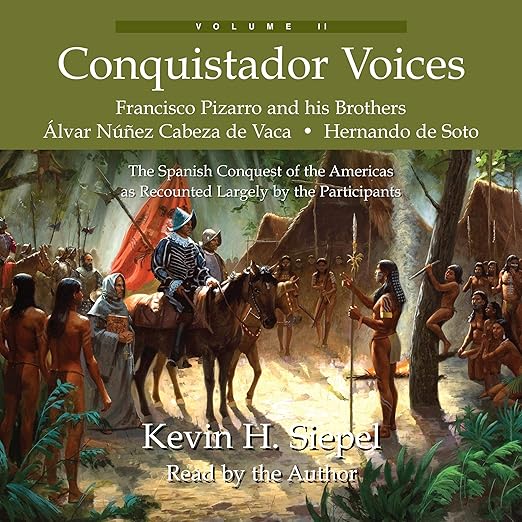
Kevin H. Siepel's method in Conquistador Voices: The Spanish Conquest of the Americas as Recounted Largely by the Participants, Volume II is deceptively simple: let the people who were there do most of the talking. This audiobook, narrated by Siepel himself across nearly fifteen hours, covers three of the most consequential episodes in the Spanish conquest of the Americas: Francisco Pizarro's subjugation of Peru, Alvar Nunez Cabeza de Vaca's eight-year odyssey across the North American continent, and Hernando de Soto's massive and ultimately catastrophic North American expedition. Each figure is treated as a historical subject rather than a symbol, and the primary-source material Siepel has assembled gives the narrative a texture that most popular histories of the conquest do not approach.
The self-narration here is not incidental to the book's effect. Siepel has spent years with these accounts, and that intimacy shows in how he reads. Where a hired voice actor might approach the primary source quotations as performance, Siepel treats them as evidence, reading with the measured precision of someone who has weighed each word's historical freight. One reviewer described finding it difficult to tear themselves away from the narrative, and that quality of sustained engagement across a fourteen-hour runtime is genuinely difficult to achieve with history writing of any kind.
From Shipwrecked Soldier to Something Like a Healer
The subtitle's phrase, recounted largely by the participants, is the key to what distinguishes this book. Siepel is working in a documentary tradition, assembling first-person accounts the way a filmmaker assembles archival footage, and then providing the connective tissue of context, geography, and consequence without letting his own interpretive voice crowd out the participants themselves. The result is a history that feels earned rather than argued. You come away from the chapters on Pizarro having heard what the participants themselves recorded about what they were doing and why, which is a radically different experience from reading a modern historian's reconstruction of their motives from a comfortable analytical distance.
Cabeza de Vaca's section is perhaps the most remarkable portion of Volume II. The eight-year odyssey, which began with a shipwreck on the Gulf Coast and ended with Cabeza de Vaca walking into a Spanish settlement in Mexico having crossed most of the North American continent on foot, is a survival story of extraordinary strangeness. Siepel's treatment draws heavily on Cabeza de Vaca's own Relacion, and the result is a sequence that reads almost like literary nonfiction, anchored in primary source material but moving with real narrative momentum. The transformation Cabeza de Vaca underwent during those years, from shipwrecked soldier to something closer to a healer living among Indigenous peoples, is rendered with the ambiguity and complexity it deserves.
De Soto's Expedition as the Necessary Counterweight
The De Soto section provides a necessary counterweight. Where Cabeza de Vaca's journey became something transformative, De Soto's expedition was a brutal, sprawling failure that left thousands dead on both sides and resolved nothing. Siepel does not moralize excessively, but the structural contrast between the two narratives makes its own argument about the range of human experience contained within the single phrase, the Spanish conquest of the Americas.
Leaving the Moralizing to the Listener
Siepel's explicit intent, stated in the synopsis, is to treat the conquest as an historical event worth learning about for its own sake, with most of the moralizing left to the listener. This is a conscious methodological choice and not everyone will find it satisfying. Readers who want a history that foregrounds Indigenous perspectives and colonial critique as its organizing principle will find Siepel's documentary neutrality frustrating. The book does get deeply into details of Native American life across all three narratives, and it does not sanitize the violence. But it approaches that material as historical record rather than as ongoing moral reckoning, and that distinction matters to different readers differently.
The nearly fifteen-hour runtime requires real commitment and rewards sustained attention. This is not a book you can dip in and out of casually. The three narratives are internally sequential, and the level of historical detail, particularly in the Peru section covering Pizarro's campaign, benefits from the kind of listening that allows context to accumulate. Treating this as an extended audio documentary, returning to it over several weeks, will yield far more than attempting to consume it in one or two intensive sessions.
Rigorous Material Delivered With Restraint
This audiobook will appeal most strongly to history enthusiasts who want engagement with primary sources rather than popularized narrative, drive-time learners willing to invest in a genuinely substantial historical work, and listeners who have specific interest in the conquest of Peru, the Cabeza de Vaca odyssey, or the De Soto expedition. The book works as a standalone volume, though Volume I's coverage of Columbus and Cortes provides useful context if you have not already encountered it. Those who work through both volumes will have a substantially more nuanced view of this period than a conventional school curriculum provides.
Skip it if you want history presented with overt moral framing or if fifteen hours of documentary-style narration feels too demanding. This is rigorous material delivered with restraint, and its rewards are proportional to the patience you bring to it.
A Few Questions About Conquistador Voices
Do I need to listen to Volume I of Conquistador Voices before this audiobook?
Volume II stands on its own. It covers three entirely separate figures from Volume I's Columbus and Cortes narratives. Prior listening adds context but is not required to follow the Pizarro, Cabeza de Vaca, and De Soto stories from beginning to end.
Is the self-narration by Kevin H. Siepel an asset or a liability for this audiobook?
For most listeners, a clear asset. Siepel's deep familiarity with the material gives his narration an authority and precision that works particularly well for the primary source quotations. It is not a performance voice, but it is a credible and engaging scholarly voice.
Does this audiobook address Native American perspectives, or is it exclusively focused on the Spanish participants?
Both perspectives are present. Siepel explicitly notes that both volumes get deeply into details of Native American life in those times, and the primary source material includes accounts from Indigenous witnesses and participants alongside the Spanish conquistadors.