The Short Version
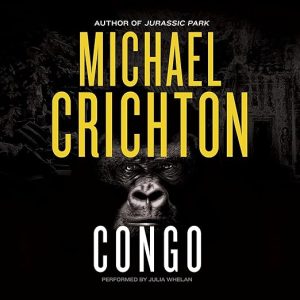
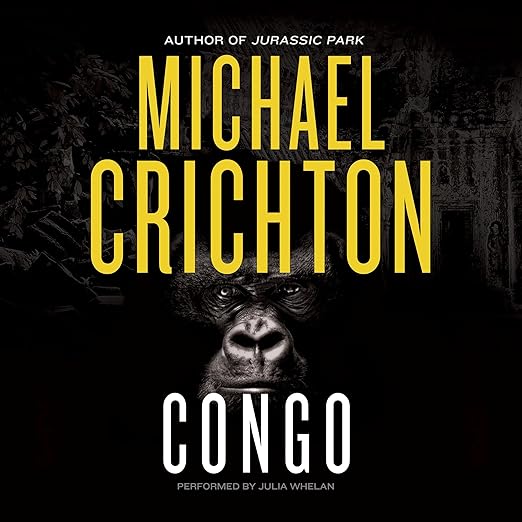
- Read by: A signing gorilla has to stay distinguishable from every speaking character by voice alone, and Julia Whelan holds the sole credit for managing it.
- At its heart: Primate language and sign fluency, a lost-city expedition, hard science exposition inside a thriller frame.
- Vibe: Methodical, briefed, then suddenly violent.
- Short version: Buy it for Amy and the sign-language material, and expect the science briefings to keep interrupting the chase.
Amy signs six hundred twenty distinct gestures, finger paints for pleasure, and has lately turned erratic. What she draws, according to the publisher's own description, matches a drawing of an ancient lost city inside a Portuguese print from 1642. Most thrillers open on a corpse. This audiobook opens on a gorilla whose artwork has started agreeing with a seventeenth-century book, and everything that follows is built out of the distance between those two facts. That distance is also why the recording is a harder assignment than the plot summary suggests.
Eight American geologists die within minutes of one another near the ruins the description calls the Lost City of Zinj. Ten thousand miles away, Karen Ross watches the video transmission arrive: a flattened camp, torn tents, gear strewn through mud beside the dead, and one thing still moving in the frame that the copy calls "a grainy, dark, man-shaped blur." That image is the engine of the novel. Everything else, the primatology, the logistics, the secret world the team walks into, exists to get somebody back to that frame.
The five written responses here disagree about exactly one thing, and it is the thing that decides whether the audio edition suits you. A five-star notice praises Crichton for "making the implausible feel utterly real," concedes that some readers will be put off by his "spewing of explanations mid action," and then says plainly that those same explanations are what makes the book engrossing. The complaint and the compliment turn out to be one observation, split down the middle by taste.
A three-star response reaches the opposite conclusion from the same starting point, objecting that the book "kept switching in and out of the story to explain a back story or give an in-depth explanation" and wanting more of the story instead. On paper you can move your eye quickly across a technical digression. A recording removes that option, and this novel carries a great many of them. Worth flagging too that the listing files a hard techno-thriller under a fantasy label, the least useful description of it available.
What Michael Crichton Gets Right
Julia Whelan is the reader on this recording, and the most interesting thing about the assignment is that one of the book's central characters never speaks aloud. Amy communicates in sign. A printed page has typography to work with and can mark her lines as categorically different from spoken dialogue without announcing it. A recording has only a voice, and it has to land that distinction every time Amy answers a question, without turning her into a cartoon or flattening her into one more member of the team.
One five-star response spends most of its length on Amy rather than on any of the humans, describing a young female gorilla orphaned in the wild and raised in a laboratory from infancy, taught to sign by Peter the researcher, and able, as that reviewer puts it with deliberate quotation marks around the verb, to speak fluently. Those marks are the reviewer's rather than mine, and they carry the whole argument of the novel inside one piece of punctuation. An audio edition has to decide what they sound like.
Another five-star notice comes from a reader who reports having read most of Crichton's books and seen every film made from them, watched the Congo adaptation without reading the novel first, and only came round to the film's critics after finishing the book. A four-star notice travels the opposite road: it enjoyed the film thoroughly, then read the novel, and felt "somewhat cheated" at a point where the review text on this page cuts off mid-word and never explains by what. The adaptation comes off badly in the first account; the second leaves the target of its disappointment genuinely unresolved.
Where Michael Crichton Loses Some Ground
Four. That is the figure the rating counter shows on this page, sitting directly underneath five separate written responses. A title cannot hold fewer scores than it holds reviews unless the two numbers are counting different populations, which is plainly what has happened here, so the 4.3 average is not describing the pool you can actually read. The written responses stretch from March 2007 to February 2026, close to nineteen years of readers arriving by different routes, which tells you far more than an average built on four data points.
None of those five responses says a word about the recording. Every one of them grades the writing, the research, or the film adaptation. The oldest was filed more than eight years before this audio edition existed, so it could not have been about a performance; the newest landed in February 2026 and still is not. Whatever you conclude about Whelan's reading, you will be concluding it from a sample rather than a consensus, which is a genuinely different purchase from the one the star rating implies.
Dated language is the other thing worth knowing in advance. A five-star reviewer notes that the writing is dated in places, offers the novel's use of "Orientals" for Asians as the specific example, and concludes that it does not diminish the narrative at all. That reader is probably right about the narrative. The point still stands that a recording gives you no way past a phrase like that quickly. It arrives at conversational speed, occupies its whole sentence, and the story carries on without acknowledging it.
Who Should Pick Up Congo
Crichton readers who have somehow never got to this one are the obvious buyers, and so is anyone who met the story through the film and now wants to know what the adaptation left on the floor. Two of the five written responses arrived by precisely that route, though only one of them says outright which format it preferred. The primate-language material is the strongest thing here, more interesting than the expedition plot it is bolted to, and it holds up even when the jungle sequences behave predictably.
Appetite for hard-science exposition inside genre fiction is the real prerequisite. This is a novel that halts to explain how something works and then resumes, over and over, and a listener who finds that pleasurable rather than obstructive is effectively buying a different book from the one the three-star reviewer describes. Just over ten hours is a manageable commitment for a story carrying this much apparatus, which helps explain why the structure survives the format at all.
Skip it if technical digressions read to you as obstacles rather than pleasures, since the three-star response is an honest preview and the format makes those passages harder to escape than on the page. Skip it too if period vocabulary in adventure fiction is a dealbreaker, because at least one reviewer met it and thought it worth naming. Amy is the reason to be here, to my mind, and she is more than reason enough.
Frequently Asked Questions
Does the Congo audiobook work if I only know the film?
Two of the five written responses came to the novel that way. One had enjoyed the film thoroughly, then read the book, and the review text cuts off before saying what disappointed it. The other had seen the film first and only sided with its critics after finishing the novel. Neither mentions the recording, and only one says outright which format it preferred.
How much of this audiobook is scientific explanation rather than plot?
Nobody supplies a percentage, but two of the five reviewers independently single out the explanatory passages as the book's defining feature. One finds them engrossing. Another objects that the story kept breaking off to deliver them, particularly toward the end. At just over ten hours, they are frequent enough that both readers noticed without prompting.
Is Amy the gorilla a major character or a gimmick?
She is central to the premise. The publisher's description credits her with a vocabulary of six hundred twenty signs, which it calls "the most ever learned by a primate," and it is her drawings matching a 1642 Portuguese print that sets the whole expedition moving. One five-star reviewer gave most of a review to her rather than to any human.