In Brief
- Read by: Greg Bond is credited as reader, and with no written listener feedback on file the performance is untested; acronym-dense material makes clarity the thing to judge.
- At its heart: five SY0-701 exam domains, understanding over memorization, study efficiency for working adults, exam-day strategy
- Vibe: Brisk, plain-spoken and unglamorous
- Short version: A sound conceptual foundation and a good final-week review, but only a fraction of the advertised study package arrives as audio.
Treat this audiobook as the spoken half of a study kit rather than as the kit itself, and it becomes genuinely useful. Read the contents list carefully and you will see why the distinction matters: most of what PrepCore Guides is advertising here does not arrive as audio at all, and knowing that before you buy is the difference between a smart purchase and a disappointed one.
Thirteen Chapters Averaging Twenty Minutes Each
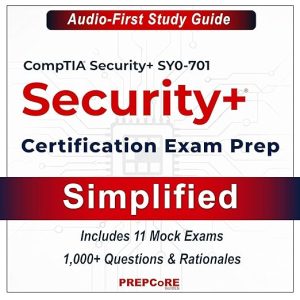
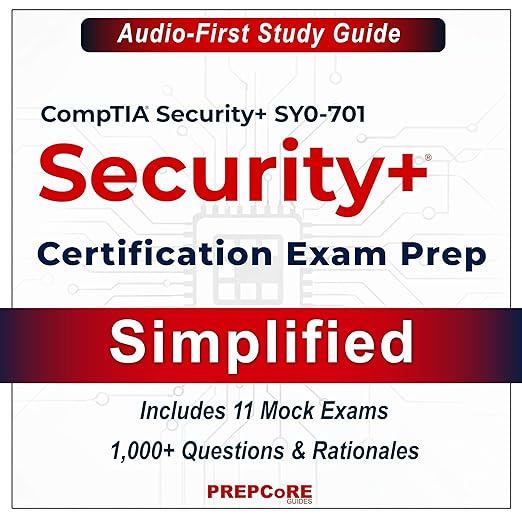
Compression is the entire proposition. The opening line of the description is blunt about it: "Most Security+ study guides run to eight hundred pages or more. This one was designed to respect your schedule." What you get instead is four hours and twenty-eight minutes across thirteen chapters, covering all five SY0-701 domains, which are listed as "general security concepts, threats and vulnerabilities, security architecture, security operations, and program management". Do the arithmetic and each chapter averages around twenty minutes, each domain under an hour. That is a real constraint, and it dictates everything about the book's approach.
The structure is sensibly built for that constraint. Part one lays a foundation, part two walks each domain with scenarios and practice questions, part three is described as "a high-yield rapid review designed for your final days of preparation", and part four is given over to exam strategy, the traps that catch people, and a plan for the day itself. That last third is where a short audio format earns its keep, because strategy and pacing advice genuinely does transfer to listening in a way that memorizing port numbers does not. The material is pitched at people without a technical background, and the description promises grounding in "SOC workflows, phishing scenarios, incident response decisions".
When You Understand Why, Answers Follow
PrepCore Guides make one argument that separates this from the standard certification shelf, and it is an argument about why rather than what. The description puts it directly: "When you understand the why behind a concept, the exam question answers itself." That is the correct instinct for an audio product. Nobody is going to absorb an acronym glossary through headphones, but the reasoning behind an incident response decision, or why a particular control exists at all, is exactly the kind of material that survives being heard rather than read. The chapters are described as grounded in real security practice rather than in exam trivia, and if the execution matches the description, four and a half hours of conceptual scaffolding is a sound investment before you start drilling questions.
Pause, Answer Out Loud, Then Check
The other advantage is repetition without cost. A four-and-a-half-hour program can be run through three times in the fortnight before an exam, which is not true of an eight-hundred-page textbook, and the final-days rapid review section is clearly designed with exactly that pattern in mind. Career switchers and working IT staff, who the description names as the target audience, tend to be studying in fragments around a job. A format that fits into those fragments and can be repeated at no extra effort is a legitimate advantage over a thicker, better-known guide that never gets opened past chapter four.
One feature of the chapters deserves more attention than the contents list gives it. The thirteen chapters are described as carrying "selected exam-style questions and detailed rationales", which means a portion of the audio is a question read aloud followed by an explanation of why the right answer is right. That format works considerably better through headphones than a written question bank does, because the rationale is the valuable part and hearing it argued through is closer to being taught than to being tested. It also gives you a way to use the audio actively: pause after the question, commit to an answer out loud, then let the explanation confirm or correct you. Done that way, the passive-listening objection loses most of its force.
Bond's Reading Has No Written Comments
Look closely at what is actually in the audio and what is not. The advertised package includes "11 full-length mock exams" with over 990 practice questions, "500 digital flashcards", a companion quick-reference document covering the CIA Triad, the incident response lifecycle, risk treatments, cryptography and high-yield ports, plus an acronym glossary, a domain alignment map and access instructions delivered by QR code. Not one of those things is something you can listen to. They come as an accompanying file alongside the audio, and using them requires a screen, a printer or a browser. So the honest accounting is this: the audio is thirteen chapters of explanation, and the majority of the advertised study value sits in material you will consume with your eyes.
Two further cautions. The first concerns the recording itself. This title is only a few months old, and while it carries a small number of ratings, nobody has left a written comment about it at all, which means Greg Bond's reading is entirely unassessed by listeners. Dense certification material puts specific demands on a reader, particularly around acronyms, numbered port references and lists that have to stay distinguishable by ear, and I have no evidence either way about how those demands are met here. The second is about the format itself. Performance-heavy exam preparation rewards active recall, and passive listening is the least active form of study available. This works as the layer that builds understanding, and it will not on its own get you through a question bank.
Two Groups Get Real Value Here
Two groups get real value here. The first is the career switcher the description names, someone entering cybersecurity from outside who needs the conceptual map before the details mean anything, and for whom an eight-hundred-page reference is genuinely intimidating. The second is the working IT professional who already knows most of this in practice and needs the exam's vocabulary and structure rather than the underlying ideas. Both of those people study in gaps, and both benefit from something they can replay.
It is a poor fit if you want a single complete resource. The description is explicit that this sits alongside mock exams, flashcards and a reference file, and buying the audio in isolation gets you a quarter of the advertised program. It is also a poor fit if you are already confident with the concepts and need drilling, since a linear recording cannot test you. My honest recommendation is to use this early in a study cycle to build the framework, again in the final week for the rapid review and test-day strategy, and to spend the middle of that cycle in the question bank where the actual learning happens.
Can this audiobook alone get me through the SY0-701 exam?
Unlikely on its own. The audio runs to four and a half hours of explanation. The advertised package also includes eleven mock exams, over 990 practice questions, 500 flashcards and a reference document, none of which can be listened to. Use the audio for understanding and the written material for testing.
Do I need a technical background to follow it?
The description says no deep technical background is required, and names career switchers and IT support staff as the intended audience. The material is framed around real situations such as SOC workflows, phishing scenarios and incident response decisions, which gives newcomers a context to hang the terminology on.
Is the companion PDF included with the audiobook?
Yes. The listing states that the accompanying PDF is delivered to your library alongside the audio, and it covers the CIA Triad, the incident response lifecycle, risk treatments, cryptography and high-yield ports, plus an exam-day checklist. Access to the flashcards and mock exams comes via instructions and a QR code.