At a Glance
- Read by: Tom Brooks keeps a clean, measured separation between each practice question and its explanation, the right register for exam-prep audio.
- At its heart: cybersecurity analyst certification, threat and vulnerability management, practice-question exam review
- Vibe: Businesslike and drill-focused, built for repeated study sessions rather than one continuous listen
- Short version: A solid supplementary review tool for CySA+ candidates who already have foundational security knowledge, not a standalone introduction.
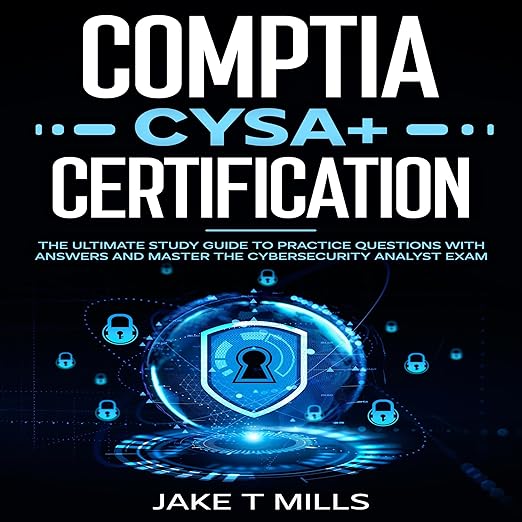
Threat and Vulnerability Management is just one of several dense domains this audiobook works through on the way to CompTIA's CySA+ certification, and Mastering CySA+ treats all of them with the same practice-question-first structure. This isn't a narrative history or a memoir; it's Jake T Mills' exam-prep guide built almost entirely around practice questions, detailed answers, and the reasoning behind each correct choice, delivered at just over five hours. The marketing language wrapped around the actual content leans enthusiastic, odysseys and journeys are invoked more than once, but underneath the hype is a fairly straightforward, useful structure for anyone actually studying toward this specific cybersecurity analyst credential.
Strip away the promotional framing, phrases like cybersecurity odyssey and press play do a lot of work in the synopsis, and what's left is a genuinely useful format: practice questions paired with detailed explanations of the reasoning behind each answer, organized around the CySA+ exam's actual domains, threat intelligence, vulnerability management, incident response, active defense, and specialized technology security. That structure matters more for retention than a straight lecture-style walkthrough would, since working through why a wrong answer is wrong teaches the underlying concept better than simply hearing it stated once. Mills builds the guide around that principle consistently rather than treating the practice questions as an afterthought bolted onto a conventional study guide. Mills also resists the temptation to pad weaker domains with filler questions just to hit a target runtime; the practice questions concentrate where the actual exam blueprint concentrates, a small but meaningful signal of genuine subject-matter care rather than a guide assembled purely to fill hours.
Tom Brooks narrates in a measured, no-frills register that suits certification exam content well: no dramatization, no vocal flourishes, just clean, unhurried delivery that treats accuracy as the only real goal. That restraint matters specifically for a practice-question format, since a listener needs a genuine beat to think through an answer before the reasoning arrives, and an over-performed delivery would blur that pause rather than protect it. Brooks keeps question and explanation clearly separated throughout, letting the content itself carry the weight instead of reaching for artificial urgency around material that should be judged on clarity alone.
Five Hours of Drilling for Weak Domains
For a listener already comfortable with foundational security concepts and specifically targeting the CySA+ credential, the domain-by-domain practice-question structure is an efficient way to drill weak spots during a commute or a gym session, in a way that reading a printed question bank doesn't easily replicate. Five hours is a reasonable length for supplementary review rather than a first-pass learning tool, positioning this clearly as a companion to more foundational study rather than a replacement for it.
The domain breakdown itself is worth taking seriously as a study roadmap on its own. Moving specifically from threat and vulnerability management into software and systems security mirrors how the actual CySA+ exam is weighted, rather than an arbitrary ordering imposed for narrative convenience, and a candidate who already knows their weaker domains can use the audio's structure to jump straight to the sections that matter most for their own study gaps rather than sitting through the whole five hours in sequence.
The high 4.9 rating, even built from a fairly small pool of responses, also suggests this lands well specifically with its intended audience of active exam candidates, even without full-length written reviews to quote from. A niche certification product living or dying on whether it actually helps someone pass a specific exam tends to earn quieter, more utilitarian approval rather than the kind of enthusiastic, story-driven reviews a memoir or novel collects, and that rating pattern is consistent with a study tool doing its narrow job well.
The format also suits spaced repetition as a study method, increasingly well understood as more effective than single-pass cramming for long-term retention. Being able to replay a specific domain's practice questions during a commute, days or weeks after first encountering them, mimics the kind of distributed practice schedule serious certification candidates are often advised to build for themselves anyway, giving the audio format a genuine pedagogical argument beyond simple convenience.
Odyssey and Journey Oversell a Conventional Guide
The synopsis itself is worth flagging honestly: it's written in dense, repetitive marketing language, journey, odyssey, unlock the doors, that oversells what is, underneath, a fairly conventional practice-question guide. Listeners should judge the book by its actual structure rather than its back-cover copy. No companion reference material is mentioned here beyond the audio itself, and a pure audio format has real limits for security certification content that often benefits from diagrams of network architecture or attack chains that are easier to absorb visually than aurally.
No written listener reviews are attached to this specific title yet, only a rating built from a modest 42 responses. That's a reasonably solid signal for a niche certification product, but it's thinner than the review depth available for more mainstream nonfiction, so go in aware that less independent detail exists to weigh against the publisher's own framing of the material. It's also worth being realistic about what a guide like this can and can't promise: passing CySA+ requires hands-on familiarity with security tools and real incident scenarios that a five-hour audio guide, however well organized, cannot substitute for entirely, so this works best as one part of a broader study plan rather than a sole preparation resource.
Reasoning Through Wrong Answers Is the Real Draw
IT professionals actively studying for the CySA+ exam, particularly those who've already built foundational security knowledge and want a portable way to drill practice questions, get real value here. It also suits candidates who learn better by working through why an answer is wrong rather than simply memorizing definitions, since that reasoning-first approach is the backbone of how the whole guide is built, domain by domain. Career-changers moving into security from an adjacent IT role will likely get more out of it once their basic terminology is solid than they would jumping straight in cold.
This won't work as a standalone introduction to cybersecurity analysis for someone without any prior foundation; the practice-question format assumes concepts have already been taught somewhere else and is built for review and reinforcement, not first-pass learning. Anyone who benefits from visual diagrams of attack chains or network architecture should also pair this with printed or digital study material, since pure audio has real limits for content this technical, and no amount of clear narration fully substitutes for seeing a network topology laid out on a page.
Does this CompTIA CySA+ audiobook teach the material from scratch, or is it only practice questions?
It's built almost entirely around practice questions and detailed explanations, so it works best as review and reinforcement for someone who already has foundational security knowledge, not as a first introduction to the concepts.
Does this audiobook cover every CySA+ exam domain, or just a few?
It works through the full domain set the synopsis names, including Threat and Vulnerability Management and Software and Systems Security, rather than focusing narrowly on one or two areas.
How long is the CompTIA CySA+ Certification audiobook?
It runs 5 hours and 1 minute, positioning it as a supplementary review tool rather than a full first-pass study course.
Are there any visual aids or diagrams included with this audiobook?
None are mentioned in the listing. For certification content that sometimes benefits from network diagrams or attack-chain visuals, consider pairing this audiobook with printed or digital study material.