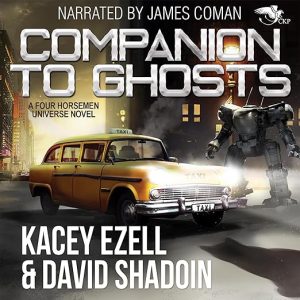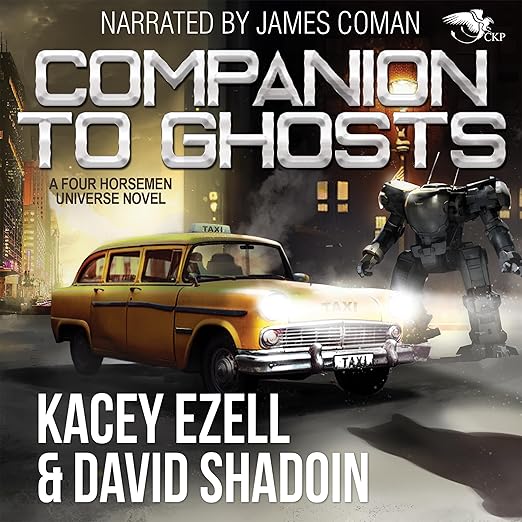
I had not read anything in the Four Horsemen Universe before I started Companion to Ghosts, which meant I was coming to Kacey Ezell's book without the accumulated affection that clearly drives some of the reviewer enthusiasm. What I found was a book that earns its 4.6 rating on its own terms: a character study wrapped in a genre thriller, set in a near-future Houston that Ezell uses well as a backdrop for a story that sits between military science fiction and noir detective fiction without falling entirely into either category.
Devlin Morrison is the kind of protagonist who could easily become a cliche. Former mercenary, too many lost comrades, drinking through the ghosts, driving a car for wealthy clients while his better life recedes in the rearview. Ezell keeps him from cliche by giving him a specific failure rather than a general wound: five years ago he thought he had found his way back to purpose when a mysterious Hunter offered him redemption, and then that went wrong too. That specificity matters. The book knows exactly what Devlin is carrying and makes the reader feel its weight before asking us to watch him lift it.
How Companion to Ghosts Holds Up
The central dynamic of Companion to Ghosts is the forced partnership between Devlin and an alien assassin called a Hunter, specifically Skakun, whose assignment involves dismantling a human trafficking network operating through Houston. The Hunter-companion relationship is an established element of the Four Horsemen Universe, and Ezell uses it here to generate friction that goes well beyond the standard buddy dynamic. Hunters are not accustomed to working with anyone. The process of building enough functional trust to complete the mission, against the backdrop of their respective histories with failure and loss, is where the book spends most of its emotional energy and where it is most rewarding.
One reviewer who came to the book as a book club selection described not being able to put it down after picking it up, and noted it was not their normal read. That is meaningful testimony from someone coming to the genre from outside. Another described the book as a great example of the versatility of the 4HU, specifically praising how it nails the noir aesthetic while remaining genuinely science fictional. Both assessments hold up: this is a book doing something specifically genre-hybrid rather than just adding a spaceship to a crime novel, and the hybrid works because the noir register and the science fiction scaffolding have been constructed to support each other.
Why Companion to Ghosts Works as an Audiobook
Ezell uses Houston with some care. The city's actual geography and social landscape inform the book's texture in ways that go beyond functional backdrop. The human trafficking network that anchors the plot is treated with appropriate seriousness: this is not a convenient villain framework, and the book does not allow genre mechanics to trivialize the subject matter. The combination of science fictional elements, specifically the alien Hunter and the galactic mercenary context they operate within, with the very earthly horror of trafficking, is managed without tonal whiplash. The stakes feel real even within a universe that includes mercenary guilds and alien assassins with centuries of training behind them.
James Coman's narration carries the noir register of the story without tipping into parody. The first-person sections, which constitute much of the book's emotional interiority, are delivered with the controlled, slightly weathered quality that Devlin requires. The action sequences, which one reviewer had been anticipating after several previous entries in the universe, are handled with appropriate pacing and physical clarity. At eight hours and thirty-four minutes, the book has room for both the character work and the thriller mechanics without either feeling compressed.
Weak Spots in Companion to Ghosts
The Four Horsemen Universe has a large catalog, and Companion to Ghosts is a thirteenth entry in its Phoenix Initiative subseries. The fact that multiple reviewers, including one who had never read any 4HU novel, found it accessible and enjoyable as a standalone is a genuine structural achievement. Ezell appears to have designed this book to work for both audiences simultaneously: series veterans will find what one reviewer called tons of easter eggs, while new readers get a story that does not require accumulated context to land. The worldbuilding is delivered through character experience rather than exposition, which is the correct technique for a book that wants to serve both functions without alienating either constituency.
The redemption arc that drives the narrative is not a simple one. Devlin does not simply decide to be better and find that the universe cooperates. The process is complicated by his history, by Skakun's own issues with trust, and by the scope of what they discover about the trafficking network's reach. One reviewer described the emotional core as two souls in need of help ending up saving each other, which is an accurate if compressed summary of what makes the character dynamic work across the full length of the book.
Who Should Listen to Companion to Ghosts
Military science fiction readers who have grown impatient with the genre's tendency to prioritize tactical detail over character interiority will find Companion to Ghosts a welcome change of emphasis. Readers who enjoy noir detective fiction and are curious about what it looks like with science fictional scaffolding will find this a clean example of the hybrid done well. Four Horsemen Universe veterans will find the entry worthy of the universe's best. The accessible standalone structure makes it a reasonable first book for readers who want to test whether the larger universe is worth the investment before committing to the full catalog.
Key Details
- Voice: James Coman brings controlled intensity to Devlin's interiority, keeping the action sequences propulsive without flattening the character work that carries the emotional weight.
- Big ideas: Redemption through unlikely partnership, the weight of past failure, the moral stakes of mercenary work against human trafficking
- Atmosphere: Dark and propulsive, with genuine character warmth underneath the noir surface
- Worth it?: A strong standalone entry in the Four Horsemen Universe that works for series veterans and new readers alike, with better character work than its genre positioning might suggest.
Before You Listen
Can Companion to Ghosts be read without prior knowledge of the Four Horsemen Universe?
Yes. Multiple reviewers with no prior series experience found it fully accessible and self-contained. Ezell delivers the worldbuilding through character experience rather than exposition, and the plot resolves without requiring knowledge of the larger universe.
How does the book handle the human trafficking subject matter within a science fiction setting?
With seriousness. Ezell does not allow the genre mechanics to trivialize the subject. The trafficking network is treated as genuinely horrific, and the moral stakes of dismantling it are real within the story rather than treated as a convenient plot device.
What makes the Hunter-companion dynamic different from a standard buddy-cop pairing?
Hunters in the 4HU are specifically designed to work alone, which means Devlin and Skakun's partnership begins not just as an inconvenience but as a fundamental violation of how both characters have organized their professional identities. The trust-building has to overcome that structural hostility, not just personality differences.
Is James Coman's narration suited to both the noir and the science fiction elements of the book?
Yes. He maintains the controlled, weathered quality of the noir register throughout without letting it flatten the science fictional elements. The eight-plus hour runtime moves without fatigue, and reviewers have not raised any narration concerns.