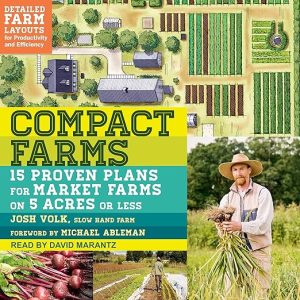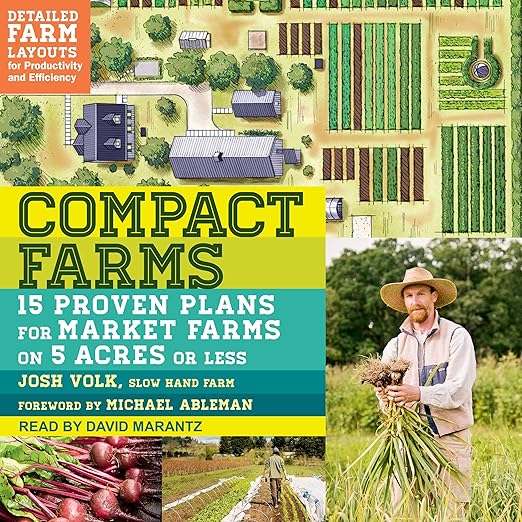
Compact Farms arrived in my listening queue during a period when I had been spending too many evenings on real estate websites looking at properties with acreage and telling myself it was research. I do not have a farming background. I have a background in reading about farming, which is a different thing entirely, but it is the kind of thing that leads you to audiobooks like this one. Josh Volk's guide arrived at exactly the right moment to do what the best practical nonfiction does: replace romantic generalization with specific, workable information.
The book profiles fifteen small farms of five acres or less, including Volk's own Slow Hand Farm in the Pacific Northwest. The selection includes well-known figures in the small-farm movement like Eliot Coleman and Jean-Martin Fortier, alongside farmers who are less nationally prominent but deeply embedded in their own regional agricultural communities. The goal is not to tell you exactly what to do. It is to show you what other people have actually done, in different climates, with different land configurations and different market contexts, so that you can extract the principles that apply to your own situation.
Fifteen Farms, One Comparable Framework
Reviewer Andrew C. Kesterson praised the organization of the book, noting that Volk takes you on a detailed tour of not only his own farm but fourteen others, with a consistent structure that allows comparison across the profiles. That structural consistency is the book's primary intellectual achievement. Each farm is analyzed through the same framework, water supply, land orientation, crop mix, marketing approach, labor model, which means the fifteen profiles accumulate into something more than a collection of individual stories. They become a dataset from which patterns emerge about what makes small farms viable.
Reviewer Tennessean specifically highlighted the value of tool recommendations from farmers who actually use the equipment in question, noting observations about hoes, seeders, and cultivators from people who have evaluated them under working conditions. In genre nonfiction, the specificity of that kind of firsthand recommendation is what separates books worth keeping from books worth skimming. Volk understands that his readers are not interested in theory. They are interested in what works in the field, at scale, over time.
Inspiration First, Business Planning Second
Reviewer Dirk Walden raised a fair point: the book is more inspirational than instructional in the strictest sense. It shows you how other people made their particular space and goals work for them, but it does not function as a step-by-step primer for starting your own market garden from scratch. That distinction matters if you come to the book expecting operational blueprints. If you come to it expecting a rigorous survey of what small-scale farming can look like across different regions and scales, it delivers that convincingly.
Reviewer Darrell Lingle, who has unused land and had been considering a market garden, found it gave him a great deal to consider and was very informative in terms of models and examples, while acknowledging that he would need other resources for the marketing and finance aspects. That is an accurate description of the book's scope. Compact Farms is strongest on farm layout, operational efficiency, and the human side of small-scale agriculture. It is less useful as a business planning document. Knowing that before you start will calibrate your expectations correctly.
Marantz's Steady Pace Skips the Diagrams
Narrator David Marantz delivers the material with a clarity that suits the practical, survey-style content. He does not try to inject drama into farm layout descriptions, which would be absurd. He reads the profiles and the analysis at a pace that allows the information to register without feeling rushed. At six hours and twenty-two minutes, the audiobook is a manageable listen even for someone who normally gravitates toward narrative nonfiction.
The honest caveat, which anyone considering this audiobook deserves to hear, is that farm plan books are often highly visual. Compact Farms includes diagrams and illustrations in its print version that describe how each farm uses its acreage. Those visuals do not translate to audio. What survives is the narrative description of each farm's approach, the tool and crop recommendations, the profiles of the farmers themselves, and Volk's analysis of why different configurations work. That is substantial. But if your primary interest is in the specific spatial layouts of the farms, the print version is a better vehicle for this particular book.
Early-Stage Planners Get Models to Compare
This audiobook is well-suited for people in the consideration or early planning phase of a small farm or market garden project, particularly those who want exposure to a diverse range of operational models before committing to a specific approach. It also works for readers with an existing interest in small-scale agriculture who want to understand how well-regarded farmers like Eliot Coleman and Jean-Martin Fortier have structured their operations in practice.
If you are already operational and looking for specific technical guidance on crop planning, pest management, or farm business finances, this is too broad and too focused on physical layout to fill those gaps. And if the visual farm plan diagrams are your primary reason for interest, the print or ebook version will serve you considerably better than audio. But as a companion to your larger reading in this space, and as an introduction to the small-farm movement through its most interesting practitioners, Compact Farms earns a genuine place on your list. Reviewer Patricia Stephenson, who praised the variety of farm layouts and the explanation of practices used, captures the book's core appeal: it is a diverse, informative window into a world that is more varied and more achievable than most people assume.