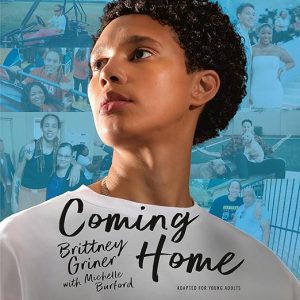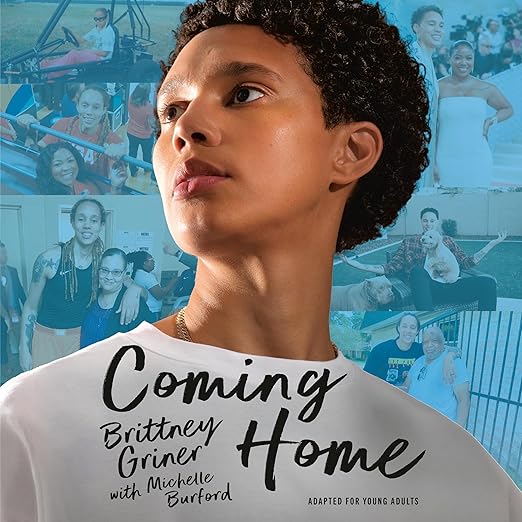
February 17 appears twice in this record. The repetition is not a coincidence. On February 17, 2022, Brittney Griner arrived in Moscow ready to play for a Russian team and was arrested at a security checkpoint. This audiobook was released on February 17, 2026. Four years to the day separate the event from the edition, and whoever picked that date knew precisely what they were doing. It stands as the only piece of editorial intent visible anywhere on the listing, which otherwise supplies nothing: not a rating, not a written response, not even the name of whoever turned an adult memoir into a book for teenagers.
Griner is telling a story in three distinct movements, and the copy withholds none of them. Early athletic stardom comes first, then the arrest and what the description calls a gateway to hell, then the return and the work that followed. The shape is not hidden: she was the first American woman to endure a Russian penal colony, she came home through a prisoner swap involving the arms dealer Viktor Bout, and she has since spoken publicly on behalf of other detained Americans. A memoir with that arc requires no embellishment, and this copy resists supplying any.
Andia Winslow is the credited reader, which means the first person in this book belongs to one woman and the voice delivering it to somebody else. For memoir that is a standard arrangement and no automatic loss, since a trained reader often serves a text better than its author would. What makes it worth flagging here is the stacking. A teenage listener receives Griner's account, adapted by a person the listing declines to name, performed by a third party. Three sets of hands on the material and only two of them credited is a lot of mediation for a book whose value is testimony.
Why Listen to Coming Home (Adapted for Young Adults)
Moscow is where the book turns, and the details the copy volunteers are the ones that turn a headline back into a story. A security checkpoint. A small amount of an illegal substance, carried by mistake. A foreign legal system navigated from the inside. Isolation, and then a penal colony. The description also names the thing that makes this unusual as teenage reading: the crisis captured the interest of an entire nation, so a private ordeal and a public spectacle were running at the same time. Very few books written for this age group carry a subject with both halves intact.
Before any of that, the book is about being a teenager, which is the reason a young adult edition makes sense at all. The copy describes Griner finding meaning and empowerment in sport during her teenage years while working through her own struggles with sexual identity. Coming of age as a queer Black woman is stated outright, not implied. For a fifteen-year-old the prison material may be the reason to start it and the earlier chapters may be the reason it stays, because a young listener has more immediate use for somebody who survived adolescence than for somebody who survived Russia.
Ten hours and four minutes is a substantial runtime for a young adult edition. No length is published for the memoir this was adapted from, so nobody can say how much was cut, though ten hours is not the shape of a heavily trimmed book. That points toward changes made to register instead of to substance, which is the better call for material of this kind: a teenager can handle the events, and smoothing them would insult the subject. It also means the commitment is genuine. This is a school-holiday listen, not an afternoon.
What to Watch For in Coming Home (Adapted for Young Adults)
Adapted for Young Adults sits inside the title, in parentheses, and that is the last anybody hears about it. No adapter is credited. The original memoir is never named, dated or described, so a listener cannot judge whether this is a light rewrite or a substantially different book, nor whether the adult edition would serve a mature sixteen-year-old better. Publishers routinely credit the person who does this work, and its absence has practical consequences: a parent, teacher or librarian weighing two editions has been handed only one of them to examine.
Nobody has graded this and nobody has written about it, six months past release. For a book by a subject this recognizable, silence of that kind is more likely a listing problem than a reception problem, and either way the usual checks are unavailable. No account exists of whether the reading holds steady, whether the prison chapters are handled with care for a young audience, or whether the adaptation reads as talking down. A first listener proceeds on the strength of the imprint and the subject, and on nothing else whatsoever.
Listening Library is the imprint, a serious children's and young adult audio operation, and in the absence of any other signal that counts for something. The category tag reads Sports and Outdoors, which is where a browsing teenager is least likely to go looking for this. Basketball is how the story opens and it is not what the story concerns; the middle of this book is a wrongful detention and the end is advocacy. Anyone arriving from a sports shelf should understand that the game is the setup, never the subject.
Who Should Listen to Coming Home (Adapted for Young Adults)
Teenage listeners who read for true stories are the audience, along with adults who want the same account at a pace built for clarity. It suits classrooms, family listening on a long drive, and any young reader working out what it costs to be publicly themselves. The wrong listener here is somebody after a sports memoir, somebody who needs an author to speak her own words, or a younger child, because a penal colony, a prisoner swap and a frank account of identity are all handled directly and none of them is softened.
Whoever chose the publication date understood exactly what this material is. What the listing fails to do is finish the job: an unnamed adapter, an unnamed source edition, a category tag pointing at the wrong shelf, and not one listener account against which any of it can be checked. Four years to the day after a checkpoint in Moscow, this arrived as a book for teenagers, and that timing remains the strongest editorial statement on the entire page.
Frequently Asked Questions
Is this audiobook suitable for a thirteen-year-old?
It depends on the household. The subject includes wrongful detention, a penal colony, isolation and a prisoner exchange, plus a frank account of sexual identity. The copy treats all of it directly. Older teenagers will manage comfortably; for younger listeners a parent should expect the real content here, unsoftened.
Does Brittney Griner read her own audiobook?
No. Andia Winslow is the credited narrator, so the first-person voice throughout belongs to a performer and never to the author. No reason for that choice is given anywhere, and nothing indicates whether Griner recorded any part of it, such as an introduction or an author's note at either end.