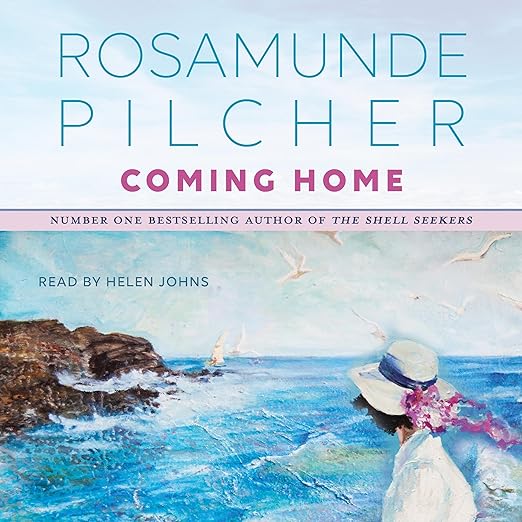
Before You Press Play
- Read by: Forty hours and thirty-seven minutes fall to Helen Johns without a second reader, spanning two generations, several social classes and a war.
- At its heart: Coming of age between the wars, boarding-school friendship, class and money, a family scattered by conflict.
- Vibe: Immersive, unhurried, deeply nostalgic.
- Short version: A novel nobody disputes, in an edition nobody on the page has actually reviewed.
What does forty hours and thirty-seven minutes of audiobook actually ask of a listener? Coming Home puts that question ahead of everything else on its page, including the plot. Helen Johns reads a Cornwall family saga that opens in 1935 with a girl left behind at a British boarding school while her family sails for Singapore, and runs on through the war that follows. That is not an evening's commitment. It is closer to a season of television, and it deserves to be chosen the same way.
Where This One Lands
Judith Dunbar is the girl in question. Her mother and baby sister leave for Singapore to join her father while she stays at Saint Ursula's, where a friendship with Loveday Carey-Lewis sweeps her into the privileged, madcap world of the British aristocracy and teaches her about values, friendship and wealth. Then the war arrives and wrenches her away from everyone she cares about. The description calls it a coming of age in every sense of the term, which is accurate and also tells you the pace. One reader summarizes the shape as the 1930s giving way to the war years, a girl in the English countryside becoming somebody else entirely.
Cornwall is what the readers remember. One who returned to the novel after thirty years says the descriptions of the sea, the cliffs and the landscape are rich enough that the place would be recognizable on arrival, and praises characters developed wonderfully across a great deal of time. The quality being pointed at, in both halves of that sentence, is accumulation. A saga this long earns its atmosphere by staying in one place until a reader learns it, and that effect is exactly what an enormous runtime can deliver.
Booklover2's entry announces its own problem in the headline: this review is for the Kindle Edition. What follows is a history of formats. A hardback read at least three times until it split down the middle. A paperback abandoned because the print had become too small to manage. Then an e-reader, and relief at seeing the words clearly again. It is a genuinely affectionate account of a novel, and not one sentence of it concerns the recording Macmillan Audio put out three years later.
Why Listen to Coming Home
Macmillan Audio released this in March 2018, and the copy on the page does something publishers usually leave to other people: it grades the product. Teeming with marvelous, memorable characters in an audiobook that is a true masterpiece, it says, a story to be savored, re-listened to and cherished forever. That is a verdict rather than a summary, and the seller wrote it. Worth separating from the reader responses underneath, which are doing a different job with considerably less at stake. The one useful thing the copy concedes is that it expects re-listening, which is a strange claim to make about forty hours.
Mystery sits among the tags here, alongside Historical Fiction and Women's Fiction, and the listing files the title under mystery, thriller and suspense as well as literature and fiction. Nothing in the description supports any of that. A boarding school, an elegant Cornwall mansion, a family scattered by war: no crime, no investigation, no puzzle. Anyone filtering a catalog for suspense will land on forty hours of family saga, which is a long way to travel before spotting the mistake.
Helen Johns is credited alone for all forty hours and thirty-seven minutes. One reader handles a cast spanning two generations, several social classes and a war fought across continents, and does it for longer than most recordings run twice over. Consistency matters more than range at this scale, because the same character has to sound the same in hour thirty-eight as in hour two. The page names who did the work and says nothing about how, so the credit is the entire disclosure.
What Gives Us Pause
Rosamund Pilcher, Rosamunde Pulcher and Rosamunde Pilcher all appear on this page, the last in the byline and the other two inside reader responses written years apart. Two people who loved the book enough to write about it could not spell the name. That is worth knowing before you go looking for the rest of the catalog, since two of those three spellings lead nowhere. Both of those responses also ask after a television adaptation, one hoping to find it and one reporting that it did not suit.
Forty hours is the real caveat, and the column offers no help with it, because every written response here is about the novel rather than this edition. At an ordinary pace that runtime spreads across weeks. Long sagas suit that rhythm better than thrillers do, since nothing has to be held in short-term memory between sessions, but a listener who abandons books around hour six should be honest about the odds. No abridged alternative is offered anywhere on the page, so the runtime shown is the only runtime available.
Fourteen people voted to make the 4.6, and the dates on the five written responses stretch from September 2010 to July 2025. Two of them were posted years before this recording existed, which means those readers were grading a printed book that happens to share a page with an audio edition. The average above the column is doing the same thing. Read it as a verdict on Pilcher's novel, which is uncontested, rather than on the performance, which nobody has weighed.
The Right Listener for Coming Home
Sagas built like this one reward the listener who wants somewhere to live for a month. A single reader, a fixed setting, a large family and a war arriving on schedule is the combination that makes forty hours pass rather than drag, and the column confirms the novel holds up on return visits: one reader came back after thirty years, another wore out a paperback bought at Christmas in 1995 and replaced it. Devotion of that kind is the most reliable signal on the page, and it is a signal about the writing rather than about any particular edition of it.
Impatient listeners, and anyone who arrived through the mystery tag, should walk away now. Evidence about this specific recording is not available here either, since the column has none to give. Coming Home is a long, warm, thoroughly loved novel wearing metadata that belongs to three different books, and the one untested element on the page is the forty hours of Helen Johns actually being sold. Forty hours asks for a commitment nobody in this column has yet made.