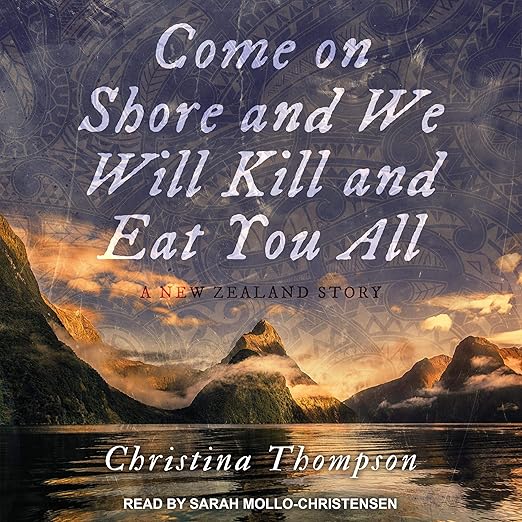
Christina Thompson's title comes from a phrase attributed to Maori warriors encountered by early European explorers, which signals immediately that Come On Shore and We Will Kill and Eat You All is not going to be a comfortable book. Sarah Mollo-Christensen narrates this audiobook with the kind of measured gravity the material requires, and Thompson's structure - a marriage at its center, a century-spanning colonial history radiating outward from it - is well served by audio's capacity to hold two registers simultaneously.
Thompson's book is a hybrid: part memoir of her marriage to a Maori man she met in New Zealand as a graduate student, part history of European contact with the Maori from Abel Tasman's 1642 first encounter through Cook's circumnavigation and the increasingly violent colonial period that followed. The personal story and the historical account don't always illuminate each other as directly as Thompson suggests they will, but the combination is more coherent in audio than the book's critics allow, largely because Mollo-Christensen's voice maintains the continuity across the shifts.
Thompson's Marriage to Seven, Never Just Symbolic
The marriage at the book's center is between two people whose backgrounds could not be more opposed in the ways that matter to Thompson's argument: she is an American academic from a middle-class background, descendant of colonizers; he is a Maori tradesman from rural poverty, descendant of the colonized. Thompson is careful not to reduce their relationship to its symbolic dimensions, and some of the book's most effective passages are the ones that resist the structural neatness the colonial history material implies. The man she calls Seven is not a representative figure; he's a specific person with specific tastes and limitations and qualities, and Thompson's insistence on that specificity keeps the personal narrative from becoming allegorical.
The historical sections are the book's more conventionally accomplished achievement. Thompson has done decades of research and it shows: her account of the early contact period, from Tasman's disastrous first encounter through the increasingly entangled economy of whale ships, missionaries, musket traders, and land purchases, is clear and well-sourced and carries the authority of someone who knows this literature deeply. The review that found the history sections stronger than the personal narrative reflects something real about the book's structure - the historical sections are more formally achieved, while the personal narrative is deliberately ragged and unresolved in ways that resist conventional memoir expectations.
Mollo-Christensen Shifts Between the Book's Two Modes
Mollo-Christensen navigates the book's tonal shifts with genuine dexterity. Thompson's historical prose is careful and sometimes formal; her personal narrative is more exploratory and occasionally tentative, written from the perspective of someone who is still working out what her marriage means rather than reporting on a completed experience. Mollo-Christensen distinguishes these modes through pace and register without making the distinction obvious, which is the right approach for a text that doesn't always signal clearly which mode it's operating in.
The book runs eight hours and twenty-nine minutes, which is the right length for this kind of layered work. Thompson doesn't overstay the historical argument or extend the personal narrative beyond what it can support. Listeners who approach New Zealand history without prior knowledge and want a personal, narrative introduction rather than a conventional account will find this a more engaging entry point than most academic histories of the contact period. Several readers have specifically noted its value before traveling to Aotearoa, since Thompson's framing gives cultural encounters a depth that conventional travel preparation doesn't provide.
An Outsider's Honesty About 1990s-Era Research
Thompson's treatment of Maori culture and history is sympathetic but comes from the position of a Western academic, and listeners familiar with Maori scholarship or with Aotearoa New Zealand's contemporary political context may find places where the book's framing reflects its late-1990s research origins. Thompson is honest about her position as an outsider, but honesty about one's position is not the same as full critical engagement with it, and the book doesn't claim to be more than it is.
The personal narrative thread leaves much unresolved. Thompson doesn't provide the kind of psychological depth or narrative closure that memoir readers often expect - she's more interested in placing her experience in a historical context than in excavating it fully. Listeners who want both the history and a fully realized personal story may find the balance frustrating. Those who are interested in the history primarily and find the personal frame a useful organizing device will get considerably more from the structure.
Aotearoa Travel Prep Beats a Straight Memoir
This audiobook rewards listeners who are curious about New Zealand and Maori history and who appreciate hybrid forms that don't resolve cleanly into either memoir or history. It's an excellent preparation for travel to Aotearoa, as multiple reviewers who visited the country after reading it confirmed - Thompson's historical framing gives cultural encounters a depth that conventional travel guides don't provide.
Listeners who want either a straight personal memoir or a straightforward academic history will find the hybrid form mildly unsatisfying. The book's most productive audience is those who are comfortable with a work that uses the personal and the historical to interrogate each other without fully resolving either. For that audience, Mollo-Christensen's narration makes the audiobook a more coherent experience than the text alone might suggest.
Before You Press Play
- Performance: Sarah Mollo-Christensen handles the dual register - intimate memoir and measured history - with genuine skill, her voice equally suited to Thompson's personal narrative and the colonial history passages.
- What it covers: Cultural collision in the Pacific, the politics of intermarriage and belonging, the contested history of European contact with Maori New Zealand
- Feel: Reflective and layered, moving between intimacy and historical breadth
- Our call: Thompson's hybrid form - personal memoir braided with Pacific colonial history - works better in audio than it might on the page, where Mollo-Christensen's voice holds the two registers together.
Common Questions
Does this audiobook require prior knowledge of Maori culture or New Zealand history?
No prior knowledge is required. Thompson's historical sections are designed as an introduction to the contact period for readers who are unfamiliar with it, and she provides sufficient context for the cultural references throughout. Several reviewers have described it as their first substantive introduction to Maori history.
How does this audiobook balance the personal memoir and the historical account?
The balance shifts across the eight-plus hours - the historical sections are more formally achieved and tend to be stronger as prose, while the personal narrative is more exploratory. Reviews consistently find the history sections more consistently accomplished, though the personal frame provides the book's organizing logic.