Before You Press Play
- Read by: Cameron Beierle carries a four-hour children's history, where tempo through the races counts for more than characterization.
- At its heart: Seabiscuit in the Great Depression, a jockey out of luck, a trainer who saw something, persistence as a virtue
- Vibe: Warm, brisk, straightforwardly heroic
- Short version: A clean four-hour family listen, provided nobody is expecting the adult treatment of the story.
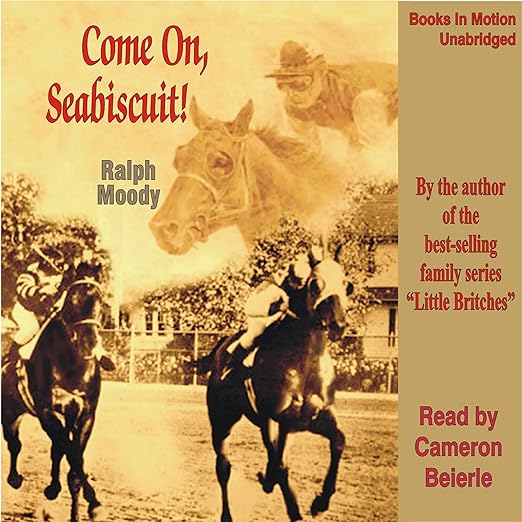
Which Seabiscuit book is this? The question is worth asking, because more than one exists, and this record answers with a runtime: four hours and one minute, which is a children's length rather than a historian's. The audiobook comes from Books in Motion with Cameron Beierle reading, and Ralph Moody tells the Depression-era story in three parts, a plucky horse that refused to quit, a down-on-his-luck jockey determined to help his horse win, and the trainer who brought out the best in both. The description compresses the whole appeal into one line: Seabiscuit captured American hearts from the soup kitchens to the White House, which is a claim about a country as much as about a racehorse.
Three-part structure does the heavy lifting, and it is the right call for young listeners. A horse on its own is not a story; a horse, a rider who has run out of luck, and a trainer who sees something nobody else sees add up to a story with three ways into it. Moody gives each of the three a reason to need the other two, which is why a book this short never feels thin. The Depression setting supplies stakes without requiring an economics lesson: soup kitchens at one end of the country, the White House at the other, and a racehorse in between holding everybody's attention. That span is also the reason the material still works. A country short of good news adopted an animal, and Moody writes on the assumption that a young listener will understand an adoption of that kind without needing it spelled out.
Moody's own background is the second asset, and two responses on this page point straight at it. One observes that he had a great amount of personal experience training horses and that the insight shows in how the book is written; another compares the prose here against his Little Britches autobiographical series, prefers the latter, and still calls this an interesting story that is not too lengthy. Both observations are useful to a buyer. The record files the title under teen and young adult with a Sports and Outdoors tag, and the teen half of that label runs distinctly older than the book actually reads.
What Works
Four hours and one minute is close to a perfect read-aloud unit, and this is a read-aloud book whatever the shelf says. One five-star describes an adult and an eight-year-old taking turns a page at a time, which is precisely the use a recording serves better than a paperback, since nobody has to do the reading and both parties get to listen. Spread across a week of bedtimes it comes to roughly thirty-five minutes a night. Spread across a car trip it becomes one long afternoon with a natural finish line built into it.
Cameron Beierle is the credited reader, and delivery counts for more here than it would on an adult title, because a children's history is carried almost entirely by pace and warmth. Race sequences need a narrator willing to push tempo without shouting, and the quieter stretches need somebody who can make a trainer's patience sound interesting to a nine-year-old. Four hours also leaves a reader nowhere to coast, since a book this short keeps every chapter within earshot of the one before it. Not one of the five written responses assesses that reading, which on a book pitched at listeners this age is the gap most worth closing before you buy. Play a race scene and judge it yourself.
What to Watch For in Come on, Seabiscuit!
Everything written about this title grades a physical book. One response praises nice illustrations and advises that a copy is worth a little effort to track down; another describes reading it as a school boy and buying it again decades later to read a second time. Illustrations in a children's history do specific work, showing a horse a young listener has never seen and a period they hold no reference for, and no illustration supplement is listed as shipping with the download. Whatever the printed edition offers visually, assume this download does not.
Two calibrations before buying. The counter records 76 ratings while the written column holds five, so the 4.7 average draws mostly on votes that arrived without a word attached, and every response you can actually read comes from an adult rather than from a child. Second, this is a 2008 recording of an older book, and older children's nonfiction frames its subjects differently: expect an uncomplicated heroic arc and a narrative that assumes the listener is on the horse's side from the opening minutes onward.
Who It's For
Families with children roughly between seven and twelve are the natural home for this, and the four-hour runtime is why: long enough to feel like a real book, short enough to finish inside a week without anybody losing the thread. Horse-obsessed young listeners will need no further persuading at all, and the record promises a true story rather than a fictionalized one, which matters to children of an age that asks whether things really happened. Adults who grew up on this style of sports storytelling and want the uncomplicated version, without three hundred pages of social context wrapped around it, will get a clean nostalgic afternoon out of the same four hours.
Older teenagers are the group the shelf label oversells. Nothing here is too young to enjoy, but a fifteen-year-old expecting the adult treatment of this material will find the pitch aimed well below them and may resent the simplification. Listeners who want the racing world examined rather than described should look for something longer and more recent. For a first encounter with the Depression, a famous horse, and the idea that persistence is a subject worth four hours of attention, this is exactly sized to the job it takes on.
A Few Questions About Come on, Seabiscuit!
What age is the Come on, Seabiscuit! audiobook pitched at?
The record shelves it under teen and young adult, but the four-hour runtime and the three-figure structure both read younger than that. Somewhere around seven to twelve is the comfortable range, with older listeners likely to find the framing simple. Nothing in the material requires prior knowledge of horse racing or the Depression.
Does the audiobook come with any supporting document?
The page lists none. A short children's history rests entirely on the reading, so if a young listener wants to see the horse or the era, plan on a separate source. Check with the seller if visual material matters to you, because the page here makes no statement either way.
How long is the story, and does it follow Seabiscuit's whole career?
Four hours and one minute. The description organizes the book around three figures rather than around a season-by-season record, so expect the arc of a horse that refused to quit, the jockey trying to get him there, and the trainer who saw the potential, rather than a complete racing chronology.