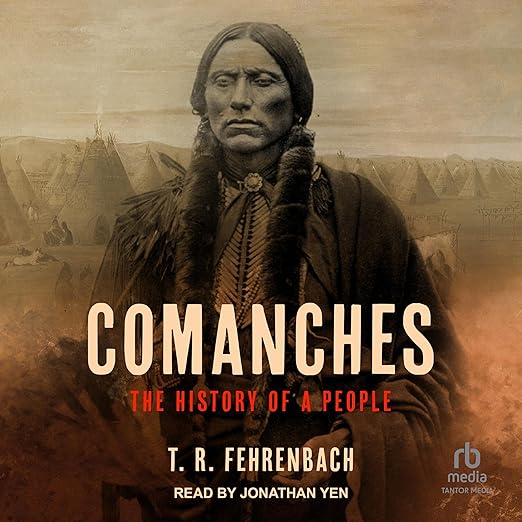
T.R. Fehrenbach's Comanches has stayed continuously in print since 1974, and my verdict after nearly twenty-five hours with Jonathan Yen's narration is that the book has earned that longevity honestly: this remains one of the more even-handed popular accounts of a Plains tribe's rise and fall, even though its age shows in specific ways worth naming before you commit to the full runtime. The Comanches Fehrenbach describes were master horseback riders, disciplined warriors, and by his account among the finest arrow-makers on the continent, and this audiobook traces their run from prehistoric origins through more than a century of dominance on the high plains to their eventual defeat by the Texas Rangers and the US Army.
Comancheria's Horseback Empire, Built Within a Century
The scope is genuinely impressive: prehistoric origins through a century-plus of dominance, framed against the failed Spanish colonization of North America and a blocked French advance into the Southwest, before the final collapse under Anglo-American expansion. Fehrenbach treats the Comanches as serious historical actors shaping outcomes, not simply a people things happened to, which was a meaningfully different stance for a popular history published in 1974.
Jonathan Yen's narration handles the material's shifting registers well, moving between ethnographic description, military narrative, and something closer to elegy by the book's final chapters without losing consistency of tone. That range matters for a history this long; a narrator who could only do one register would make twenty-five hours feel considerably longer.
At their territorial height, the Comanches controlled a vast region historians now call Comancheria, spanning parts of present-day Texas, Oklahoma, New Mexico, Kansas, and Colorado, an empire built and defended almost entirely on horseback. That geographic scope is worth holding in mind throughout; this isn't the story of a small, localized group but of a power that shaped the entire course of Spanish, French, and eventually American expansion across the Southern Plains for well over a century.
Their reputation as master horsemen is not exaggeration; historians broadly regard the Comanches as among the most skilled mounted warriors in world history, having transformed their entire culture around the horse within roughly a century of first encountering it. That transformation, from a relatively marginal group to the dominant power of the Southern Plains, is itself one of the more remarkable rapid cultural shifts in North American history, and Fehrenbach gives it the sustained attention it deserves.
One reviewer's phrase, describing 'the clash that occurs leading to real unavoidable tragedy,' captures Fehrenbach's actual argument precisely: this isn't framed as a story with villains and heroes so much as two fundamentally incompatible ways of organizing a society colliding with genuinely tragic, not merely unfortunate, consequences on multiple sides.
The book's elegiac final register, mentioned earlier, earns particular weight because Fehrenbach spends so much of the earlier material establishing the Comanches as active agents shaping their own destiny rather than passive victims of history; the fall lands harder specifically because the earlier chapters worked so hard to establish genuine power and agency first.
Fifty Years in Print, Still Called Fair
One reviewer calls this probably the fairest, most readable and unbiased book he's read on North American history, and another describes it as twofold: a history of the Comanche and a history of the settling of the West, told with an even hand toward both Native Americans and white expansion rather than favoring either side's narrative.
The cultural detail goes well beyond battles and territory. Fehrenbach describes a people who lived by a strict legal code and worshipped within a genuine cosmology of magic, texture that elevates this past a purely military account into something closer to a full portrait of a civilization on its own terms.
Fehrenbach brings real historian's credentials to the project beyond this single book; he wrote several other well regarded popular histories, including a widely read account of the Korean War, and that broader body of work shows in Comanches' structural confidence, a writer comfortable moving between sweeping strategic overview and specific, textured detail without losing control of either register.
The book's final chapters, describing the Comanches' eventual defeat, carry real emotional weight without tipping into melodrama, which is a difficult balance for popular history to strike. Fehrenbach lets the scale of the loss speak through documented fact and consequence rather than through overwrought language, which is part of why reviewers consistently praise the book's fairness even decades after publication.
This book has stayed continuously available for half a century, an unusual longevity for a work of popular history that hasn't been substantially revised, and that durability speaks to something beyond nostalgia: successive generations of listeners have apparently kept finding the same even-handed treatment of a complicated history genuinely useful rather than dated.
Pair This with Hamalainen's The Comanche Empire
One reviewer offers a blunt warning worth taking seriously: this isn't an exhaustive, cross-referenced academic work, and readers sensitive to unvarnished depictions of warfare, greed, and the costs of western expansion should know Fehrenbach writes from a 1974 vantage point, not a contemporary revisionist one. Pekka Hamalainen's more recent academic study The Comanche Empire makes a genuinely useful, more current companion for listeners wanting that additional scholarly lens.
Nearly twenty-five hours is a serious commitment, longer than most single-tribe histories tend to run, and worth knowing upfront that this functions as an immersive deep dive rather than a survey text you could finish in an afternoon or two.
The phrase 'worshipped within a cosmology of magic' deserves to be read as respectful anthropological framing rather than dismissive exoticism; Fehrenbach treats Comanche spiritual life as a coherent, internally consistent system worth understanding on its own terms, not as primitive superstition contrasted against a more supposedly rational European worldview, which was a genuinely progressive stance for a popular history written in 1974.
Reviewer Rodger specifically praises the book's use of contemporary and current information within its historical narrative, worth noting since it suggests Fehrenbach was drawing on the best available scholarship of his own moment, rather than working from outdated or thin sourcing even by 1974 standards.
The synopsis itself closes by calling this 'a classic American story, vividly and poignantly told,' and that word poignantly is doing careful work: it signals upfront that the book's sympathies extend to its subjects even while documenting difficult, often violent history, a tonal promise the text itself largely delivers on according to the reviewers who praise its fairness.
Nearly Twenty-Five Hours for Era-Aware Readers
Readers of classic narrative history, anyone building a Western-expansion or Plains-tribes reading list, and listeners who appreciate Fehrenbach's reputation for fairness relative to his era will find this a genuinely rewarding, if lengthy, listen.
Skip this one if you want explicitly contemporary Indigenous-studies framing as your primary or sole source, or if you're not willing to sit with a sometimes blunt, pre-21st-century authorial voice across a very long runtime.
Questions Listeners Ask
Is this audiobook's portrayal of the Comanches outdated, since it was written in 1974?
In some ways, yes. Fehrenbach writes from a 1974 vantage point rather than a contemporary revisionist one, and pairing this with Pekka Hamalainen's more recent academic study The Comanche Empire gives listeners a genuinely useful, more current scholarly counterpart.
Is the Comanches audiobook biased toward one side of the history?
Reviewers describe it as unusually fair-minded for its era, giving an even hand to both Comanche and white-expansion perspectives, though one reviewer bluntly warns it isn't a neutral, cautious academic text either.
How long is the Comanches audiobook, and is that runtime justified?
It runs nearly twenty-five hours, a serious commitment, and the scope, from prehistoric origins through more than a century of dominance to eventual defeat, genuinely earns that length rather than padding it.