Key Details
- Voice: Frank Muller works alone for twenty-three hours and forty-nine minutes, covering Rangers, two Comanche leaders, a Kickapoo tracker and a Mexican bandit with no second voice in the credit.
- Big ideas: Frontier violence with neither villains nor heroes glorified, middle age and its attachments, the twenty-year gap before Lonesome Dove.
- Atmosphere: Wide, unhurried and frequently brutal.
- Worth it?: The reason to spend the time is character rather than chase; treat the length as the price of that.
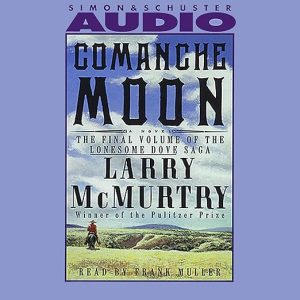
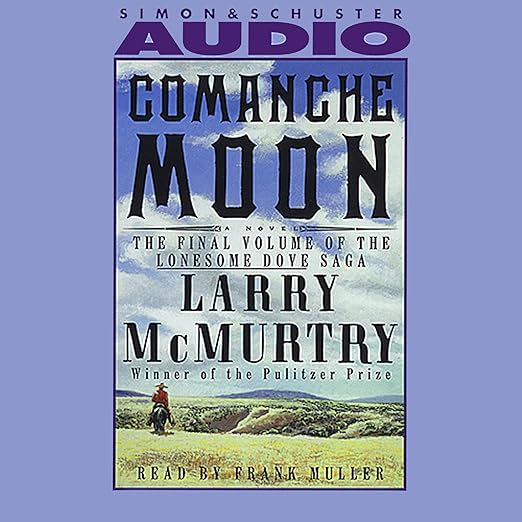
The description and the shelf label disagree about where this book sits. Simon & Schuster Audio files Comanche Moon as volume two of Lonesome Dove, while the copy underneath calls it the second prequel, following Dead Man's Walk, to the novel that made the name. Both statements can be true at once, and a listener deciding what to play first is left to work out which ordering the page means. The audiobook runs twenty-three hours and forty-nine minutes in Frank Muller's hands, and the question stops mattering roughly twenty minutes in.
First, the Big Picture
Everything in the jacket copy sounds confident except the hero's name. The opening paragraph gives you Texas Rangers Augustus McCrae and Woodrow F. Call. Two paragraphs later the same two men are August McCrae and Woodrow Call, the middle initial gone and the first name clipped, inside copy that is otherwise careful about the Pulitzer and the tetralogy. Scott Kuffel's review then spells the surname McRae. None of this changes a syllable of what Frank Muller reads, but on a page where you are deciding whether to commit almost twenty-four hours, it does not build confidence. The copy also opens with NATIONAL BESTSELLER in capitals, a jacket line carried over from a printed edition onto a recording issued in 2008.
Where the review column gets genuinely interesting is in how differently people arrived. Milashka took a friend's recommendation of Lonesome Dove, never read it, and decided to do the whole sequence in chronological order, loving Dead Man's Walk and then needing a while to settle into this one. Kimberly A. Sharpe arrived from the other direction and finished here, describing four very long books shared with these characters and real sadness at reaching the close. Same novel, same page, one reader treating it as an early chapter and the other as a farewell.
An entire layer of this book is missing from the publisher's paragraph, and Tripower53 restores it. The blurb mentions a deadly Mexican bandit king with a penchant for torture and never names him; that entry calls him Gomez. The copy says nothing about who leads the Ranger troop either, while the review supplies Captain Inish Scull, also known as Old Nails, at the head of exactly twelve men, on a horse so imposing it gets called Buffalo Horse. Blue Duck, whom Scott Kuffel sets against Buffalo Hump, is likewise nowhere in the description.
What Makes Comanche Moon Worth Hearing
Both the length and the cast make this a real test of a single reader. Frank Muller has twenty-three hours and forty-nine minutes and a roster running from two Rangers in their middle years, through a Comanche war chief and a celebrated horse thief, to a Kickapoo tracker named Famous Shoes and a bandit with a taste for torture. Add Clara Forsythe and Maggie Tilton, and the comrades the copy lists as Deets, Jake Spoon and Pea Eye Parker. One voice holds all of that, and the credit line names nobody else at all.
Three names in this column make the same case without coordinating: the people, not the pursuit, are what stay. Milashka praises development that glorifies neither villains nor heroes, and finds unimaginable cruelty sitting right beside humor and vulnerability. Kimberly A. Sharpe, an avid reader by that entry's own account, says only a few books and characters have ever lived on in memory this way. Scott Kuffel calls the balance between Call and McCrae the thing that worked, and singles out the contrast between two antagonists as the stretch that held attention for pages.
It helps to know what this book is structurally, because the description says so outright: Comanche Moon closes the twenty-year gap between Dead Man's Walk and Lonesome Dove. That is an unusual thing to advertise. The novel exists to fill a space between two other novels, and its destination is fixed before a word of it is read. What makes the hours work anyway is that the Rangers have reached their middle years, Gus is attached to Clara Forsythe and Call to Maggie Tilton, and the tensions of adult life run alongside the chase instead of pausing for it.
A Few Reservations
This one has a star line worth doing the arithmetic on. The badge sits at 4.5 across six votes, which means those six have to total exactly twenty-seven points out of a possible thirty. Five of the six left a review, and those five carry twenty-four points between them: four 5s alongside a lone 4. The vote nobody explained is therefore a 3, the lowest number anywhere on this page. One silent reader, three points, and not a syllable about what the objection was.
Most of the column is recent, and then a single entry from October 2011 sits underneath doing something peculiar. It spells the author McMurty throughout, calls him a writing machine, and describes him in the present tense as living in his primitive, miniscule hometown in Texas, churning out sequels. The writer found these books through a movie on television, does not usually read cowboy fiction, and the body stops before that thought finishes. Scott Kuffel's entry is partly about the screen too, praising the series and Robert Duvall before turning to the novel. From that 2011 response to Kimberly A. Sharpe's, posted in February 2026, this column covers more than fourteen years of people finding their way to the same book.
The Right Listener for Comanche Moon
Some listeners should start here and some should not, and this column happens to show you both routes. If you have never read any of it, Milashka's path is the one on offer: begin with Dead Man's Walk, take this second, and expect a slower way in than the first book gave. If you already know Lonesome Dove and want the twenty years before it, the novel was constructed for exactly that, and knowing where Gus and Call end up sharpens the middle years rather than spoiling them.
Nothing about this is a light listen. The publisher's paragraph promises harrowing careers, a war chief, a horse thief and a torturer, and Milashka's warning about cruelty is not decorative. Nearly twenty-four hours with one reader also asks for a particular patience: no cast, no shortcuts, and long stretches of Texas between events. At twenty-three hours and forty-nine minutes, Frank Muller is either your company for a month of evenings or not, and no reviewer here will settle that for you.
Frequently Asked Questions
Should you listen to Dead Man's Walk before this audiobook?
It helps, but the description summarizes enough to start here. Milashka began with Dead Man's Walk, loved it, and then needed longer to settle into this one. Kimberly A. Sharpe reached Comanche Moon after four books with these characters and felt it as a farewell, which is the other way people arrive.
Is the Comanche Moon audiobook read by more than one narrator?
No. Frank Muller is the only voice credited across twenty-three hours and forty-nine minutes, carrying the Rangers, Buffalo Hump, Kicking Wolf, Famous Shoes and everyone else in the book. The recording dates from October 30, 2008, and nothing on this page points to a dramatized or full-cast production.
How can the badge read 4.5 when four of the five visible reviews are 5s?
Because six votes averaging 4.5 must total twenty-seven points, and the five people who wrote account for twenty-four of them. The remaining vote has to be a 3, the lowest score anywhere on the page, and whoever cast it left no explanation. A reader you cannot read is pulling the average down.