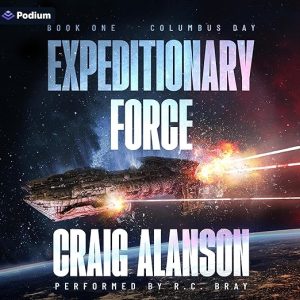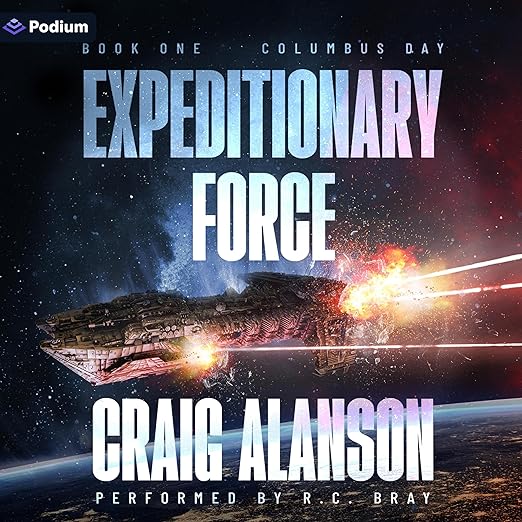
I started Columbus Day on a long drive that I thought would take me halfway through the book at most. I finished it in a single sitting the following evening, having rearranged a dinner just to get back to Joe Bishop and his infuriating, magnificent AI companion. That does not happen often. The opening pages, where Alanson draws a bleak parallel between Columbus arriving in 1492 and the Ruhar fleet dropping out of the sky on a random Tuesday, are funny and sharp and just a little unsettling. That contrast between gallows humor and genuine dread is what Craig Alanson sustains for the full sixteen hours.
The Expeditionary Force series has earned its massive following, and this first installment explains why. But the reasons are more specific than the marketing copy would have you believe. This is not a straightforward military space opera. It is, at its core, a story about what happens when you discover that the war you volunteered for was built on a lie, and what an ordinary soldier does with that knowledge when he has almost no leverage, no allies, and no good options.
How Columbus Day Holds Up
What Alanson does particularly well here is resist the temptation to make Joe Bishop exceptional. He is competent, resourceful, and stubborn, but the synopsis is honest when it says he is an ordinary Joe. The genius of the novel is that his ordinariness is precisely what makes him credible. He is not chosen-one material. He stumbles into circumstances, improvises, and survives largely because he is willing to ask uncomfortable questions. That grounded quality gives the book its traction. The reviewer who compared the human-versus-alien-hamster setup to a punchline has a point, the Ruhar are bipedal hamster-like creatures, but Alanson takes that absurdity and plays it completely straight. It works because the world-building underneath it is genuinely thought through. The Kristang and the Ruhar are not window dressing. Their civilizations have histories, grievances, and agendas that matter to the plot.
Why Columbus Day Works as an Audiobook
The honest answer is Skippy. The AI entity that Joe discovers and eventually drags into an improbable alliance is one of the more entertaining characters I have encountered in recent science fiction audio. He is ancient, functionally omnipotent within his domain, deeply condescending, and somehow also desperately lonely in ways he refuses to admit. R.C. Bray voices him with a particular brand of airy disdain that never tips into cartoonishness. Multiple reviewers singled out Skippy as their favorite element, and the early scenes where Joe and Skippy negotiate the terms of their working relationship are the highlight of the production. Bray handles the tonal whiplash between Skippy's grandeur and Joe's flat Midwestern frustration with real skill. The nomination for Audie Awards Audiobook of the Year in 2018 makes complete sense once you hear those passages.
Weak Spots in Columbus Day
The pacing is relentless in a way that can feel a little breathless in the middle section. Alanson spends the first third building his premise carefully, then accelerates into a sequence of missions and complications that does not let up. One Italian reviewer found the book charming but more appropriate to a 1950s space opera sensibility, and there is something to that observation. The plotting prioritizes momentum over interiority, and Joe's emotional responses to events, particularly the revelations about the true nature of the war, are handled quickly rather than dwelt upon. Readers who prefer their military fiction heavy on psychological depth may find the pace a little lean. The book is also the first in a long series, and it functions as a setup volume in the best and worst senses: the world expands confidently but the central arc does not fully resolve.
The Right Listener for Columbus Day
This is the right listen for anyone who has ever bounced off military SF because it felt too grim or too technical. The humor here is genuine, not decorative, Skippy's presence means the book actively resists the kind of po-faced solemnity that makes some genre entries feel like homework. It also works for readers who came to it skeptically, as one reviewer noted who described themselves as someone who usually picks magic over science in their fiction. If you have sixteen hours and a road trip ahead of you, Columbus Day was practically designed for the occasion. Skip it if you need your fiction to sit with consequences and let them breathe; Alanson moves too fast for that kind of reflection.
- Narrator: R.C. Bray delivers an ideal performance for military SF, gruff, wry, and completely at home in Joe Bishop's everyman voice. His comic timing with Skippy is the backbone of the listening experience.
- Subjects: First contact gone wrong, reluctant heroism, interstellar political deception
- Tone: Fast-moving and irreverent, with unexpected comic warmth beneath the action
- Bottom line: If you have any tolerance for military science fiction laced with sharp humor, Columbus Day earns every one of its five-star reviews.
Is R.C. Bray's narration the reason the series developed such a devoted audiobook audience?
Significantly, yes. Bray's voice work, especially his characterization of Skippy the AI, is widely credited by fans as essential to the experience. Reviewers who encountered the series through audio specifically before print consistently cite his performance as the draw.
The synopsis mentions the Ruhar and the Kristang, do I need to keep a lot of alien faction details straight?
Less than you might expect early on. Alanson introduces the factions gradually and repeats key context at useful moments. The political architecture becomes more complex across the series, but in this first book the essential alignment is clear: the humans backed the wrong side.
One review mentioned the book feels more like 1950s space opera than modern SF. Is that fair?
Partly. The plotting structure and the hero's relationship to luck and improvisation do recall older genre conventions, but the humor and the AI character feel contemporary. It is not a hard science fiction novel, the tech is hand-waved and the focus stays on character and situation rather than plausibility.