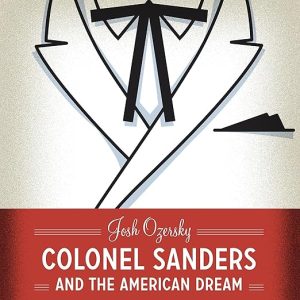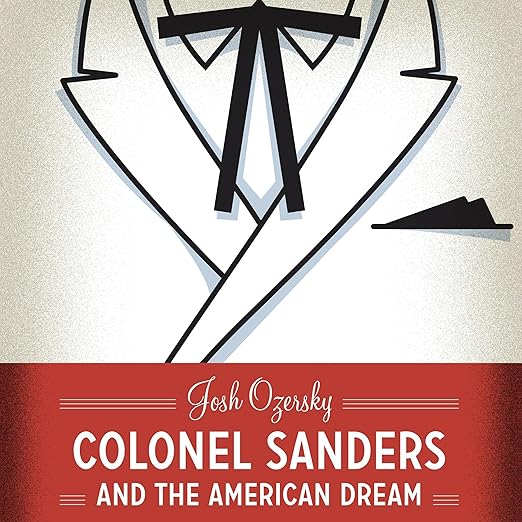
I put on Colonel Sanders and the American Dream during a long Sunday afternoon with a vague interest in American food culture and no strong expectations. The book surprised me by being considerably more intellectually ambitious than its cover or its subject might suggest, and also by being considerably shorter than the listening time usually allocated to biography. At four and a half hours, this is a novella-length cultural essay rather than a comprehensive life, and once you recalibrate your expectations accordingly, it becomes exactly the kind of precisely argued piece that rewards attention.
Josh Ozersky was a cultural historian and food writer who knew how to make an argument through a subject rather than simply about it. His previous work The Hamburger took a similar approach to fast food history, and Colonel Sanders and the American Dream applies the same method to the man who sold his fried chicken recipe for a nickel per bird and eventually became one of the most recognizable commercial icons in the world. Ozersky's central argument is that Harland Sanders is the American Dream in its most literal form: a dirt-poor striver who failed repeatedly, transcended his roots, created himself as he saw fit, went broke again at 65, and then built a global franchise from a pressure cooker and eleven herbs and spices.
The book has two distinct sections, and reviewers have responded to them differently. The first half, covering Sanders' origins in a 1930s roadside cafe in Corbin, Kentucky, through his self-transformation into the white-suited, goateed figure known as The Colonel, is the stronger section. Ozersky traces the specific mechanisms of how a regional restaurant owner became a franchise pioneer and then a global icon, and the details are both surprising and specific: the handshake deal structure, the pressure cooker as the secret to the original recipe's consistency, the interstate bypass that destroyed his first business and forced the late-career reinvention that produced the franchise model.
The second half, dealing with the succession of corporate takeovers of KFC and Sanders' increasingly difficult relationship with the management that owned his image, is where the book's thematic argument becomes more complicated and, for some readers, more frustrating. One reviewer described this section as hard to follow at points, and there is a quality of density to the corporate history that moves at a different pace from the biography. But Ozersky is making a specific point about what happens when a person becomes a symbol: Sanders was still alive during much of this period, watching people use his image in ways he found offensive, unable to control the thing he had become.
Winkler's Restraint Fits an Essay About Cost
Kirk Winkler's narration suits the essay form better than it might suit a conventional biography. His delivery has the clean pacing of someone reading intelligent journalism aloud, which is exactly what this material is. He doesn't ornament the prose or inject personality that isn't on the page, and for a text that relies on the precision of its argument rather than narrative drama, that restraint is the right choice.
Ozersky defines the American Dream as the ability to transcend your roots and create yourself as you see fit, and he applies that definition with analytical precision rather than patriotic warmth. Sanders did exactly that, multiple times, under conditions of genuine adversity. But Ozersky is equally interested in what the dream costs and what it transforms its achievers into: by the end of his life, Sanders was largely powerless over his own image, a goodwill ambassador often disregarded by the corporation that owned what he had built. The irony is documented rather than exploited.
A Novella-Length Essay, Not a Full Biography
Listeners expecting a straightforward biography will be mildly misdirected. One reviewer described the book as a novella-length essay about the complications of striving and success in America, and that description is accurate and helpful. You will learn a great deal about Harlan Sanders, but the book is using him to think about something larger, and the something larger is more interesting to Ozersky than the details of individual biographical moments.
At four and a half hours, there is no fat in the material. The book moves quickly through decades, and some biographical periods are necessarily compressed in ways that a longer treatment would not require. Listeners who want the full life in comprehensive detail will need to look elsewhere. Listeners who want an intelligent argument about American mythology conducted through one man's story will find this efficient and well-aimed.
Skip for Biography, Listen for Cultural History
Listen if you enjoy cultural history that uses a specific figure to think about larger American themes. Listen if you appreciate short, precisely argued nonfiction rather than comprehensive biography. Skip if you want a detailed life of Harland Sanders with full biographical coverage, because this is not that book. Also worth noting for listeners who enjoyed Ozersky's work on The Hamburger: the approach is similar and the quality is comparable.