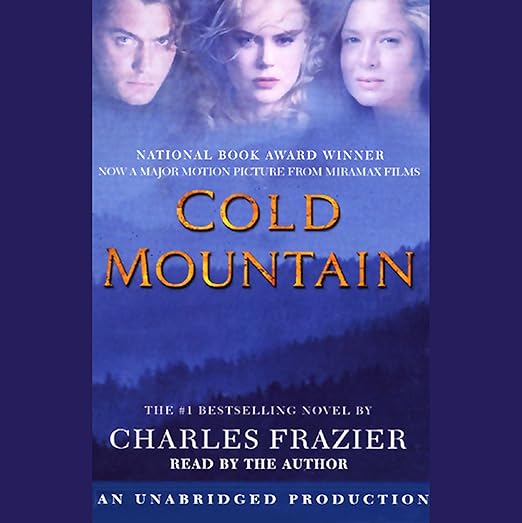
- Performance: Frazier self-narrating gives the prose its proper deliberateness but underserves female characters, especially Ruby Thewes.
- What it covers: Homecoming, endurance, the cost of war on the individual spirit, and the landscape that outlasts all of it.
- Feel: Elegiac, slow-burning, rooted in place and season.
- Our call: A genuine American literary achievement that rewards patient listeners, with a self-narrated performance that suits the material more than it serves every character.
Charles Frazier wrote Cold Mountain in a prose style that insists on its own slowness, and the audiobook of this Civil War novel, narrated by Frazier himself, makes that slowness audible in ways that produce both the book's greatest pleasures and its most demanding passages. Inman's walk home from Petersburg across a disintegrating Confederacy is structured less as a plot and more as an accumulation of encounters, each one a world unto itself, and Frazier the reader brings to each encounter the careful deliberateness of someone who wrote every sentence to be read more than once.
Published in 1997 and adapted into a film in 2003, Cold Mountain belongs to a tradition of American epic that treats landscape as moral argument. The Blue Ridge Mountains are not backdrop here; they are destination, aspiration, and the measure of everything Inman has lost. Ada Monroe, waiting at the Black Cove Farm she is learning to work with the help of the fierce and practical Ruby Thewes, carries an equally weighted storyline. Frazier interweaves their narratives with the confidence of a writer who trusts that readers will wait for the two threads to meet.
The novel reads as a Southern Odyssey and wears that reference openly. Inman encounters figures who resemble the island-dwellers of Homer's Mediterranean: a goatwoman who feeds him and tells him uncomfortable truths, bounty hunters who want him dead, a widow who offers a different kind of sanctuary. Each encounter reveals something about the war's wreckage and about Inman's diminishing certainty that he can survive his own homecoming. The structural boldness of that approach is part of what distinguished the novel at publication, and it holds up.
Frazier self-narrating is an unusual choice and an imperfect one. His literary voice carries authority, and he knows where every sentence should breathe. What he lacks is the full range of a trained narrator: his female voices in particular are less differentiated than a professional performer would achieve, and Ruby Thewes, one of the novel's most vivid presences, does not quite get her due in his hands. That said, the quietness of his delivery suits the novel's register, and we find long passages of landscape description and internal monologue where his reading feels exactly right.
Highlights
At just over fourteen hours, this production is a significant commitment, and the right circumstances matter. This is not a commute listen for short drives; it rewards sustained attention over longer sessions. The novel's episode structure means you can pause at the end of a chapter without losing momentum, which makes it well suited to long car travel or dedicated weekend listening.
Frazier's prose, particularly in the descriptions of the North Carolina mountains in late autumn and early winter, is some of the finest American nature writing of the last thirty years. Hearing it read aloud at the pace the sentences require reveals textures that fast reading skips over. The novel was designed for deliberate attention, and the audio format enforces that productively.
Listeners coming to the book after the film should expect a different experience. The novel is richer in episode and interiority than any film can accommodate, and Ada's story in particular gets far more space on the page than the adaptation provided. Ruby, Ada's resourceful companion at Black Cove Farm, is arguably the novel's most alive character, and her sections carry a different energy than Inman's long solitary walk.
What to Watch For in Cold Mountain
The novel's greatest weakness, and Frazier's narration does not compensate for it, is its occasional tendency to linger in a scene past the point of illumination. Several of Inman's roadside encounters run longer than the material justifies, and listeners who came to the book expecting propulsive momentum will find themselves testing patience by the middle sections.
As noted above, Frazier does not differentiate his female characters as sharply as a professional narrator would. Ruby Thewes and Ada Monroe are fully realized on the page but somewhat collapsed in the audio, a limitation worth knowing before committing to the production.
The ending is famous for its refusal of easy resolution. Listeners who have managed fourteen hours of investment deserve fair warning: Frazier does not write the homecoming you spend the whole novel wanting. Whether that is artistic integrity or a willful withholding depends on the listener. It is worth knowing in advance rather than discovering at hour fourteen.
The novel also rewards a second listen, which is unusual to say about a fourteen-hour audiobook. But Frazier plants details early that accrue meaning as the narrative develops, and the awareness of what Inman is walking toward, something the novel's structure eventually makes inevitable, changes the emotional register of passages heard the first time as simply beautiful landscape writing. The Blue Ridge Mountains at the novel's close carry a different weight for the listener who has spent fourteen hours learning what Cold Mountain cost its characters to reach. Frazier's self-narration, whatever its limitations with female voices, does convey that cumulative weight better than a neutral professional performance might. He knows the ending when he starts; every sentence carries that knowledge quietly.
Is This One for You?
Readers of Cormac McCarthy's The Road or Blood Meridian who want something with a stronger emotional core will find this a natural companion. Fans of literary Civil War fiction, The March by E.L. Doctorow, Andersonville by MacKinlay Kantor, will respond to Frazier's approach. This is emphatically not a book for listeners who want wartime adventure or plot momentum above all else. It is for readers who trust that the journey is the point and who can sustain attention through a narrative that values landscape and interiority over incident.