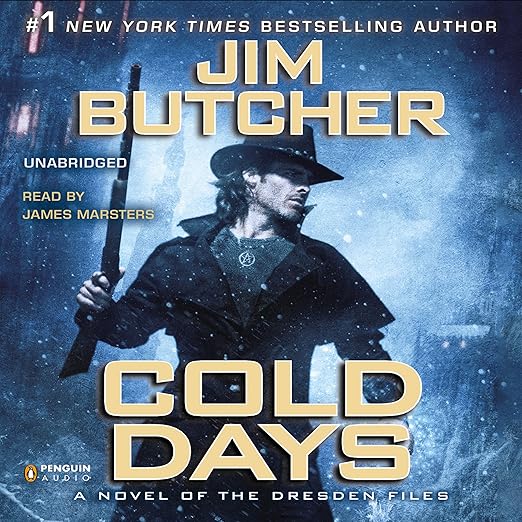
- Voice: James Marsters is as inseparable from Harry Dresden as any narrator is from any long-running series character, delivering the sarcasm, exhaustion, and heroism with calibrated precision across nearly nineteen hours.
- Big ideas: debt and servitude, the cost of resurrection, power and moral compromise
- Atmosphere: Dark and propulsive, with the compressed tension of a series approaching a significant turning point
- Worth it?: Cold Days rewards loyal Dresden Files listeners with major series mythology payoffs and some of Butcher's most inventive plotting at book fourteen.
Picking up Cold Days, the fourteenth Dresden Files audiobook, without having listened to the preceding thirteen is technically possible in the same way that walking into the final act of a long opera is technically possible. You will follow some of what is happening. You will miss most of what it means. Jim Butcher has spent more than a decade building a mythology dense enough that the revelations in Cold Days land with a cumulative force that only readers who have followed Harry Dresden since Storm Front can fully appreciate.
The premise is stark. Harry was dead. He is now not dead. The process of becoming not dead required swearing fealty to Mab, the Queen of Air and Darkness, which means Harry is now her Winter Knight, bound to follow her commands regardless of what those commands require. And what she requires of him first, almost before he has finished recovering from the ordeal of returning to the mortal world, is the assassination of an immortal. He is given three days. The Winter Knight's enhanced power comes with a catch, naturally: the power wants to be used in ways that are antithetical to who Harry is trying to remain.
James Marsters has been the voice of Harry Dresden for so long that imagining another narrator for this material is essentially impossible. His performance here is doing something genuinely difficult: conveying Harry's familiar sardonic voice while registering the changes that death and resurrection and supernatural servitude have wrought on the character. The sarcasm is still present. The wit is intact. But Marsters finds something graver underneath it in Cold Days, a Dresden who knows that the quips are partly armor against the recognition that he may not be the person he used to be. It is a subtle shift, but it is there across nearly nineteen hours of audio.
Reviewer Sneaky Burrito finished the book in a single day despite its length, calling it longer than the series average at 500+ pages, and noting the sadness of approaching the end of the then-published installments. That response captures the particular quality of being deep into a long-running series: the investment has accumulated to the point where the experience of listening is inseparable from the emotional architecture of everything that came before.
Highlights
Butcher is doing something structurally ambitious in Cold Days that rewards attention. The book uses its three-day deadline structure to compress the plotting in ways that generate sustained tension without feeling artificially rushed. Harry is gathering allies, fighting enemies old and new, trying to complete an assassination he finds morally dubious, and simultaneously trying to prevent what may be an existential threat to Chicago and the broader mortal world. The interleaving of these threads is handled with the control of a writer at the height of his craft in this specific genre.
The Faerie politics, which have been building through several prior novels, come to something close to a crisis point here. The Winter Court, always presented as more alien and more genuinely dangerous than the Summer Court, gets its most sustained examination of the series to date. What the Winter Knight's bond actually means, what power it grants and what it costs, and whether Harry can maintain his identity while using it, is the book's central preoccupation and its most interesting thematic territory.
Weak Spots in Cold Days
Reviewer Karissa Eckert notes that Harry "struggles to recover after his ordeal" before Mab sends him on assignment, and that recovery sequence in the first act of the book is worth paying close attention to. Butcher uses it to establish the degree of change in Harry without stating it directly. The way Harry reacts to things he would previously have handled differently tells you more about what the Winter Knight bond is doing to him than any explicit description could.
The ensemble of allies Harry assembles feels both familiar and subtly different. Relationships that have shifted through the preceding books are in new configurations here. For long-term listeners, tracking those shifts is part of the pleasure of a series this long. Characters who were secondary earlier have grown into genuine narrative weight. Characters who seemed central have been changed by circumstances. Cold Days is a book where the history you have accumulated matters, and Butcher handles the cast with enough control that none of the necessary exposition feels like a burden.
Reviewer Jenny, writing about the Dresden Files generally, notes appreciating how the books maintain their individual pleasures while advancing a clear overarching narrative. Cold Days is perhaps the most strongly series-arc-dependent of the earlier volumes. Individual pleasures, Harry's voice, the Chicago setting, the escalating supernatural stakes, are all present. But the specific satisfactions of this book are deeply tied to what has come before.
Is This One for You?
This audiobook is for established Dresden Files listeners who have reached book fourteen of the series. Starting here without the preceding novels is not recommended. The mythology is too dense, the character relationships too layered, and the emotional stakes too dependent on accumulated history for Cold Days to work as an entry point. For listeners who have followed Harry from the beginning, this is one of the series' most satisfying installments and represents a significant escalation of the overarching story.
New listeners curious about the Dresden Files should begin with Storm Front. The early books are shorter, the world is established accessibly, and James Marsters' narration is equally compelling from the series' opening. The investment pays compound returns as the series progresses toward Cold Days and beyond.
A Few Questions About Cold Days
How does James Marsters' narration in Cold Days compare to earlier Dresden Files audiobooks?
Marsters has voiced Harry Dresden for the entire series and his performance in Cold Days reflects the character's changed circumstances after death and resurrection. The sardonic voice is intact, but Marsters brings a subtly graver quality that registers Harry's new position as Winter Knight without making the shift explicit.
How long is the Cold Days audiobook and is the runtime justified by the content?
The audiobook runs approximately 18 hours and 47 minutes, making it one of the longer entries in the series. Reviewer feedback suggests the length is supported by the plotting density and the series mythology payoffs. At least one reviewer completed it in a single day despite the runtime.