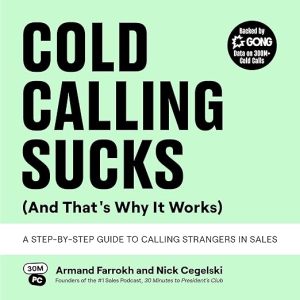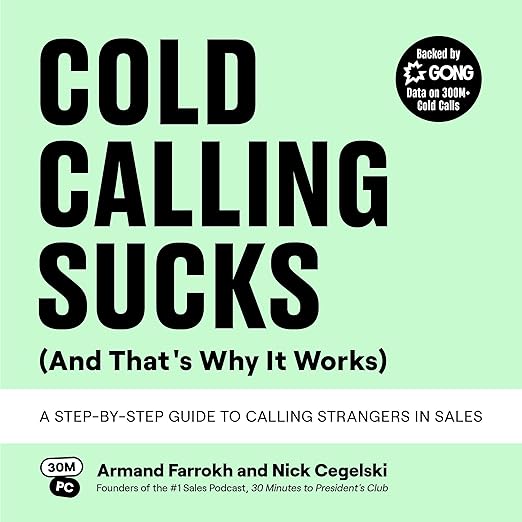
Armand Farrokh built the number-one sales podcast, 30 Minutes to President's Club, and led Pave from zero to $13 million in ARR in two years as VP of Sales before co-writing Cold Calling Sucks (and That's Why It Works) with Nick Cegelski. He also narrates this audiobook himself, which turns out to be the single most important production decision in the book. Over 31 embedded voiceovers demonstrate the actual tone, pacing, and verbal construction he is describing in the text - and listening to those voiceovers is a qualitatively different experience than reading about them in print.
Farrokh Records Himself Delivering the Voicemail Lines
The book's central argument is stated in its title and expanded in its first chapter: cold calling is uncomfortable for every salesperson, the discomfort does not go away, and the willingness to keep dialing anyway is what separates the top 10% of reps from the rest. That is not a novel observation, but Farrokh and Cegelski do something more useful than simply making it - they build a step-by-step framework for the specific mechanics of a cold call, from winning the first 60 seconds through overcoming objections to landing the meeting, and they back every tactical recommendation with data from Gong's analysis of over 300 million cold calls.
One reviewer who said this was the first Amazon review they had written in 36 years specifically cited the combination of honesty and depth as the book's distinguishing features. Another described the system as simple in the best sense - "no pressure tricks, no pushy lines" but rather real conversational frameworks that treat prospects as adults. The 200 elite rep interviews across SaaS, real estate, and other industries provide enough industry variation that the frameworks do not feel narrowly applicable to a single sales context.
The book's treatment of voicemail alone is worth the four-hour runtime. Most sales training either ignores voicemail entirely or offers generic scripts that no one answers. Farrokh presents specific constructions that have data behind them, and he records himself delivering them so listeners can hear the exact pacing and tone. That combination of specific language plus audible demonstration is the book's core value proposition, and it is one that only audio can deliver.
A Book That Teaches Tone by Performing It
The self-narrator advantage is the primary reason to choose this audiobook over the print version. Farrokh demonstrates the talk tracks in real time - you hear the exact tone he uses to open a call, the pacing on an objection response, the verbal construction of a specific value proposition. Sales training is an inherently performance-based discipline, and a book that teaches tone by actually performing tone is using its medium correctly. At four hours and nine minutes, this is also a book you can listen to once at full speed and then revisit specific sections before a calling session.
The practical density is impressive - step-by-step breakdowns compressed into under four and a half hours - and the runtime feels efficient rather than compressed because Farrokh has aggressively cut the filler chapters and academic throat-clearing that most business books pad themselves with. A reviewer who described the writing as "clear, honest, and easy to follow" is not just being complimentary; the absence of overhead is a deliberate structural choice that reflects the book's respect for the reader's time.
This Is What the Data Shows
The objection-handling section is where the book makes its most counterintuitive contribution, and it is also where the audiobook format most clearly earns its value over the print version. Hearing Farrokh deliver the exact response to "send me an email" or "we're not interested" - with the specific tonal control and pacing he recommends - gives the technique an immediacy that reading a script never achieves. Most sales training frames objections as problems to overcome - obstacles between the rep and the meeting. Farrokh reframes them as information, and his specific scripts for responding to the most common rejections ("send me an email," "we're not interested," "we already have a vendor") are built on a different psychological model than the aggressive-close tradition. The emphasis is on staying in the conversation rather than winning it, which produces better results and makes cold calling considerably less miserable to sustain over time.
The Gong data provides empirical grounding for recommendations that might otherwise feel like opinion, and Farrokh is careful to distinguish between what the data shows and what his own experience suggests in cases where they diverge. That intellectual honesty is notable in a genre where most authors present personal anecdote as universal principle. Here, the claim structure is clear: this is what the data shows, this is what I believe based on experience, and these are not always the same thing.
Applicable With Minor Translation Outside Sales
SDRs and AEs in their first two years of outbound sales will get the most direct application from this audiobook - the frameworks are pitched precisely at the level where those foundational calling skills are being built, and the audio format means they can listen in the car between appointments and immediately apply what they heard on the next call. - the frameworks are pitched at the foundational level where those skills are being built. Experienced reps who have developed their own systems may still find the objection-handling and tone-modeling sections useful as calibration against the Gong data. Sales managers looking for a coaching framework can use the book's structure as a training curriculum. Listeners outside professional sales who are building outreach skills for other contexts - fundraising, partnership development, recruiting - will find the underlying principles applicable with minor translation.
A Few Questions About Cold Calling Sucks (and That's Why It Works)
Is this audiobook based on real call data or just the authors' personal experience?
Both, with deliberate transparency about which is which. The tactical recommendations are backed by Gong data from over 300 million cold calls, and the book also draws on interviews with more than 200 elite sales reps. Farrokh distinguishes between data-supported claims and experiential suggestions throughout.
Does the audiobook cover industries other than SaaS and tech sales?
Yes. The examples span SaaS, real estate, and a range of other verticals, and the underlying frameworks are presented as broadly applicable rather than tech-specific. Listeners in fields outside software should find the core structure adaptable to their context.