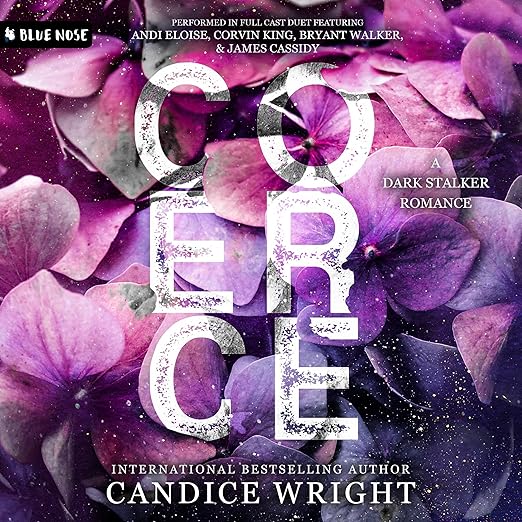
Dark romance occupies a specific space in audiobook culture, and Candice Wright's Coerce arrives with a narrator and a premise that both understand the assignment. Andi Eloise delivers the dual-perspective structure, alternating between Ivy and Atlas, with the kind of tonal confidence that this subgenre requires: the material is dark, the antihero is genuinely morally compromised, and the audiobook does not pretend otherwise. Wright includes an explicit author's note warning that Atlas is not a redemption arc in the conventional sense, and that honesty is characteristic of how the book positions itself throughout.
I came to this one having spent several weeks reviewing cozier material, and the contrast was instructive. Coerce is the first entry in the Death in Bloom series, and it functions as a complete story despite the series framing. The nine-hour runtime is appropriate for the dual timeline; neither Ivy's perspective nor Atlas's feels compressed or perfunctory. Wright builds two distinct voices, and Eloise leans into that distinction in ways that clarify the emotional architecture of a story that could easily blur between perspectives.
Is Coerce Worth Your Time?
Andi Eloise's performance is central to why this audiobook succeeds on its own terms. Dark romance lives and dies on narrator commitment; the material requires a voice that can embody both the pull of obsession and its danger without either romanticizing or moralizing. Eloise does this well, particularly in Atlas's chapters, where the controlled coldness of his perspective needs to read as genuinely menacing rather than simply edgy. Reviewer Alexciz noted that Wright delivers "OTT H, sassy smart, STRONG h," and Eloise captures both sides of that dynamic without defaulting to a single emotional register for the entire book.
The structural conceit of alternating first-person narrators is well-suited to the audiobook format in ways it might not be on the page. Ivy's sections establish the emotional baseline and the stakes, while Atlas's sections recontextualize what has already happened in ways that are more effective when heard than read. The gap between what Ivy understands and what Atlas reveals is a significant source of tension, and Eloise manages the two voices with enough distinction that the recontextualization lands cleanly rather than confusing the listener. Each chapter transition reinforces the psychological distance between the two perspectives.
The Best Parts of Coerce
Wright's handling of the dark romance toolkit is competent and occasionally more than that. The obsession-as-structure premise could easily produce a narrative where the female protagonist feels passive, but Ivy as written is anything but. Reviewer Alexciz specifically called her "sassy smart, STRONG h, who refused to be a doormat," and that characterization holds up. The power imbalance in the central relationship is real and the book does not pretend otherwise, but Ivy's interiority is given enough space that she reads as a subject rather than an object of Atlas's manipulation.
For listeners approaching dark romance who want to understand the subgenre's appeal, Coerce is a reasonable entry point precisely because it is transparent about what it is doing. Wright's author's note functions as a content framing that genre veterans will recognize as a courtesy, signaling that the book is not going to walk back Atlas's moral status in a final act redemption. Whether that choice satisfies depends on what the listener wants from the genre, but the clarity is appreciated and the execution commits fully to the premise it announces.
Before You Commit to Coerce
The content warnings are substantial and should be taken seriously. The book contains graphic violence, explicit sexual content, and power dynamics that extend well beyond discomfort. Wright's note advises listeners over 18 only, and that is not a formality. Listener MistressDraven described it as a "dark stalker romance" with a "revengy/unfinished business" dimension, and that frame is accurate. Listeners who want darkness that stays within tight genre guardrails will find Coerce goes further than some comparable titles.
The rating of 4.3 from a small sample suggests genuine enthusiasm rather than a statistically robust consensus, and listener sherrejon's qualifier of "4.5 stars" reflects that even committed readers found the pacing slightly uneven. The book's nine-hour runtime is well-used in the first two-thirds, but the final act moves faster than some listeners will want, compressing a resolution that the buildup has primed them to savor. This pattern appears across debut dark romance where setup receives more care than payoff, and Wright is not immune to it.
What the audiobook captures that purely textual dark romance sometimes loses is the rhythm of manipulation. Eloise's pacing in Atlas's internal monologue sections reveals how much of his control is performative, calibrated rather than instinctive. That performance quality is part of what makes him compelling in the genre-specific sense: the listener can see the mechanics while Ivy cannot, which is precisely the dramatic engine that dark romance depends on. In audio, that gap between what the listener knows and what Ivy experiences is sustained with unusual clarity.
Should You Listen to Coerce?
This audiobook is for adults who already know and enjoy dark romance as a subgenre and are looking for a well-narrated entry with a morally consistent antihero and a genuinely capable heroine. It is not recommended as a first exposure to dark romance for listeners uncertain about the genre's conventions. Those who want romantic tension to resolve in conventional ways, or who require moral redemption as part of the love story structure, will find the book unsatisfying by design. Fans of Penelope Douglas's Kill Switch or Shantel Tessier's darker work will find Wright's register familiar and well-executed.
A Few Questions About Coerce
How dark is this audiobook compared to other dark romance titles?
Darker than the genre average. The content warnings cover graphic violence, explicit sexual content, and obsessive possession dynamics. Wright is not softening the antihero or walking back the moral stakes, which puts this toward the more intense end of the dark romance spectrum.
Does this audiobook work as a standalone or does it require reading the Death in Bloom series?
It functions as a complete standalone. The series framing suggests future books, but the central story of Ivy and Atlas resolves within this audiobook without cliffhanger dependency.
How does Andi Eloise handle the dual-narrator structure in the audiobook?
Well. The distinction between Ivy's voice and Atlas's is maintained throughout, which matters for the dual-timeline structure. Eloise gives Atlas the controlled coldness the character requires while keeping Ivy's interiority warm enough to maintain listener investment.
Is Coerce appropriate for listeners who are new to dark romance?
No, and the author's own note says as much. The book's darkness is intentional and sustained; it is not scaffolded with lighthearted elements to ease in newcomers. Listeners unfamiliar with dark romance conventions should start somewhere lighter before approaching this one.