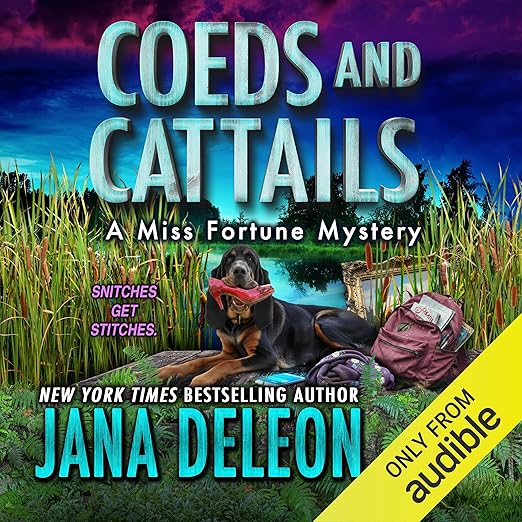
Twenty-nine books into a series is a strange place to arrive, and this audiobook makes no apology for it. Sinful, Louisiana comes with a standing cast, a shared history of small crimes, and a set of running jokes that nobody is going to re-explain for a newcomer's benefit. Jana DeLeon does not slow down to catch anyone up. All five responses on this page read like they come from people who have been in town since roughly book four, and that changes what the recording can reasonably do for a first-timer.
Casey Can't Investigate Her Own Daughter
Jana DeLeon builds this case on a victim almost nobody will mourn. Mimi Clark made a career of reporting other students to the dean, which is an efficient way of guaranteeing that the suspect pool is an entire campus. Detective Casey's daughter, Audrey, lands at the top of that pool. Casey is pulled off the investigation, cannot protect her own child through official channels, and hires Swamp Team 3 instead. That is how Fortune ends up working a murder the badge is forbidden to touch, with an ADA circling.
The Mystery Is Scaffolding, the Company Is the Point
Susz went to five stars on March 2 and summarized twenty-nine books in eleven words: all of them read, easy, mystery and humor. Accurate, and also a fair warning. The killing here is scaffolding. What the novel actually wants is a reason to send Fortune and Gertie somewhere they have no business being, and the case obliges by handing them, in the publisher's own phrase, enough suspects to fill a stadium. The investigation exists to keep generating those reasons, and it generates them reliably.
Deduction, then, is not the pleasure on offer. Company is. The ADA subplot supplies genuine stakes, because Audrey's future is what sits on the table rather than a stranger's, and DeLeon leans on that to stop a comic novel from floating off entirely. Nine hours and fifty-seven minutes is generous for a cozy, and most of that time goes to people rather than clues. Whether that reads as a feature or a flaw depends entirely on how much you like the people.
Cassandra Campbell Must Keep the Whole Cast Distinct
Cassandra Campbell has the harder job here, and the reason repays a moment's precision. A comic ensemble mystery lives on separability. Three women of similar age and similar nerve, a New Orleans detective, a prosecutor's office and a campus full of suspects all have to stay distinct across ten hours without a single dialogue tag reaching your ear. Add a regional register that has to sound lived in rather than performed, and the sample chapter becomes the only test worth running before you buy.
The Bayou Earns Its Billing as a Character
Setting is the second argument for the recording. L W Stubenrauch landed on five stars on January 27, calling the Louisiana bayou a character in its own right and crediting the series with comfort supplied through hard stretches, which is a specific and unfakeable kind of loyalty. Setting as character is a claim about register more than description. Register is precisely the thing a reader either finds or misses, and it is the one element of this book that a printed page cannot deliver at all.
Timing is the third. Southern comic writing runs on the pause before the punchline and on the deadpan delivery of an outrageous sentence, and neither survives being rushed. If you have listened to this series before, you already know whether that delivery lands for you. If you have not, two minutes will settle it, because DeLeon plants a joke early and then never really stops, and the jokes arrive at a rate the reading either matches or flattens.
Two Reviews Predate the Audio Release Itself
Two of the five responses went up before the recording existed. One landed on December 7 and another on December 27, both ahead of the January 13, 2026 audio release, which means they were written about the book in print or on a screen. For a series this deep in, that distinction matters more than usual: the star average is a verdict on the twenty-ninth Miss Fortune novel, not on the twenty-ninth Miss Fortune performance.
Four ratings are reported against five written verdicts, and the mismatch is worth naming. A counter that trails the visible record usually means separate editions have been merged under one entry, which is also the likeliest explanation for the pre-release dates. Abibliofob stopped at four stars on December 7, the only mark on the page below the top, and that response still describes laughing out loud, so the four functions as a ceiling rather than a complaint.
Structure is the deeper caution. A cozy series at book twenty-nine is partly a social occasion, and the reunion is doing at least half the work in any given chapter. Newcomers get the twists but not the reunion. They also get a town whose tolerance for its own residents has been established over twenty-eight previous entries, none of which is restated here. The comedy assumes a relationship the recording cannot manufacture on a first listen.
Long-Time Readers Get Exactly What They Came For
Miss Fortune regulars are the obvious buyers, and they need no persuading. C Lynn P posted five stars on December 27, reported not guessing the culprit until the very end and then asked for more of Mannie next time, which is exactly what long-run readers sound like when a formula is still doing its job. If that is your relationship with this series, the twenty-ninth entry is the twenty-ninth entry and it behaves accordingly.
Newcomers should start further back. The plot is self-contained enough to follow, but the nicknames, the running jokes and the shared history are all inherited and none of them is re-explained. Anyone wanting a procedural with a real investigative spine will be happier elsewhere too, since the detection is loose by design and the comedy is not. This is not a book that rewards being taken apart for its clues.
Company is the actual product, and the audience for that is large and honest about itself. Cozy listeners who work through a series while their hands are busy elsewhere will get precisely what they came for, and the regional texture gives the recording something a straight suspense novel would not have. The murder is the excuse. The reunion is the reason, and after twenty-nine books that remains a perfectly good reason to press play.
Key Details
- Narration: A single reader for a standing ensemble, with the regional register carrying as much of the comedy as the character voices.
- Themes: Small-town found family, a murder with far too many motives, a mother forced to protect her daughter from outside the badge.
- Mood: Warm, loud and unhurried.
- Verdict: Entry twenty-nine delivers everything for listeners already living in Sinful, and asks a great deal of anyone arriving cold.