Key Details
- Narrator: Mark Deakins brings appropriate gravity and clarity to complex material, keeping technical sections from becoming impenetrable without oversimplifying them.
- Subjects: Cold War signals intelligence, NSA institutional history, the politics and failures of state secrecy
- Tone: Scholarly but propulsive, with the texture of serious narrative history rather than popular thriller non-fiction
- Bottom line: An authoritative and engrossing history of NSA signals intelligence from WWII through the Cold War that rewards patient listeners with a genuinely rare inside view of an agency built on silence.
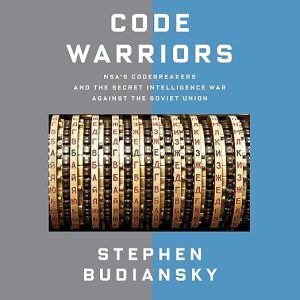
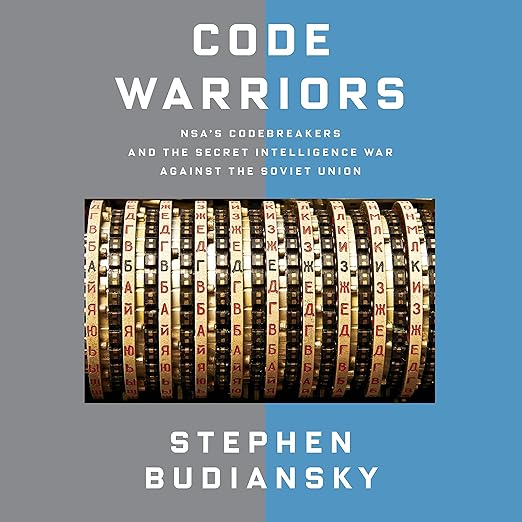
I have been interested in the history of signals intelligence for a long time, partly because the codebreaking operations of World War II sit at such a strange intersection of mathematics, linguistics, and institutional power, and Code Warriors is the audiobook that finally gave me a comprehensive account of what came after Bletchley Park. Stephen Budiansky is a longtime expert in cryptology, and his expertise shows on every page. This is not a popularized overview dressed up with thriller conventions. It is a carefully researched, technically fluent history that assumes a literate adult audience and does not apologize for its depth or its occasional demand that you hold multiple complex institutional threads simultaneously.
The book begins where it logically should: with the extraordinary codebreaking programs of World War II that cracked the Enigma machine and Imperial Japanese communications, operations whose success genuinely altered the course of the war. But Budiansky's real subject is what happened when that war ended and the United States found itself with a vast intelligence apparatus, a workforce of trained cryptanalysts, and a new adversary whose communications were dramatically harder to break than anything the German or Japanese militaries had produced. The transition from wartime codebreaking to Cold War signals intelligence is where Code Warriors becomes genuinely original, because it is territory that remains underexplored in popular non-fiction even decades after the fact.
Where This One Lands
Budiansky had access to newly declassified documents when writing Code Warriors, and that access shows throughout. The NSA's institutional culture of extreme secrecy, which the book describes as a cult of silence, has meant that histories of the agency have typically been either hagiographic inside accounts or speculation from outside observers with incomplete information. Budiansky threads between those two inadequate alternatives. He can show where the agency succeeded and where it failed in specific historical moments, and the failures are at least as interesting as the successes because they illuminate the structural tendencies that persist across decades of institutional life.
The accounts of NSA's involvement in the Cuban Missile Crisis, the Korean War, and Vietnam give the book its geopolitical spine. These are not secret incidents in the sense of being unknown, but the specific role signals intelligence played in each of them, what was intercepted, what was missed, what was politically inconvenient to act on even when it was obtained, is genuinely illuminating territory. Budiansky makes the case carefully that NSA's tendency to prioritize collection breadth over analytical depth is not a post-Snowden revelation but a structural tendency that goes back to the agency's earliest institutional decisions and culture.
What Makes Code Warriors Worth Hearing
Where Code Warriors is genuinely exceptional is in making the human dimension of signals intelligence vivid without romanticizing it into something it was not. The people working at Arlington Hall and later at Fort Meade were not romantic figures in the Alan Turing mold. They were linguists, mathematicians, former military personnel, and institutional survivors navigating an agency with an extremely specific culture that rewarded certain behaviors and punished others. One reviewer whose mother was a code breaker at Arlington Hall during the war noted that Budiansky's account resonated with the obsessive intensity she recognized from her mother's relationship to the work, even decades after the fact. That kind of recognition from someone with direct family proximity to the history carries real evidential weight.
The book includes technical appendices explaining the details of specific Soviet cryptographic systems and the methods by which they were broken, which are available in the companion PDF rather than in the main audio narrative. This is almost certainly the right call for the audio format. Budiansky integrates enough technical context into the main narrative that the cryptanalytic achievements are comprehensible without a mathematics background, and the audio listener loses very little by having the raw technical detail relegated to the written companion.
What Gives Us Pause
One reviewer with a critical note flagged timeline confusion as a real difficulty across the book's long runtime, and that observation is fair. Code Warriors covers roughly half a century of institutional history across multiple presidential administrations, military conflicts, and technological shifts. Budiansky's thematic organization sometimes sacrifices chronological clarity in ways that create orientation challenges in the audio format, where the listener cannot flip back to chapter headings or scan ahead to reorient. This is the book's primary structural weakness, and it is worth knowing about before starting. Each major section is relatively self-contained, so refocusing on the specific crisis or period being discussed usually resolves confusion when it arises.
Mark Deakins as narrator handles the full fourteen-plus-hour runtime with consistent professionalism. He paces the technical passages more slowly and gives the narrative passages more forward momentum, which reflects a genuine understanding of how the two types of content need different delivery to land effectively with audio listeners. The result is a listening experience that never becomes actively exhausting, even during the denser sections on Soviet cryptographic systems or the complicated bureaucratic politics of the NSA's early decades.
Should You Listen to Code Warriors?
Listeners who want a narrative thriller about codebreaking will find Code Warriors more demanding and ultimately more rewarding than that genre typically provides. Listeners who want a strictly technical history of cryptographic systems should understand that this is primarily institutional and political history with technical context rather than the reverse. The ideal audience is the serious non-fiction listener with genuine interest in Cold War intelligence, American institutional history, or the long shadow that wartime signals intelligence cast over the surveillance infrastructure we live with in the present. Code Warriors belongs on any serious Cold War reading list and earns that place without reservation.