Quick Take
- Narrator: Jennifer Ehle holds a single-voice recording that has to land invented vocabulary, a Victorian register and an American girl abroad without a glossary in sight.
- Subjects: Shapeshifting and stolen identity, a triangle between two best friends, Victorian London's supernatural underclass, a brother worth crossing an ocean for
- Tone: Gaslit, ornate, slow to ignite and then genuinely mean
- Bottom line: The strongest doorway into Clare's world for anyone who prefers corsets to Brooklyn, though the first act asks for patience.
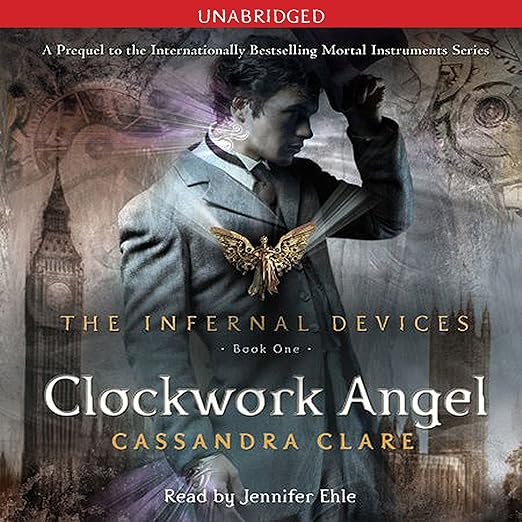
Victorian London, gaslight, and a girl who can put on other people's faces. This audiobook runs fourteen hours and thirty-six minutes through the opening volume of The Infernal Devices, Cassandra Clare's prequel trilogy to The Mortal Instruments, and it commits early to the idea that makes the series work: a protagonist whose gift is to stop being herself. Simon and Schuster Audio released the recording at the end of August 2010, with Jennifer Ehle credited as reader.
Magic is dangerous but love is more dangerous still, the copy announces, and the book means that more literally than the phrasing suggests. Tessa Gray crosses the Atlantic looking for her brother and gets abducted by an outfit called the Pandemonium Club, which wants her precisely because she can become another person on command. That premise does real structural work. A story about a girl who can be anybody is also a story about a girl nobody can quite locate, including herself.
Clare treats the setting as more than wallpaper. Queen Victoria's London is where the Downworld lives, with vampires and warlocks working the same streets as the Shadowhunters sworn to police them, and the class machinery of the period keeps intruding on the supernatural machinery in ways that sharpen both. The London Institute functions as a household with rules, and those rules generate as much conflict as the Magister does.
Two best friends complicate everything: James, whose fragile beauty conceals a deadly secret, and Will, whose caustic wit exists mainly to keep people at distance. A response filed from Canada in March 2016 argues that this trilogy runs darker and sadder than The Mortal Instruments, more intense in both plot and feeling while stopping short of outright tragedy. My own read matches that. The stakes here are quieter and more personal, and they cut deeper for it.
The Strengths
Fourteen and a half hours is a serious commitment for a first volume, and the shape of the book justifies it in a specific way. The plot escalates in a spiral rather than a straight line, circling the same institutions and returning each time with more information, until the last stretch detonates a run of revelations the early chapters had quietly loaded. Booklist called it compulsively readable, and the compulsion is structural rather than a matter of cliffhangers.
Jennifer Ehle carries the recording alone, and the material puts a specific load on whoever holds that microphone. Clare's world runs on invented vocabulary: parabatai, iratze, stele, Downworlder, Magister, terms that arrive without a glossary and have to be delivered so consistently that a listener learns them by ear. Layer on a period register, a cast split between London and an American newcomer, and a house full of characters who all speak in a heightened idiom, and the single-voice format stops being a neutral choice.
Series architecture is the other reason to pick this up rather than the more famous books. As a prequel, Clockwork Angel gets to build its own mythology from the ground rather than inheriting one, so the explanations feel like discovery instead of recap. Anyone who bounced off the contemporary Shadowhunter novels may find the Victorian frame does the trick where Brooklyn did not.
Before You Commit to Clockwork Angel
Pacing is the honest complaint. The first act spends a lot of its runtime establishing who governs what, and the information arrives in conversation, which means long stretches of people explaining institutions to a newcomer who conveniently needs it explained. That the payoff justifies it does not make the middle hours feel shorter while you are in them. Clare is also fond of withholding, and a listener who wants the central question answered promptly will spend a long time being told that the answer matters rather than being given it.
Newcomers get contradictory advice from the responses themselves, which I find genuinely useful. A 2015 five-star response credits prior knowledge of the Shadowhunter world, knowing what a parabatai is and what an Institute does, with propelling the whole experience. A five-star response filed from the United Kingdom argues the opposite: the storylines never interweave, the fantasy elements get explained cleanly in the opening chapters, and no prior reading is required. Worth noting that this second response carries a date four days ahead of the recording's own release, so it describes the book rather than this edition of it.
Four countries are represented in the handful of responses on the page, and one of them is written entirely in German, praising how the story tightens like a spiral before exploding across the final three chapters. That is a fair description of the architecture, though it also means a buyer skimming for consensus is reading across editions, languages and formats at once. The page does not distinguish between them.
Recommended For
Give this a shot if you want Victorian fantasy with actual teeth, if love triangles interest you when both corners are fully drawn rather than one being obviously correct, and if you like a magic system explained through use rather than through lecture. It suits long commitments especially well: the reward curve is back-loaded, and listeners who ration an hour at a time tend to get more out of the final act than bingers do.
Avoid it if slow openings defeat you, or if invented terminology delivered without definition is the kind of thing that pushes you out of a story. A four-star response describes taking nearly a month to finish, though the reason given is a grandfather freshly out of hospital rather than any failure of the book, and the same response is warm about the characters and impatient for the next volume. That combination is common here: people love it and still put it down.
My honest position at the end is that Clare wrote the better trilogy second. The Infernal Devices has a cleaner emotional spine than the series it precedes, partly because a prequel already knows where everything is heading and can afford to be patient. Tessa's particular gift, the ability to wear anyone, remains the most productive metaphor either trilogy offers, and the book keeps finding new uses for it long after the novelty should have worn off.
A Few Questions About Clockwork Angel
Do I need The Mortal Instruments before this audiobook?
The description frames this as a prequel trilogy, and the book behaves like one. Its magic system, its institutions and its factions all get introduced from scratch in the opening chapters rather than assumed. Starting here is entirely viable, and the Victorian setting arguably makes it the better doorway.
How much of the audiobook is romance and how much is demon hunting?
Both threads run throughout, and neither gets sidelined. The plot engine is the Pandemonium Club and the Magister's pursuit of Tessa's ability, while the triangle with James and Will develops alongside it rather than replacing it. Expect the emotional material to intensify sharply across the closing hours.
Is Clockwork Angel suitable for younger teen listeners?
The listing files it under teen and young adult, and the content matches that band: abduction, a supernatural underworld, and violence that lands with weight rather than being waved through. No content notes appear anywhere on the product page, so parents buying for a younger reader are working without guidance from the seller.
Does the audiobook explain Tessa's shapeshifting, or is background assumed?
It explains it. Her ability to transform into another person is treated as the central mystery rather than as inherited lore, and the discovery unfolds along with her own understanding of what she is. No outside reading is needed to follow how the power works or why the Club wants it.