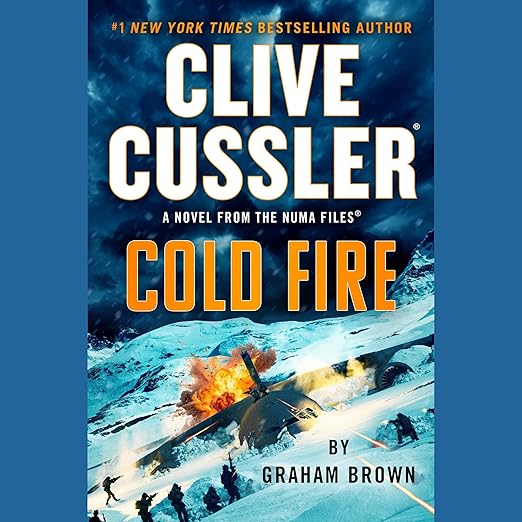
Brand and byline part ways on this listing before you reach a word of the story. The title field reads Clive Cussler Cold Fire, with no colon, no comma and nothing at all to mark where the name ends and the novel begins, while the author line credits Graham Brown. The description settles the question: this is the latest entry in a series created by Cussler, and the writing is Brown's. The audiobook runs ten hours from Penguin Audio, and the record files it as book twenty-two of the NUMA Files.
Missing Plane, Missing Series Number Twenty-Two
Setup is where this earns its ten hours. A C-17 flying high above the Arctic Ocean carries a laser powerful enough to bring down a ballistic missile from nearly four hundred miles away, does exactly that, and then goes dark before the celebration can start. The crew is found murdered at their stations. Its last heading pointed at Russia, the CIA insists it never arrived, and a stray signal puts it in the water somewhere between Norway and the North Pole. The President asks how deep the sea runs there. Not deep enough, comes the answer.
Welding a creator's name onto a title is ordinary practice for a continued series, and it still costs something on a product page. Anyone hunting for Cold Fire has to know the prefix. Anyone searching for Cussler lands on a novel written by somebody else. Nothing in the displayed title says twenty-two, so a reader who wants to begin at the beginning gets no signal whatever. The series field does carry the number; the field a shopper actually reads does not.
Whoever assembled the page was working fast as well. One sentence opens in the frigid air high above the Arctic Ocean American C-17 carrying a cutting-edge laser, short an article and a comma, and a few lines later the planes arrival loses its apostrophe. None of that touches Brown's prose or the recording. It is worth registering before you treat anything else on the page as precise.
Three Navies Converge, Entry Costs Little
Three navies converging on one wreck is a strong structure for listening. Russian ships put to sea in numbers, Chinese vessels appear north of Norway, and the only American asset within reach is a small NUMA research vessel that gets ordered straight into the middle of it. That geometry does the work of a countdown without needing one, since every fleet in the water has a reason to shoot and a reason to hold fire, and the rules of engagement have already been suspended.
Twenty-two books in, the cost of entry is lower than the number implies. Kurt Austin and Joe Zavala lead the search, NUMA is introduced as a research agency with a special projects team, and the description assumes nothing beyond that. Adventure series of this kind rebuild their premise every volume by design. If you have never opened one, this is a serviceable place to test the water, and ten hours keeps the commitment modest.
Brick Tracks Fleets, Briefings, and Blocks
Penguin Audio's June 2026 release also lands the book in the format its own construction suits. The description moves in short blocks, each one a location and a development: the aircraft, the lost radar contact, the briefing, the fleets, the research vessel. Chapters built that way survive interruption, which matters more for a technical thriller than for almost anything else, because a listener who loses the thread of a hardware premise rarely goes back to pick it up.
Ten hours of this material asks a reader for traffic control above all. Command decks, a presidential briefing room, a research vessel and three national fleets have to stay separate in a listener's head without any of them collapsing into a caricature accent, and exposition about laser output and ocean depth has to move at the same clip as the action around it. Scott Brick is the credited reader, and the board to keep straight here is a wide one.
Crime Tag, Military Plot, Spoiled Ending
Stop reading the description after the question about how deep the water runs. Its final paragraph hands over the shape of the ending, naming a single man behind the manipulation of the great nations and attaching a motive of revenge to him. That is the reveal, printed on the page you buy from. Publishers do this more often than they should, and in a plot built on who is behind it, the disclosure removes a good part of the reason to keep listening.
Crime Fiction is the tag hanging on a novel about hijacked military aircraft, deep-water salvage and three navies squaring up in the Arctic. No crime is being investigated in any sense a crime reader would recognize. The genre field says mystery, thriller and suspense, which is near enough; the tag beneath it will pull the wrong shoppers in and keep the right ones out, and it is the second field on this page pointing somewhere the book does not go.
Series machinery arrives on schedule, because the description promises it. Kurt and the special projects team pull on threads, a mystery involving several great powers resolves into one antagonist with a personal grievance, and the scale narrows as it goes. Listeners who want a superpower standoff to stay a superpower standoff will feel the air leave the room. Listeners who came for a NUMA adventure will find the machinery running exactly as advertised.
Hardware Adventure That Fits Into a Week
Nothing here is built for a reader who wants moral complication or a slow burn. This is a cold, forward-moving adventure with a hardware premise and a body count in the opening minutes, and its audience is the one these books have always had: listeners who like a military-technical hook, an underwater search, and a plot that treats the Arctic as a chessboard with warships on it. Ten hours fits into a week without taking the week over.
Look elsewhere if you need to start a series at volume one, because the displayed title gives no hint that twenty-one books came before. Look elsewhere too if a description that names its own ending has already ruined the book for you, and if you are still deciding, read no further down that page than the water depth. Ten hours is a modest commitment, though not one to make on the strength of a description that has already told you how it ends.
Questions Listeners Ask
Do I need the earlier NUMA Files books before this audiobook?
The series field places this twenty-second in the NUMA Files, and the displayed title carries no number at all. The description introduces Kurt Austin, Joe Zavala and NUMA as though for the first time, so the ten hour file stands alone. The series field is the only place that sequence appears.
How long is the Clive Cussler Cold Fire audiobook, and who reads it?
Ten hours flat, with Scott Brick credited as reader and Penguin Audio as publisher, released on June 2, 2026. That runtime sits at the shorter end for a naval adventure with this many fleets in play, which points to a tight book rather than a sprawling one.
Does the publisher description give away the ending of the audiobook?
Its final paragraph does considerably more than hint. It names the shape of the antagonist and the motive driving the entire plot, so stop reading after the exchange about how deep the Arctic water runs. Everything before that point is fair setup and tells you whether the premise appeals.