One person wrote about this audiobook, and that person did not finish it. The single response carries a one-star score under a title reading Pass, then DNF, and it runs long enough to explain itself: the story was boring, both main characters were boring, and the plot progression, in that reader's account, stops making sense somewhere in the last quarter. That is the whole written record for the title. Everything else a buyer gets comes from a description written to sell the book and a star average that does not match the one opinion actually available to read. It is the first entry in a sequence called Savage Planet Mates, filed under romance with a science fiction tag attached.
Where This One Lands
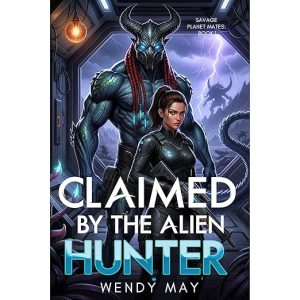
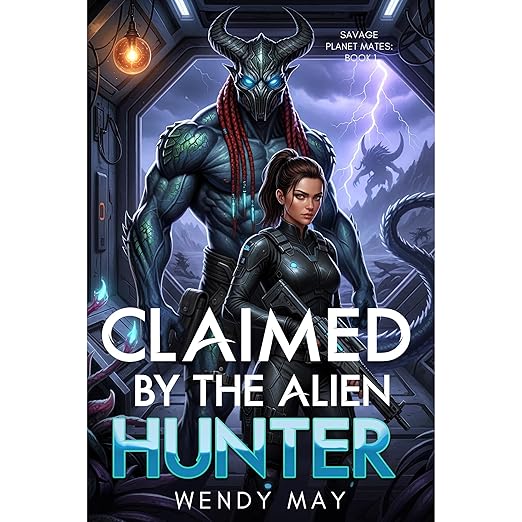
Drax is a Xenjian, a warrior species bred for the hunt, and the description hands him horns, scales, lethal power and a sacred law forbidding any interference with outsiders. He breaks it. A communications specialist for the Special Space Forces crashes onto Kroel, a planet built to hold the galaxy's most lethal criminals under a toxic atmosphere, with a wrecked ship, a failing suit and, by her own reckoning, no tactical future at all. He should have left her to die and did not, which is the hinge the entire book turns on.
Barely over four hours covers the whole of book one, which is short for the amount of world this copy promises. A prison planet, a species with an undisclosed reason for being there, monsters out of a colonist's nightmare, an exile with a secret behind it, and a bond described as permanent, all inside four hours and eight minutes. Compression is not automatically a fault in this subgenre, where the appeal sits in the relationship rather than the ecology, though a listener expecting the planet to get built should know how little time the building can possibly get. The series label promises further books, so some of that construction may simply be postponed, not abandoned.
Nine people rated this without writing a word, and what they collectively think is unusually legible. The counter shows ten votes at 3.7, which pins the running total at exactly 37 against a ceiling of 50. The one visible score is a single star. Take it away and thirty-six points remain across nine silent votes, which works out to exactly four stars apiece. The only reader who described the book at length sits three full points below everyone else who registered an opinion, and that gap is the most useful fact anywhere on this listing.
Kroel is a strong premise. A planet designed as a container for the galaxy's worst, with an atmosphere that kills and a landscape stocked with things a colonist would have nightmares about, gives a survival romance somewhere genuinely hostile to happen in. The copy sets its stakes efficiently: bleeding out inside a failing suit, already dead for all tactical purposes, and then a silhouette resolving out of the wasteland. Whatever the book does afterward, the opening situation is clean and the danger is not decoration. Nothing in the copy wastes time reaching it either, which for a four-hour recording is exactly the right instinct.
Language is where the description makes its most interesting promise. We do not share a language, the narrator says, but the way he looks at me speaks volumes, and what follows is framed as a trade: he teaches her to survive here, she teaches him to feel. A romance conducted without a shared vocabulary is a real constraint to write inside, forcing everything onto gesture, timing and misreading. That constraint, far more than the horns or the toxic sky, is the thing that could make four hours worth spending.
Things to Know Before Starting Claimed by the Alien Hunter
Seventy-five percent of the way in, according to the one written response, the only characters shown are still the two leads. That is a specific objection rather than a mood, and it lands squarely against the description's own setup, which advertises a planet full of the galaxy's most lethal criminals and a species with a whole society surviving on it. That same reader adds that the language barrier does not hold either. The two of them, in that reading, blip into communicating fully, which retires the constraint the copy leans on hardest.
Machine-generated speech occupies the slot where a performer's name would normally sit. Virtual Voice is what the credit says, meaning nothing in this recording passed through a human interpretation, and that falls awkwardly on this particular book. A romance whose stated engine is a look that speaks volumes, and a truce assembled out of tone instead of words, asks a reading to carry meaning the sentences deliberately withhold. Synthesis cannot supply that, because it holds no view about what the silence between two people is doing.
Nobody in the nine-vote majority left a sentence explaining the score. The asymmetry deserves naming plainly, because it cuts both ways: the harshest verdict here is also the only one with reasoning attached, while the most favorable verdict amounts to nine anonymous clicks. A prospective listener has a detailed complaint on one side and a number on the other, and the number is the one the listing puts in large type. Nine ratings is a thin sample by any measure, thin enough that two more votes in either direction would visibly move the figure on display.
Recommended For
Science fiction romance readers who want the trope executed at speed are the audience, and four hours makes this a cheap experiment. It fits anyone drawn to a possessive protector, to forced proximity in a shelter with the weather trying to get in, and a fated-mate structure where the claim is declared permanent from the opening pages. As the first book of a sequence it is also the least costly way to find out whether the setting merits coming back to. It suits listeners who prefer a first installment short enough to abandon without regret.
Buyers who want an alien society more than an alien love interest should put the time somewhere else, on the specific evidence of the only reader who has reported back so far. Listeners who need a human performance have a second reason to hesitate before committing. Four hours is a small bet, but the one person who described this book at length walked away from it, and nothing else on this record argues back.
Common Questions
Is the low score on this audiobook based on one opinion?
Partly. Ten votes at 3.7 put the total at 37 points, and the single visible score is one star. Remove it and thirty-six points sit across nine silent votes, an average of four stars each. So the written verdict and the numerical one point in opposite directions here.
What does Virtual Voice mean for this audiobook?
It means the recording was generated by synthesis software; no performer was hired at all. Nobody made interpretive choices about Drax, the narrator or the pacing. That matters more than usual on a book whose premise is communication without shared words, since generated speech holds no view about what a pause conveys.